Wednesday, August 3, 2016

Tanqueray's Bloomsbury Gin with Charles Dickens

I don't think I discovered Tanqueray gin until I found myself working for Oddbins (17 years ago today, it was a blessed escape from working with a crazy woman in a bookshop, she tried - honest to god - to curse me, it seemed to be a constant disappointment to her that I never got hit by a bus or similar. It was not a happy working environment) but it's the gin that made me passionate about gin.

Straight Tanqueray remains a favourite, and should probably be the one I wrote about tonight, but I've chosen their limited edition 'Bloomsbury' because I had such a good time buying it.

The Tanqueray available almost everywhere is now bottled at 43.7% abv, it used to be a generous 47.3% and if you ever see a bottle of that, get it, and if what I read is true they're still using the same basic recipe they came up with in around 1830. It's a very juniper forward, dry, gin and I love it.

'Bloomsbury' is a recreation of a recipe from the 1880's, so technically it's a bit late for Dickens, but the original distillery was in Bloomsbury (it got bombed out in the Second World War) and it seems likely that Dickens could have bought the local product. His characters are certainly no stranger to gin, or its evils.

It's perfectly easy to find 'Bloomsbury' online, but I got my bottles first from the famous Gerry's on Old Compton Street in Soho, and secondly from Beervana in Lerwick (Shetland, where I was surprised and delighted to find it). Spending quite a lot of money (around £50 for a litre bottle) for something to turn up in the post lacks a certain romance compared to the thrill of a hunt around Soho, or the serendipitous find in a tiny Scottish town. The day I bought that first bottle in London I also managed to bump into the distiller (Tom Nichol, now sort of retired, responsible for some great gins) in a bar/shop. It was a memorable day out, armchair click to collecting is dull by comparison.

It's a traditional juniper led gin, very smooth - so perfect for a martini, and it would also be a great background for a hot gin punch - something like These  (I see no reason to use Hendrick's). It also makes a brilliant G&T.

I admit a hot punch isn't the most summery of drinks, but then depending on where you are in the UK August isn't always as summery as one might hope for, and it's always something to look forward to for winter. Meanwhile Dickens is the sort of author who seems ideally suited to being accompanied by some sort of beverage. Something to drown the sorrows of the sad bits, to raise appreciatively when he's more convivial, and truly - the whiff of gin does pervade his books.


Tuesday, August 2, 2016

Gordon's Gin with Gin and Murder

Much as I love an exciting new gin - something with a smart label in a pretty bottle, with an option on an amusing name, excellent artisanal credentials, and a price tag to match - I'm not a snob about it.

I am a snob about tonic water, I loathe diet versions, and have no truck with supermarket brands. Schweppes if you must, Fever Tree for preference (they have an increasing range of flavours which makes things interesting). A good tonic, plenty of ice, and a wedge of lime, should make any but a truly awful gin taste pretty damn good, and who am I to judge someone else's gin preference (tonic yes, gin no). Never cut corners when it comes to mixers.

Some people do get sniffy about Gordon's, but (and I know I've said this before) for anyone much over 30, and for quite a lot under, Gordon's will likely have been the first gin you met. To me it's the benchmark, and yes it might not be particularly exciting, and it's definitely a shame the abv was lowered to 37.5%. Also, no, I don't have a bottle around the place - but I'd never turn my nose up at it elsewhere.

It's a gin with history (around 225 years of it) and I find that green bottle iconic. It's the gin that I associate as much with the dark days when it was considered a drink fit only for golf clubs and old ladies, as I do the Jazz age, or even the lost (if tawdry) glamour of the great Victorian gin palaces.

Josephine Pullein -Thompson's 'Gin and Murder' is a fascinating book. (Annoyingly I've lost my copy, as soon as I've written this I need to bite the bullet and order another one from Greyladies books). Admittedly it feels in questionable taste to recommend a book that centres around an alcoholic to read with gin - truthfully you might feel more inclined to have a cup of tea instead by the end of the first chapter - but it's no bad thing to be reminded of why drinking to much is such a bad idea. It's also such a very good title that it's hard to resist.

I could almost here the bottles of Gordon's clinking together when I read this one. It's a good murder mystery (clever solution to a chilling scenario) but it's really remarkable as a portrait of a certain moment and class in English society. It's an upper middle class hunting set sometime in the late 1950's. They all drink a bit to much, all are recognisable types, most are struggling to maintain appearances and it's all done with an amount of compassion and sympathy that makes the book memorable. Should you be lucky enough to find a cheap copy grab it, all I can say is that it appealed to me so much I'm willing to spend another £13 on a replacement copy.


Monday, August 1, 2016

Booze and Books is back

And this time it's all about gin. I really enjoyed trying to match drinks to books last December and had been thinking about doing something along the same lines for a while. My summer drink of choice is gin, and when I started making a list of gins I've known and gins I love it was more than long enough to fill a month so here we are...

Wines and spirits (the selling of) is my day job, and will have been so for 17 years this week. In that time the rise and rise of gin has been easily the most exciting thing I've seen, in the last few years I've started to amass enough of the stuff to make my wardrobe (it's where I keep the bottles - it's dark and has the steadiest temperature in a flat that gets very hot in summer) stop resembling a tiny cellar, and instead look like a particularly cramped speak easy.

The reason for this is that I might buy quite a bit of gin, but I don't drink much, so it hangs around. It's one reason to love spirits - a good wine has to be finished within a day or two to be at its best, but spirits don't and if you're only going to have a glass or two a week I feel there's room for a certain amount of extravagance regarding choice.

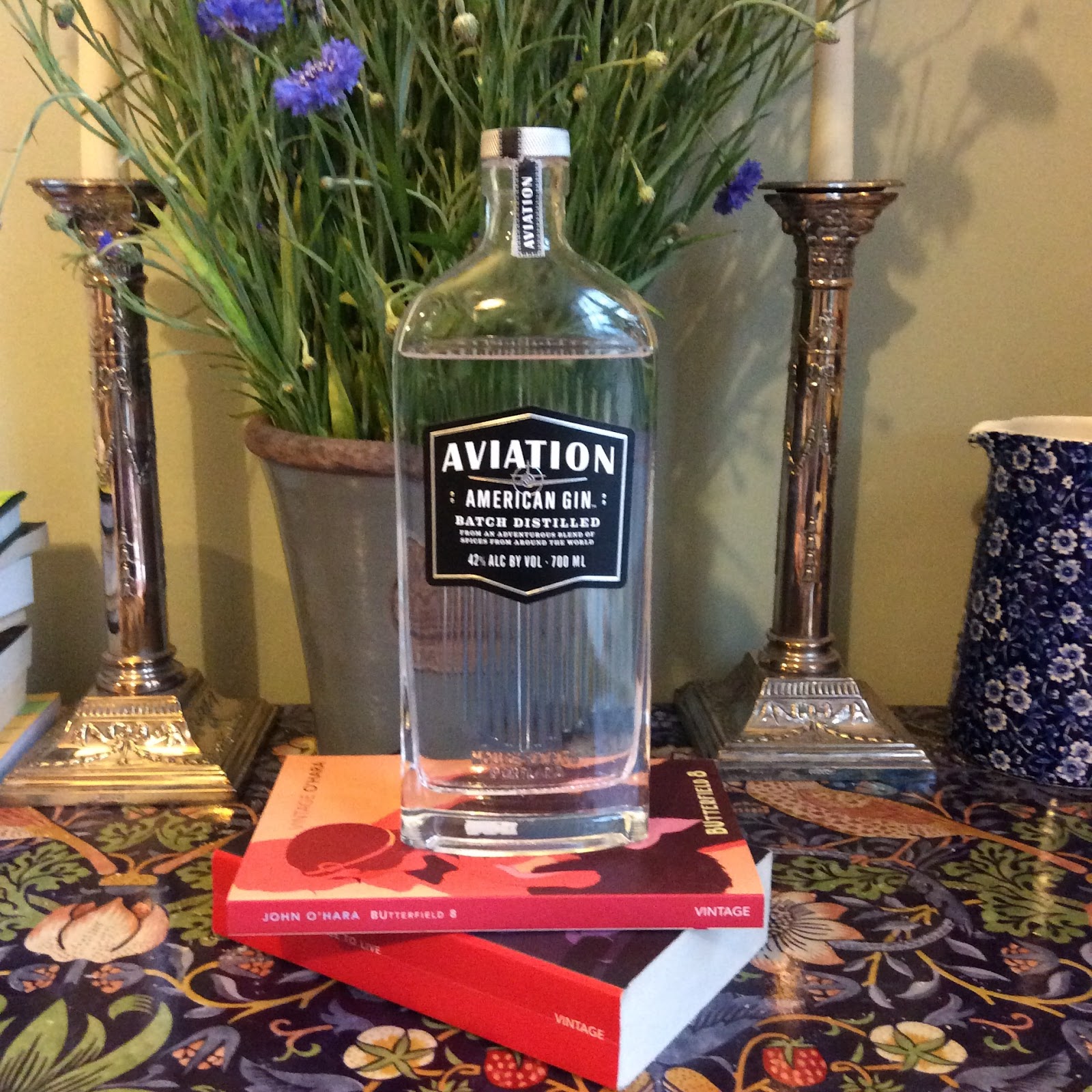
The first gin is an American one, bought simply because I hadn't tried any at the time and it was the most glamorous looking bottle I found locally (the glamour matters!). Named for a Cocktail first officially recorded in 1916 Aviation is the least ginny gin I've yet tasted (the juniper is, in my opinion, very restrained). It also seems to be a gin that divides people somewhat. I liked it for its smoothness - it's a gin that could easily be sipped on its own in an exceptionally dry martini, would blend beautifully into cocktails, and gives some scope to playing around with garnishes.

In contemporary terms it's a gin that was made with the specific intention of moving away from the classic juniper led English take on the spirit and as such is part of something new and exciting... But there's something about that not very traditional palate which suggests a refined take on what I imagine prohibition era gin might have been.

There's an element of fantasy to that of course, bathtub gin certainly wasn't smooth, never mind as smooth and complex as this one, but it's the image in my mind and in turn that suggests John O'Hara (who I think has a bit more sympathy for his alcoholics than John Cheever does). BUtterfield 8 which traces a tragedy as it unfolds against the speakeasy's of prohibition era New York seems like just the book for this gin.

Sunday, July 31, 2016

Game fair and Ghostbusters

It's been a busy, but not very bookish, week. Tuesday was the day we change all the promotions over at work, it's a dirty, exhausting, job during which I always pick up a handful of cuts and bruises. It's not an experience improved by hot and humid weather - nobody enjoys doing it, so it made going to see the new Ghostbusters film on Wednesday something to really look forward too.

I'm a big fan of the original film (less so the sequel) even if it does start with Bill Murray being almost unbelievably sleazy by current standards. I loved the new one too, it was funny, a little bit silly, smart, and the cameos by original cast members were brilliant. I went with two other women old enough to remember the first film and a nineteen year old, we all enjoyed it, as has everyone else I know who's seen it which makes all the negative comments directed at it frustrating.

Even more exciting (which I didn't expect) was the Game Fair at Ragley Hall. I've been to the horse trials at Burghley a few times, which is fun, but nowhere near as good (for someone who can frankly take or leave horses) as the game fair - which was amazing.

Apparently it's been billed as the biggest event dedicated to country pursuits in the world. I can believe it, it was massive and it turned out we missed quite a bit (ferrets and archery are the things I'm sorry about). I didn't miss a tent full of the weirdest taxidermy I've ever seen. There were a lot of stuffed birds, and a bat, which had been turned into lamps- I have no idea why anyone would want a swan holding a lightbulb around the house, but I'm pretty sure it would be a bitch to dust. In another stand we saw a stuffed shrew holding a miniature shotgun in a clump of heather, it's peak was more obvious.

Taxidermy aside (is it a specifically 'country' art form?) there was a lot to enjoy as well as the feeling of having strayed into an alternative world. I recently bought a subscription to 'The Field' magazine as a birthday present for someone, it described itself as perfect for those brave souls who hunt, shoot, or fish.

It's something that gave me pause for thought. I really had to think about posting something about a New Year's Day hunt meet that I saw this year, and I'm often doubtful about talking about how much I love shooting (clays) here too. The kind of fishing I've enjoyed isn't the sort that The Field is likely to cover (a few mackerel for dinner if we're lucky) but still the suspicion is there that the bravery referred to is in admitting that you can enjoy these things. There is an us and them feel about it all which is discomforting.

Meanwhile I got to watch dogs retrieving paint rollers (watching dogs working is great, not least because they look so excited about it), some falconry, a Shetland pony race, shooting, and fly casting demonstrations. We saw all sorts of tweed, missed some cookery demonstrations, fell in love with a Bavarian mountain hound, and some Slovak rough haired pointers (also known as Slovak pointing griffons, which are apparently not the same as wire haired pointing griffons - who knew) and found a lot of gin.

A lot of gin. D and I came home with a bottle each and a longish wish list. Gin, it seems, is much more country than whisky, of which we saw none. In short the good and drink (mostly gin) section was great. We had Tally (mums dog with us) she got so over excited she was wiped out and didn't want to get up this morning, I was the same and that was without seeing a ferret working demonstration.

Sunday, July 24, 2016

On reading an Ann Cleeves Shetland book for the first time...

I've been doing some book reviews for 60 North Magazine (it promotes Shetland, and is well worth investigating), it's why I was reading so many herring related books in the spring, and one reason why I've been so immersed in textile books recently. It was also a prompt to read my first Ann Cleeves Shetland book, and that's been interesting.

I've been aware of this series since the first book 'Raven Black' came out. I have a friend who enjoys fairly brutal contemporary crime fiction at the end of a hard day who passed on a copy to me. I think she found it a bit sedate, I on the other hand prefer my crime fiction to be of the vintage whodunnit type, and didn't really click with Cleeves either to the point that I never quite got round to finishing the book.

'Cold Earth', which I've just finished is the seventh in a series that I think started out as a quartet. My copy is an uncorrected proof (it's not due for publication until October) so I'm not going to say much about it now (I will in October) but I thought I could talk about reading it.

I might not have read the rest of the series but I have watched the adaptations on television which has given me a superficial familiarity with the characters. What I've very quickly realised is that the TV version of  'Shetland' is a very loose adaptation indeed of Cleeves original books, I also knew that she hadn't had any hand in the last series (the best so far purely because it was given 6 episodes to unfold in, instead of being crammed into a couple of hours as the earlier ones had been) so that was somewhat disorienting.

It also makes me wonder how a writer deals with her characters, along with their world, being taken out of her hands and developed along somewhat different lines. There is nothing in this book that suggests to me that the TV version has crept into it, but because I'm more familiar with the TV version reading this book felt oddly like watching it.

That might also be because I'm familiar with the landscape and weather that Cleeves describes, when she mentions actual places they're often places I know (if you've read the books and visit the islands you can't miss a lot of her locations). More than that, as Cleeves has been familiar with Shetland for something like 40 years she also understands how it's changing, and I think she's caught the current moment in its history brilliantly here.

She's said in the past that she treats the landscape as a background rather than a character, being more interested in the dynamics of the community and how life works on relatively isolated islands. That's certainly bourn out by what I've read here - the complicated family relationships, communities where everyone knows each other, the growing number of incomers to the islands, and the way secrets are kept in a place where there isn't neccesarily much privacy. I do think she uses the weather as a character though, and that's something I found interesting too. This book is set in February which is very much still winter, with a few days that suggest spring. The wind is a constant physical presence (I had a real reminder of that when I was home this summer) as is the dark, and the rain, and that more than anything evoked the absolute spirit of Shetland for me.

So will I go back and read the rest of the series? Maybe. I enjoyed this one and it's certainly made me more curious about them. Cleeves doesn't go in for gory details (I'm not much of a fan of gore or gruesome ways of killing people) but police procedurals still aren't really my thing. If I found one on a bookshelf somewhere I was staying I'd definitely read it, as to picking one up in a bookshop - I guess I'll have to wait and see.

Friday, July 22, 2016

Passage of Arms - Eric Ambler

I've been meaning to read some Eric Ambler for a while, so was really excited by the news that the British Library were releasing some as part of their classic thrillers series. There's nothing like a new (to me, I know it's not strictly speaking new) book to push an author to the top of the to be read pile.

I know I've heard good things about Ambler before, certainly good enough things to mentally bookmark him, but I wasn't at all prepared for how much I would enjoy 'Passage of Arms' or just how good he would be. It was a proper light bulb/love at first read moment.

Written in 1959 'Passage of Arms' sits (apparently, this is what I read when I looked him up) in the second distinct phase of his career as a novelist (I think I've got a lot to look forward to). The late 50's isn't a time I know a lot about but there were enough cues in the book to remind me of the history I did know so I didn't end up looking much up.

The book opens in Malaya on a rubber plantation. The British army have shot some terrorists and the Indian estate clerk has realised they probably had a cache of arms hidden somewhere nearby. He's a young man with a dream that needs capitalising and a lot of patience, he manages to find the weapons and wait a good 3 years until it's safe to sell them at which point he goes to a Chinese business man.

From here things start to move, but before the arms can be sold its necessary to have a frontman for the deal, and ideally that would be an American. A suitable American is found and duped into taking part in the deal with vague talk of red China and selling communist guns to anti communists. The specific date the book is set isn't entirely clear but occasional references to McCarthyism are enough of a clue to start explaining the naivety of the American tourist who finds himself dealing with some very dodgy people in downtown Singapore.

Ambler's genius is in making the long lead up to the actual action, which mostly deals with the intricacies of setting up a small arms deal in a world of post colonial rebellions, communists, and Islamic revolutionaries, not just interesting but a gripping. It's also in making Greg and Dorothy Nilson's actions credible.

Why, after all, should a respectable, reasonably successful, middle aged American and his wife take such a risk? To answer that involves far to many spoilers, but by the end of the book all the pieces had fallen into place and it made sense.

There's something fascinating about a really bad decision, and all the smaller lapses of judgement and sense that lead up to it. Maybe it's the uneasy feeling that there but for the grace of God go I. In the end though, I loved everything about this book and can't wait to get stuck into more Ambler.

Monday, July 18, 2016

A Hero of Our Time - Mikhail Lermontov

After a bit of a reading slump (and with a looming deadline to read something I'm not feeling terribly enthusiastic about) it's been a relief to find myself raving through a couple of books I've absolutely loved.

I picked up 'A Hero of Our Time' in Hatchards at St Pancras (there's something particularly agreeable about finding a reasonably good bookshop at a train station, it's as if the world is suddenly just as it should be for a moment) because it sounded like that rare thing; a Russian book that I might get on with.

I was right (and better yet it only took me a month to get round to reading it, rather than the usual gap of some years, but that's a matter of purely personal satisfaction) I did get on with it. The back blurb tells me it was the first major Russian novel, the forward says it's also the only Russian novel that truly belongs to the romantic movement. It seems it was both lauded and reviled upon publication (back blurb again) partly because it was suspected to be autobiographical. The hero is 25 year old Pechorin, he's "a beautiful and magnetic but nihilistic young army officer, bored by life and indifferent to his many sexual conquests". Some of the action takes place in the Caucasus (vivid in my imagination thanks to 'Samerkand') and there are brigands, smugglers, and Russian roulette (the promise of brigands and smugglers may have been the hook that sold me the book).

The introduction explains at length about how interesting this book is, how groundbreaking and influential, but it also stresses how enjoyable it is to read and on the end that's really what matters most to me on a sunny July afternoon. Neil LaBute describes Pechorin as 'One of the most vivid and persuasive portraits of the male ego ever put down on paper', he's a difficult character, both compelling and repulsive, but he's still a very young man in a book written by a very young man. Pechorin isn't allowed to grow old, and neither was Lermontov (it seems he was killed in a duel) so we'll never know what either of them might have been. Which as far as Lermentov is concerned is a shame.

'A Hero of Our Time' is cynical, ironic, funny, provocative, picturesque, and it mentions Sir Walter Scott's 'Old Mortality'. I can't offer any great insight into it, but I can wholeheartedly recommend it.

Sunday, July 17, 2016

Polska - Zuza Zak

I'm quietly pleased by the growing trend in cookbooks that look to Eastern Europe. One reason for that is summed up in the opening paragraph of 'Polska'; "to understand a cuisine is to understand a culture. To understand a culture is to understand the spirit of a nation." Which builds on the quote that Zuza Zak chooses to start with; "The most vital attribute of food is its placement precisely on the border between the world of nature and the world of culture" ("Najistotniejsza cecha jedzenia jest jego umiejscowanie na granicy świata natury I świata Kultury", which I've copied just to see if the iPad would let me).

Another reason, especially with this book, might be that there's already a deep rooted cultural link that food enhances. The Białowieża forest is one of the last, and largest, remaining parts of the primeval forest that once covered Northern Europe, that's the remains of the forest that so many of our fairy tales have come from. I've never seen it, though it's high on my wish list of places to go, I wonder if I do get there if I'll find the same moments of recognition as I do on this book - memories of food I've never eaten but which come straight out of fairy tales.

On a less fanciful note (though half the charm of a new cook book lies in its potential romance) because the intention of this book wasn't to write a typical traditional cookbook 'but to create something contemporary, a love letter to the country I left behind.' there's little that can't easily be picked up in any polish shop or the international section of a supermarket. Lovage and lemon balm would probably be the hardest things to find, but as both are easy to grow (especially lemon balm which has totally colonised D's garden) they don't present much of a challenge. Handily the names which will appear on the packets/tins/jars/tubs are also given, that makes the Polish shop round the corner easier to use, and that's something else I like about this book - it'll take me out of Tesco's and into the community on my doorstep.

It's reassuring (at least, I find it reassuring) that these books are appearing, they're a long way from the Cold War image of queue's, shortages, and a grey uniformity (which is pretty much how I pictured life behind the iron curtain). In that sense they really do hint at the spirit of a nation, nations full of colour and flavour.

Other things I like about this book are that a lot of the meat and fish recipes serve 2 or 3 (the puddings on the other hand are designed to feed 10 - 20...). As someone who habitually cooks for only 2 or 3 people at a time it's refreshing not too have to think to much about scaling recipes down all the time. The breakfast and bread chapter has all sorts of good things in it; scrambled eggs with caramelised onions, semolina and honey porridge with raspberries (semolina pudding basically, but why not have it for breakfast?) a cinnamon apple bake which is basically a rice pudding with thick layers of juicy sweet apple sandwiching thin layers of soft sticky rice (which sounds like a great autumn winter breakfast). It's a slight readjustment of ideas towards families ingredients, and that's something that I always find exciting.

The cocktail chapter is also intriguing - a spiced chocolate martini made with cardamom infused vodka sounds very good, mulled beer has possibilities, and so does a bilberry or blackberry concoction with lime, vodka, brown sugar, and soda water. There are lots of dumpling recipes which beg to be made (I've never really cooked dumplings so this might be fun).

Finally, the photographs and bits of history, family memories, quotes, and other snippets give context to the recipes without overwhelming them. The overall effect really does feel like a love letter to Poland. It's a beautiful book.

Wednesday, July 13, 2016

Samarkand - Caroline Eden & Eleanor Ford

I've been in a bit of a slump since returning from holiday, there's so much going on (generally, work is busy, there are people I want to see, things I want to do) and it seems like no time to do it all in. Hours spent following the news haven't really helped with time management, and even though I could really do with escaping into a book I'm finding it really hard to concentrate on fiction right now.

Thank god then for cookbooks. I bought 'Samarkand' just before I went away (because it was irrisistable) and promptly buried it under a pile of other books. I dug it out last night and promptly got lost in it again the moment I opened it.

This is a book that explores recipes and stories from Central Asia to the Caucasus. Samarkand, in its role as a cultural crossroads is a starting point for this particular culinary journey. It's a part of the world that's mostly a total mystery to me, but it's a romantic mystery with all the associated history of the Silk Road, and just the kind of escapism I'm looking for.

My one criteria for buying a cookbook is that it pass the flick test - if the first two or three recipes found at random don't appeal then the book stays in the shop. 'Samarkand' got me on the first page I looked at - roasted peaches with marzipan and rose syrup. It's not a complicated recipe, though it does provide another pleasing hint of romance, it just sounds delicious and subtly different from anything I might normally do with a peach. (It led me to experiment with roasted apricots with a rosemary and thyme syrup with just enough butter added to make it slightly toffeed - something I can recommend...)

After that there were pages of salads and dips that sounded just as good, combinations of sweet and sour, sweet and savoury, familiar and new that were all beguiling. Even more so thanks to the beautiful photography. I'm not generally a fan of cookbooks that devote pages of potential recipe space to atmospheric images of spice markets, temples, or artfully piled vegetables, but I'm making an exception for this one. Perhaps because it sets out to give context to the recipes as well as the recipes themselves they don't feel like filler, or maybe it's just that the balance is right here, but either way it's a gorgeous book to look at as well.

For anyone already smitten with Persian, or Middle Eastern cooking, or who has encountered Georgian food (or fans of Olia Hercules fantastic 'Mamushka') the flavours and ingredients will be familiar, but the combinations here are different enough to be fresh. Or at least they're fresh to me, and there's nothing I like more in the kitchen then that moment where you take familiar things and with a minimum of effort meet them anew (a salad of grated courgette with pine nuts and poppy seeds was another flick test winner). I love this book!

Sunday, July 10, 2016

Ask A Policeman - by members of the detection club

I didn't read much when I was on holiday (despite hauling a huge pile of books around the country with me), there just didn't seem to be much time for it, and since getting back I've been buried in textile books. I've already written about a few of them here (all of them should be appearing elsewhere in due course) but thought all of them on the trot might get a bit repetitive...

What I did manage to read, after picking it up at the Bodies From The Library day (it was a very well organised event right down to the chance to buy so many of the books mentioned) was 'Ask A Policeman'.

I'm not quite sure why it's taken me so long to come across this book, but I'm glad I finally have. The founding members of The Detection Club wrote a few joint mysteries, but what I loved about the idea of this one is that not only does it boast a couple of characters I'm reasonably familiar with (Gladys Mitchell's Mrs Bradley, and Dorothy L. Sayers Lord Peter Wimsey) but better yet the writers swapped characters (so Wimsey's chapter was written by Anthony Berkeley - and that's what sold the book to me).

You might think that would be enough, but no, it gets better. A newspaper tycoon (very much along the Rupert Murdoch lines which just goes to show that not much changes) is found dead, the suspects are an Archbishop, the Assistant Commissioner of Scotland Yard, and the Chief Whip. Add a liberal helping of red herrings and taking into account that nobody is taking themselves to seriously and there you have it - a book so perfect for me that I really, really, can't believe it's taken me so very long to find it.

I don't want to give anything away, but can safely say that it absolutely met my high expectations for entertainment, as well as making me want to read more Anthony Berkeley (especially Berkeley, but also Helen Simpson and Milward Kennedy - though they might be a challenge to find at an affordable price). Any fans of golden age detective fiction out there who've missed this - it's a treat.