Showing posts with label John O'Hara. Show all posts

Monday, August 1, 2016

Booze and Books is back

And this time it's all about gin. I really enjoyed trying to match drinks to books last December and had been thinking about doing something along the same lines for a while. My summer drink of choice is gin, and when I started making a list of gins I've known and gins I love it was more than long enough to fill a month so here we are...

Wines and spirits (the selling of) is my day job, and will have been so for 17 years this week. In that time the rise and rise of gin has been easily the most exciting thing I've seen, in the last few years I've started to amass enough of the stuff to make my wardrobe (it's where I keep the bottles - it's dark and has the steadiest temperature in a flat that gets very hot in summer) stop resembling a tiny cellar, and instead look like a particularly cramped speak easy.

The reason for this is that I might buy quite a bit of gin, but I don't drink much, so it hangs around. It's one reason to love spirits - a good wine has to be finished within a day or two to be at its best, but spirits don't and if you're only going to have a glass or two a week I feel there's room for a certain amount of extravagance regarding choice.

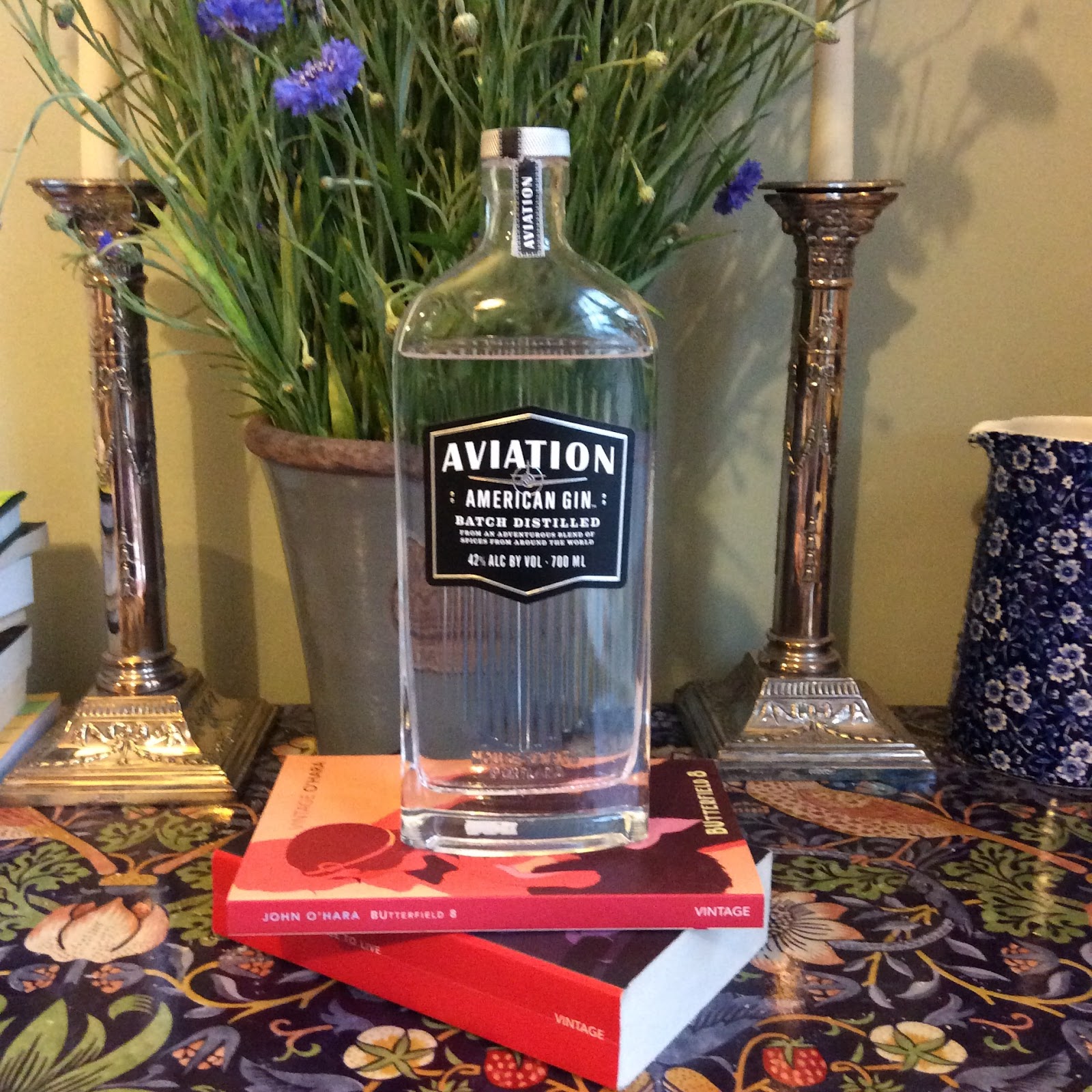
The first gin is an American one, bought simply because I hadn't tried any at the time and it was the most glamorous looking bottle I found locally (the glamour matters!). Named for a Cocktail first officially recorded in 1916 Aviation is the least ginny gin I've yet tasted (the juniper is, in my opinion, very restrained). It also seems to be a gin that divides people somewhat. I liked it for its smoothness - it's a gin that could easily be sipped on its own in an exceptionally dry martini, would blend beautifully into cocktails, and gives some scope to playing around with garnishes.

In contemporary terms it's a gin that was made with the specific intention of moving away from the classic juniper led English take on the spirit and as such is part of something new and exciting... But there's something about that not very traditional palate which suggests a refined take on what I imagine prohibition era gin might have been.

There's an element of fantasy to that of course, bathtub gin certainly wasn't smooth, never mind as smooth and complex as this one, but it's the image in my mind and in turn that suggests John O'Hara (who I think has a bit more sympathy for his alcoholics than John Cheever does). BUtterfield 8 which traces a tragedy as it unfolds against the speakeasy's of prohibition era New York seems like just the book for this gin.

Sunday, December 4, 2011

Ten books from the last twelve months.


Books of the year lists are a bit of a departure for me but I thought I’d give it a go, indeed I meant to do it for the first of December but didn’t get organised in time – which is why lists like this generally are a departure for me. However it’s the season to look back on things and having looked back at books it feels like it’s been useful – and slightly surprising. I’ve not perhaps read as much as I hoped I might this year but that’s par for the course (damn having to work for a living and its constant getting in the way of more entertaining things) but although there have been a lot of good books – this is after all the year that I finished Trollope’s Barchester chronicles, read my first Walter Scott, and worked through Mrs Oliphant’s Carlingford series – I don’t feel that it’s been a vintage year. It’s not a struggle to come up with ten books I’d happily recommend, anything I’ve written about I’ve been enthusiastic about, but it’s been quite hard to identify the ones that really stood out – the books which might make it to my fire shelf.
Somehow though I managed, and so in no particular order here they are – all read between December 1st 2010 and December 1st 2011. First up is Matthew Sweet’s ‘West End Front’ from a couple of weeks back. The more I think about it the more time I have for this book. It’s a lot of the dirtier side of war which we do well to remember, it’s also a lot of stories that deserve to be told, thoroughly entertaining, and at times desperately moving. All good.

Another recent read was Constance Maud’s ‘No Surrender’ from Persephone books. Not the best novel ever written but possibly a contender for the most passionately heartfelt. It has an enthusiasm for a cause that’s infectious. It’s also a book that makes you question how much things have changed, and how much has stayed the same. The answers aren’t entirely encouraging for anyone of a feminist persuasion and again these are things which should be thought about otherwise nothing will ever change for the better.

Mark Girouard’s ‘Enthusiasms’ also makes the list, partly because it’s a lovely thing in itself, partly because it’s entertaining, but mostly because it’s a showcase for the virtues of good scholarship – whatever they’re being applied to.

A.S Byatt’s ‘Ragnarok’ was easily my most anticipated title of the year, it didn’t disappoint. I read it months ago but there are still bits that run through my head. I think Byatt is at her best when she writes short stories and novellas; she’s pretty bloody good when she writes epic doorstops as well but I find her shorter books perfectly polished jewels – or something like that anyway. She’s just very, very, good.

Preparation/anticipation for ‘Ragnarok’ featured Kevin Crossley-Holland’s ‘The Penguin Book Of Norse Myths’ which I approached in the manner of a chore. It wasn’t, and good intentions to read far more saga’s feature for next year.


 John O’Hara’s ‘A Rage to Live’ was a great big messy compelling wonderful book – I love vintage for reprinting him (and so many others). He’s a slight departure from my normal middle brow women – rather less tea and a nice sit down with a scone, more dirty martinis and a few too many of them.   

Sticking with sleazy was Mae West’s ‘The Constant Sinner’ – not just an eye opener. I have more Mae West to read which is something to look forward to. She’s everything I hoped in the way of one liners and wisecracks but underneath that there’s a veracity that makes the heroine Babe Gordon stick with you.

I’m a big fan of Victorian literature and if I’d read Lady Audley this year she would be a shoe in, but I didn’t and I also really love Mrs Oliphant so I’m going with ‘Phoebe Junior’ the last of the Carlingford chronicles. I think it stands well alone, has a cracking good plot, and rips of Trollope with style. That’s virtually the perfect Victorian novel in my world.

The last two books on my list are both a little bit Noir. Vera Caspary’s ‘Bedelia’ which had a twist I didn’t see coming and which turned something run of the mill into something extraordinary. Dorothy B. Hughes ‘In a Lonely Place’ was even darker – and nothing like the film which is good, but an entirely different story. Dorothy B. Hughes was a Persephone find and since then I’ve come across a few of her other titles. Persephone’s ‘The Expendable Man’ is so far the best; ‘In A Lonely Place’ is a very close second.

Now I need to go and get a head start on next years list.  
Saturday, July 9, 2011

A Rage To Live - John O’Hara


Posts have been few and far between of late (and with a holiday looming that’s going to be a pattern) partly because of work hours which have given me little time for anything but sleep between shifts, partly because of the diligent revision I was engaged in, and partly because the last book I read was a monster boasting 713 closely printed pages between its now sadly battered covers.

It was via Caustic Cover Critic that I first came across O’Hara (a classic case of successfully judging a book by its cover) and it was there that I saw that Vintage were releasing two more titles – ‘A Rage to Live’ and a collection of short stories. I still don’t know very much about O’Hara but was really quite excited about the chance to read more of his work. The first thing that struck me about ‘A Rage to Live’ is how long it was. Both the earlier novels (‘Appointment in Samara’, and ‘Butterfield 8’) are short and pack a lot in, ‘A Rage to Live’ is long and wordy with it. It reminded me of ‘Peyton Place’ which is not an allusion I Imagine O’Hara would have cared for, but is basically complimentary in my mind.

A Rage to Live’ tells the story of Grace Caldwell, she’s born into the elite of Fort Penn society, is in fact the only daughter of the only family that really matters and from a young age goes pretty much her own way, showing in the process a precocious sexuality. Mrs Caldwell takes care to get her daughter married as soon as she realises what’s afoot and before a real scandal can brew. The man chosen for the role of consort is Sidney Tate an outsider from New York. Fort Penn is deep in Pennsylvania (and seems to be a predominantly German town) and they’re suspicious of strangers there, a condition of Grace and Sidney’s marriage is that they stay on the family farm which Grace receives as a wedding present and has no desire to leave.

Grace loves Sidney but they marry very young and she’s used to taking what she wants with no conception of denying her passions. When temptation comes her way years of happy marriage and the fate of three children are as nothing to the impulse of the moment, Grace gives in, and the consequences are what you might expect from a small town where nothing stays a secret. Grace pays for her indiscretion with her marriage, its 1917 and Sidney plans to go off to war never to return. Sidney has placed his wife on far too high a pedestal to forgive her this kind of mistake. Fate intervenes (although the result is the same) and Grace is left a widow which is when things start to become complicated for her. She may be the queen of local society but she’s also a woman with a past and both of these things mean she’s under constant scrutiny.

O’Hara is sympathetic to Grace portraying her need for sex as something natural and admirable. He certainly points out the double standards at play between what his male characters can get away with (they are for the most part seemingly never out of brothels) and what Grace can do. Her transgressions are quite mild really, what’s shocking is that she does what she does motivated mostly by lust – it’s very masculine.

When scandal comes again, which it inevitably does, Grace is as good as innocent but it doesn’t matter, her past is all that counts and that’s that. A lot of other things happen, this is a proper saga with a long character list and despite the 700+ pages I was finished far too soon. It’s big and messy but utterly compelling. ‘Appointment in Samara’ is a better book by far, but this one is more fun. It was apparently a huge best seller back in 1949 and I can see why – and this is what brings me back to ‘Peyton Place’. There is a similar sense of scale, a similar sprinkling of salacious detail, and underneath it all a subversive message about our accepted moral values. It’s a great book, not perfect, but splendid.

Sunday, June 6, 2010

BUtterfield 8 – John O’Hara

I slightly resent that it’s taken me this long to discover John O'Hara – way back in the mists of A level English one of our modules was ‘The American Dream’ – which meant ‘The Great Gatsby (still love the book and the works of F Scott Fitzgerald generally, cannot abide Robert Redford or Mia Farrow) and ‘The Adventures of Huckleberry Finn’ (just a brilliant book that no amount of studying can dim). Anyway it seems to me that sometime in the Gatsby period someone should have mentioned O’Hara – English teacher whose name I can’t remember – that means you.

‘BUtterfield 8’ is a hell of a book; opening with the heroine Gloria waking up in a strange bed after a drunken one night stand and closing a week or so later with the aftermath of her death. That’s not really a spoiler because it’s all on the back blurb, and it’s not so much about how it ends as what leads up to the end that matters in this book. Gloria; barely out of her teens is a habituĂ© of numberless speakeasies, a heavy drinking, heavy doping, loose living kind of a girl. She’s also bright, warm hearted, generous and probably the most damaged individual I’ve yet found on the page. Her fate is sealed when she walks out of that one night stand wearing nothing but another woman’s mink coat, stolen both from necessity and compulsion.

(I should say at this point that even knowing Gloria doesn’t make it through to the end, what actually happens to her came as a total surprise to me, which just goes to show that knowing what happens doesn’t always rob you of the surprise to come.)

O’Hara has a gift for drawing a character in with a few deft strokes, and he does it over and again. I won’t lie - at times I found it a little bit confusing trying to work out who everyone was, and then I realised I didn’t need to know; they do all eventually connect, but in essence they’re people overlapping for a few moments and then separating again, only briefly part of the same story. The other heroine of this story is New York itself, it’s definitely the seedier side of the city that O’Hara celebrates; if it had a smell it would be a mix of cigarette smoke, sweat, gin, Chanel N°5, whisky, and things on the turn. There is a palpable sense of menace around the speakeasies’ – the mob is there and it seems to mean something - some really disturbing incidents are alluded to, and Gloria’s own life when it comes under scrutiny is shocking enough by modern standards, so no surprise the book was banned in Australia until 1963.

I read, and was slightly disappointed by Mary McCarthy’s ‘The Group’ earlier this year, mostly I think because I was expecting a book a bit more like this. Gloria’s sexuality is fairly thoroughly explored, and although I don’t know how it read in 1935 I don’t feel like she’s being judged for her behaviour. This is a remarkably promiscuous girl who at 22 has racked up a number of abortions and is left wondering what that coupled with the birth control steps she’s taken will do for her future chances of motherhood. She’s done things she clearly wishes she hadn’t, but at the same time she also takes pleasure in her own body and her sexuality. At times she’s a victim – not least of some nasty childhood experiences which play no small part in her adult lifestyle, but O’Hara also gives her dignity and a measure of respect – whatever she does she’s never treated as a whore.

I think it takes a man to write about a woman like this, and this is perhaps another of the reasons why I found ‘The Group’ disappointing – McCarthy is honest, but often cruel in her observations, O’Hara writes with love so Gloria for all her faults is looked at kindly. The end result is a book I can’t recommend highly enough!


Thursday, February 4, 2010

Appointment In Samarra - John O’Hara

I found John O’Hara through Caustic Cover Critic who did an interview with Tomer Hanuka about some of his covers including the ones he’d done for the vintage reissues of O’Hara’s ‘Appointment in Samarra’ and ‘Butterfield 8’. The covers looked great and the reviews on amazon sounded intriguing so it went on my Christmas list and was kindly donated by my lovely mother, by which time I’d kind of lost interest. However it’s a shortish book and that suits lunch times so I picked it up again last week and ended up being blown away by it.

This is the first time I’d heard of O’Hara and the more I find out about him the more I’m surprised about that (also disappointed that I’ve missed out for so long, and that none of my local bookshops stock either of the recently reissued vintage titles) because he seems so much the sort of writer that I would know about – a friend of Dorothy Parker damn it. First published in 1934 ‘Appointment In Samarra’ charts the fate of Julian English from tipping point to final fall – all taking place over a single Christmas weekend.

I’ve been wondering how to write this without giving away chunks of plot – I don’t think I can – so there will be spoilers. Mr and Mrs Julian English are leaders of the young married social set in their home town of Gibbsville Pennsylvania, outwardly they appear affluent, happy, popular, successful; the perfect couple, inwardly it’s clearly been falling apart for a while before Julian gets drunk and throws a drink in the face of an influential business colleague. From there on things literally fall apart; the fractures in the English marriage widen past repair, Julian’s drinking is revealed to its full extent as is the state of his finances. Caroline English is revealed as a loving but difficult wife – one who leaves her husband unsure of himself and her. Julian compounds one foolish action with another and within forty eight hours the marriage is in tatters – he’s stayed drunk, gotten into fights which will destroy his business, been seen to leave a bar with the local gangsters mistress, and finally takes his own life.

It could be very depressing, and at times it is, but what made this book for me was the way O’Hara looked beyond what was happening to his immediate protagonists and took time to examine what the repercussions of Julian’s actions are on those around him; characters whose lives are peripheral to the English’s but which will overlap in potentially catastrophic ways. Like his contemporary Fitzgerald, O’Hara exposes the tarnish on the American Dream but I warmed to Julian and Caroline more than I ever have any Fitzgerald character. They may be flawed and weak, but they’re also human and recognisable as are the pressures they face. I also found this book a neat contrast with McCarthy’s ‘The Group’ – both are set in the same time period – although McCarthy was looking back and O’Hara is writing what he sees around him – and both deal with many of the same issue’s – careers for wealthy young women, sex out of wedlock, marriage, contraception; it’s all in here.

The other thing that O’Hara reveals, and I have no idea how deliberate this is, is the casual and bitter racism prevalent in small town 30’s America. An absolute hatred of Jews, the divide between wasp’s and Catholics at the higher end of the social scale, attitudes towards Greeks, poles, and Italians – everything in the cultural melting pot bubbles up to the top. I can’t imagine anything post war could be as openly and casually anti Semitic and I find it fascinating to read; it’s a shock to my pc eyes, but to forget that these attitudes existed - where accepted as normal – is surely almost as bad as still quietly holding onto them.

I loved this book, can’t recommend it highly enough, and will be looking out for more O’Hara – first 'Butterfield 8' and then anything I can find second hand.