Back in my student days, so basically pre amazon, I worked in one of those discount bookshops which specialised in publishers over runs and slightly damaged books. With the exception of The Works which was never really the same kind of thing those shops don't seem to exist anymore which is a shame. The shop I worked in had what I now realise was a really impressive poetry section - hundreds of slim volumes that inevitably got in a hopeless mess, so one day I decided I was going to sort them out. It took hours but eventually everything was alphabetised and perfect. Perfect that is until the next day, putting new stock away we realised that somebody had come in and reorganised the whole lot according to some system that clearly had a logic but one that baffled us. I was not pleased.
Years down the line I have some sympathy for that mystery book fiddler, it seems more likely that what they did came from a passion for poetry rather than a desire to annoy booksellers (it could have been both) which is somehow encouraging. At school I dutifully studied the Romantics (well suited to my 17 year old self) and at university I read quite a lot of Victorian poetry for background to the Victorian art I was studying. I have a slight acquaintance with some 20th century poets, and in theory I'm aware of how big a part of popular culture poets and their work have been - but it's somehow hard to realise that it's something that people make a living out of - that it's their actual profession (this is coming from an avid radio 4 listener).
I'm attracted to poetry for the same reason I love short stories and novellas, there's something positively intoxicating about an idea or an image distilled down into a handful of lines and a good poem (a good short poem) is the ultimate expression of that. I was attracted to Jen Hadfield's work when I heard she lived in Shetland and that 'Byssus' deals first and foremost with what it takes to find and forge a home (there was a radio 4 programme about her a couple of months ago which I thought was particularly good on dialect).
I've been carrying 'Byssus' around with me for weeks now, reading and rereading bits in both concentrated bursts and odd moments which has made it a companion read for the last 3 Peirene books I've read. All of them have demanded real effort from me as a reader (there have been corresponding rewards) but with 'Byssus' it has at least been possible to read things over and over again and find new things every time. Honestly I feel like I want someone to teach me this book, I want to be in a classroom arguing over what it might mean, and what it does mean to each person there. As it is - just me and the book - I find myself delighting over particular images and quietly in awe of how certain poems have been put together. The use of dialect words (there is a glossary at the back) anchors the collection to a specific place and they're just frequent enough to occasionally trip the reader up, but not so much as to seriously get in the way. In my case it meant enjoying the sound and feel of an unfamiliar of half forgotten word and then going back to properly test it and consider it's place in the poem. The arrangement of the words on the page does the same thing - forcing me to spend proper time on piecing out how they fit together.
In the end the only insight I feel I have to share is that reading this, and I'm still reading it, has been essentially rewarding - exciting even, but I'm stuck when it comes to writing about reading it. If I ever sort them out more thought may follow. Byssus, by the way, turns out to be the fibrous stuff that mussels use to anchor themselves to their surroundings.
Showing posts with label Shetland. Show all posts
Thursday, June 26, 2014
Sunday, May 11, 2014
The Trowie Mound Murders - Marsali Taylor
I had hoped I'd manage to write about this before I went on holiday, that at least was the plan but it didn't quite work out, I even took my laptop away with me along with good intentions to catch up on all manner of things. Happily it wouldn't work so instead I had a lazy holiday with lots of reading rather than mindless browsing on amazon and lost hours on twitter. 'The Trowie Mound Murders' have been another outing for my phone in kindle mode - it's an occasionally handy app but not a way of reading I particularly like - particularly now that I come to write about the book as the phone app isn't great for trying to find bits for reference. Price wise however the kindle option wins here (£2.49 as opposed to £12.99 and I know it shouldn't be about price but if you're looking to take a chance on a relatively unknown writer it helps - this is one you should take a chance on.)
As I mentioned in the last post Marsali used to teach me, it feels a little bit odd to be commenting about her writing - but I'm going to do it anyway. This is her second novel and the second to feature Cass Lynch as the heroine who isn't quite a detective, both are set in Shetland and have a nautical theme. The first book is Death on a Longhsip (also a kindle bargain) which both myself and D enjoyed though I would say that it does that first novel thing where everything gets thrown into it and some of it's a bit distracting from the action. In the best second book tradition 'The Trowie Mound Murders' improves on everything.
Cass is teaching local children to sail over the summer whilst she considers her options, the plan is to go to college in the autumn to get the qualification she needs to skipper tall ships but the idea of going back to school is rather daunting for a woman who's been footloose and fancy free for the last decade or more. Anders (the very attractive Norwegian) is still sharing her boat and the dust is generally settling after the events of the previous book. One evening a couple of yachts moor in the same marina and is as is the general way everyone falls into conversation. One of the couples don't seem to be quite legit, there are odd things about their boat and they ask a lot of questions without giving anything away about themselves, and then the other couple disappear in an odd way. Cass feels compelled to inform the coast guard and she also lets her old adversary DI Gavin Macrae know there's something odd afoot too. Gavin turns up post haste - he's another possible complication for Cass, there's a definite attraction between them but would he be another unwelcome tie to a land bound life?
Meanwhile all sorts of undercurrents are detectable behind the net curtains of Shetlands croft houses, there are hints of art theft, smuggling, drug trafficking , and a possible porn ring. In real life Shetland has a reassuringly low crime rate but the black fish scandal a couple of years ago suggests that a certain piratical Viking spirit is alive and thriving. There are a couple of dodgy local characters here and they feel absolutely authentic - there's a real sense of menace about these guys but it's nuanced too but then just generally I felt it all hung together really well. Cass calling the coastguard when she does is responsible behaviour, when she gets to close to the crime it's a feasible accident that she should do so, and a set piece where it looks like it might end very badly for her is truly chilling. And as for the murders, it was quite bad luck on the murderers part that they didn't get away with it - they almost could have...
Easily a character in it's own right is Shetland, it's landscape, sea ways, and history are integral to the plot as is it's language (there's a handy glossary at the back for dialect words) which really gives a sense of the place. I really like books with a strong sense of place so it's another element that scores for me here. On the basis of this I'm really excited about the next book, it's going to be fun seeing what Cass does next.
As I mentioned in the last post Marsali used to teach me, it feels a little bit odd to be commenting about her writing - but I'm going to do it anyway. This is her second novel and the second to feature Cass Lynch as the heroine who isn't quite a detective, both are set in Shetland and have a nautical theme. The first book is Death on a Longhsip (also a kindle bargain) which both myself and D enjoyed though I would say that it does that first novel thing where everything gets thrown into it and some of it's a bit distracting from the action. In the best second book tradition 'The Trowie Mound Murders' improves on everything.
Cass is teaching local children to sail over the summer whilst she considers her options, the plan is to go to college in the autumn to get the qualification she needs to skipper tall ships but the idea of going back to school is rather daunting for a woman who's been footloose and fancy free for the last decade or more. Anders (the very attractive Norwegian) is still sharing her boat and the dust is generally settling after the events of the previous book. One evening a couple of yachts moor in the same marina and is as is the general way everyone falls into conversation. One of the couples don't seem to be quite legit, there are odd things about their boat and they ask a lot of questions without giving anything away about themselves, and then the other couple disappear in an odd way. Cass feels compelled to inform the coast guard and she also lets her old adversary DI Gavin Macrae know there's something odd afoot too. Gavin turns up post haste - he's another possible complication for Cass, there's a definite attraction between them but would he be another unwelcome tie to a land bound life?
Meanwhile all sorts of undercurrents are detectable behind the net curtains of Shetlands croft houses, there are hints of art theft, smuggling, drug trafficking , and a possible porn ring. In real life Shetland has a reassuringly low crime rate but the black fish scandal a couple of years ago suggests that a certain piratical Viking spirit is alive and thriving. There are a couple of dodgy local characters here and they feel absolutely authentic - there's a real sense of menace about these guys but it's nuanced too but then just generally I felt it all hung together really well. Cass calling the coastguard when she does is responsible behaviour, when she gets to close to the crime it's a feasible accident that she should do so, and a set piece where it looks like it might end very badly for her is truly chilling. And as for the murders, it was quite bad luck on the murderers part that they didn't get away with it - they almost could have...
Easily a character in it's own right is Shetland, it's landscape, sea ways, and history are integral to the plot as is it's language (there's a handy glossary at the back for dialect words) which really gives a sense of the place. I really like books with a strong sense of place so it's another element that scores for me here. On the basis of this I'm really excited about the next book, it's going to be fun seeing what Cass does next.
Saturday, August 10, 2013
The Story of Busta House - Marsali Taylor
Busta house is apparently the oldest continually inhabited house in Shetland the original bits date from 1588 (but it has been much added to - a good portion of what you can see in the photograph is an extension from the 1980's after it became a hotel in the late 1970's) and in that time it's gathered a few peculiar stories (and some bomb damaged gargoyles from the house of commons).
The most peculiar story is the history of the Giffords of Busta, I've heard a few versions of the tale and even a suggestion that the Gifford case was a model for Jarndyce v Jarndyce. I was curious enough about a possible Dickens connection to follow that up but I think it's probably fantasy, though as the law suits dragged on through the courts for almost a century and ruined the estate it has a very Jarndycen feel to it, and even if Dickens didn't use the story Eric Linklater does in 'The Dark Of Summer'.
The rough bones of the tale are this... In the 1730's Busta belonged to Thomas and Eizabeth Gifford, Elizabeth was by all accounts a proud hard woman, and Thomas a ruthless man in business, he had the mortgage of a neighboring estate and seems to have blackmailed it's owner into handing over the property after he'd been heard expressing Jacobite sympathies. The dispossessed man took to visiting Busta at night to shout curses at Gifford, until he was found dead some miles away after one of these nocturnal visits in 1744. Thomas and Elizabeth had 14 children so the future of the family line looked secure but in 1740 the family was struck by smallpox and (if I count correctly) 5 of their children died. this still left 4 sons though and everything should have been fine but then one calm May evening in 1748 all 4 headed out in a boat with the younger boys tutor the Reverend John Fiskin, and a servant to visit family on the other side of the voe. They never returned. Next day a search party was sent out, the boat was found and eventually the body of John the eldest son dredged from the water and was taken back to Busta.
The Giffords had a house guest - Barbara Pitcairn, who had been living with them for over a year and at this point she announced that she was John's wife and pregnant. John Fiskin had performed the ceremony and 2 of the other brothers had been witnesses. In short there was nobody to back up Barbara's story - or deny it, and legend has it that Lady Busta nabbed the wedding lines and hid them, determined not to acknowledge Barbara as a daughter in law. Regardless of this Barbara's son Gideon Gifford was recognized by Thomas and Elizabeth as their heir and bought up by them - Barbara was sent packing and only saw her son once more in her lifetime.
Gideon inherited the estate with the general consent of the family and everything seems to have gone well with the Giffords for some years, in the 1790's there were stories that the original marriage certificate had been found, but if it was, it was speedily lost again, and then possibly found and used to try and blackmail Gideon into giving up some property to his cousin. Nothing much came of it until the 1830's however when the next generation came to blows over who the estate should rightfully belong to - on and off the case lasted until 1925.
It's a great story, and though I must admit I like the more fanciful versions which come with various supernatural elements woven in (selkies, ghosts, and premonitions abound, as well as the curses showered on the house) the much more scholarly and factual 'The Story of Busta House' is a welcome addition to the mix. There are plenty of people with ghost stories about Busta, the assumption being that it's Barbara Pitcairn who haunts the place, but as most the odd occurrences seem to take place in the part of the house built in the 1980's I find it easy to be rational about them. Of the two women central to the story I don't know whether to pity Barbara, who may have lost her husband and who gave up her son, or Elizabeth who outlived 13 of her 14 children more. What I can say for sure is that Busta house hotel does a great fish and chips at lunch time and has a fabulous whisky list.
Saturday, July 27, 2013
A trip to The Mill
It's still horribly hot and humid here, so much so that I doubt the current thunder storm rumbling in the background, or the torrential rain doing it's best to get in through the need-to-be-open-or-I'll-suffocate windows will actually do much to freshen the atmosphere. My poor lap top continues to pant away in the manner of an overweight octogenarian Labrador that's been taken for a far to brisk walk and at the end of my first week back at work I feel much the same as it does but with added bruises. In my absence an illusive spider has taken to leaving webs in the oddest places, I can't find the damn thing anywhere, just the evidence of where it's - been mostly at ground level so I'm increasingly paranoid that the thing is going to jump out at me, if it does it won't get a warm reception. To lighten the my mood I've been finding homes for all my new woollens, looking at holiday pictures and listening to this and other examples of Shetland dialect on you tube.
Jamieson's mill in Sandness is an experience. Wool from Shetland sheep is quite fine (and I think long, but I forget precisely what makes it so unique - please bear with me) so traditionally had to be mixed with wool from coarser clips to go through commercial spinning machines, the guys at Jamieson's were told that it would be impossible to spin pure Shetland wool, but they wanted a pure Shetland product so they bought a machine anyway and tinkered with it until they could get it to work just the way they wanted. The result is that at Jamieson's you can see the whole process from raw wool coming in, to bales of dyed wool, wool spun into yarn, and yarn knitted up into garments or woven into tweed.
From my point of view the best thing about it is this... You go along to the factory which has a little shop, find the shop is locked and try a few doors till you find the office which looks like somewhere you shouldn't be, but somebody very helpful comes and lets you in the shop anyway. The shop is mostly balls of wool and jumpers which I guess are very slight seconds or overs from large orders, what the shop doesn't have is tweed but if you ask nicely you will be led through a door, round a corner, through another door and into the factory where you skirt around some terrifying looking knitting machines and if you dare close your eyes for a moment imagine that you could be in Victorian Lancashire. Closing your eyes isn't wise because there's a lot more machinery going full tilt to be skirted around,and then just when you're wondering why a man is fixing his car in the middle of a textile mill you find yourself handed over to a man at a loom. He takes you up a rickety set of wooden stairs and into the tweed loft where you negotiate your way around more sacks of wool and find a wall of tweed. He will casually wave at it, tell you the stuff in the corner is samples and not for sale and then go back to his loom whilst you get to rummage around the rest of the fabric to your hearts
content. We had a great time. This is really just left overs - most of the tweed is exported overseas - so you have no idea what you might find or if there'll be enough of what you find to do what you might want with but there's plenty of variety. Eventually you make a choice, retrieve the man from his loom, he gets the scissors out and then you try and reach the shop again without falling into any moving machinery. It's an extremely friendly and civilised way of buying something, the place smells strongly of wool (by which I mean lanolin, once you recognise it is extremely evocative) and seeing the entire process taking place under one roof is inspiring.
Monday, July 22, 2013
Woollens
It was somewhat cooler in Shetland than in Leicestershire (a balmy 12 degrees or so which is very much as I like it) so knitwear was quite appropriate especially when out in boats. Back at work today and it's fair to say I'm a shade less enthusiastic about all the woollens - just taking pictures of them made me feel hot and bothered (thunder is a vague threat in the background but even if we do get a storm it seems unlikely to clear the air - my poor laptop is to old to handle this kind of heat and is fanning itself in a manner appropriate for an over excited Victorian lady). Even so I'm still really excited about all the knitted stuff (if I thought I had the patience I would try and remember how to knit, sadly ambition would outstrip ability quite quickly - I do better to buy it ready made) and want to share even despite the heat.
Shetland is justly famous for it's knitwear, specifically lace and what I'll loosely term 'Fair Isle' patterned stuff. I love it primarily because it's beautiful, but also because it's played an important role on the economics of the islands over the years, especially for women. It's also been a political issue with more than a hint of sweated labour in the past. When I was at school girls were taught to knit which was great - we had a brilliant teacher and the classes were fun, 16 years or so down the line both my brother and sister were taught (my brother made an excellent tea cosy which I rather covet) but sadly cutbacks have meant that knitting is no longer on the curriculum which I consider a real shame.
| just look at it! |
Looking back at old school photographs almost all the children are wearing traditional jumpers, looking about on the streets of Lerwick there are still a lot of them around (you can even buy woolly Fair Isle hoodies - if hoods didn't make me look like a hunchback I'd be really tempted) so I hope it's a skill that continues to be passed on, and this is why: I was visiting a friend now almost 80 who has a lot of family photographs on the wall including a rather magnificent one of her father. It's brown with age but shows a very smart young man in a suit, shirt with a stand up collar, and a very natty looking pullover, I would judge it to have been taken in the 1920's from the general style of the thing and was commenting on it when my friend (Laura) told us that her mother had knitted the jumper for her father before they were married, she also quite casually mentioned she still had it then disappeared for a moment coming back with the actual jumper. It was a bit frayed round the elbows but otherwise perfect. Exquisite even. And it made the picture come to life.
Meanwhile Shetland is getting better at displaying some of it's knitted treasures; the museum has some very nice things on display and so does the Bod of Gremista both have shops but the Bod of Gremista is by far the best of the two. I'm also inclined to spend a small fortune in The Spider's Web which is a cooperative venture with a brilliant cross section of knitted and felted stuff to fall in love with. Buy from either and they can tell you who knitted your item, they also make it abundantly clear what a living, vibrant art form this is. Colours change and new things to decorate with a bit of Fair Isle pattern are found (coffee pot warmers, oven gloves, bow ties, notebooks, bunting, decorations...) but the tradition remains much the same. I'm not sure I have the necessary panache to wear the beret I bought but it's so lovely I had to have it; if I don't wear it I'll frame it - it's the choice of colour that made it so desirable and crosses the boundaries between craft and art.
Sunday, July 21, 2013
And I'm back!
Thursday, October 11, 2012
Otter Country - Miriam Darlington
Otters are beguiling creatures and like Miriam Darlington I've been fascinated by them since childhood. Growing up in Shetland there were plenty of them about, even in the darkest days of the seventies and eighties when they had vanished from much of mainland Britain. The thrill of seeing a live otter has never diminished but perhaps the most profound experience I had was with a dead one. Our next door neighbour was handy at skinning things and someone had bought him an otter that had been hit by a car, children are callous little beasts so we had gathered to watch him do the job - and we really were young at the time.
Farming types aren't generally very squeamish so nobody thought this was an inappropriate form of entertainment, it was as gruesome as you might expect, but also educational - what I chiefly remember now is that between pelt and muscle there were perhaps have a dozen balls of shot in various places. That otter had been shot at, perhaps more than once, and that was truly shocking. An accident we could comprehend but the idea that someone would shoot at an otter of all things was utterly outrageous.
Shetland remains a particularly good place to see otters, twenty plus years of protection have increased their numbers and reduced their fear to the point that one of the best places to spot them is next to a busy ferry terminal. The overall combination of clean waters, food rich coasts, and relatively empty spaces to make homes in is obviously just what they need. Early this summer it was announced that for the first time in many years otters have been recorded in every county in Britain, which speaks volumes for the difference protection has made, and also for the improvement in water quality throughout our river network. It's not all good news though - numbers are marginal in many places, new diseases and parasites picked up from cats and ornamental fish are doing their damage, and there's a depressing number of road casualties.
The bad news I've gleaned from 'Otter Country', a book that's troubled me somewhat over the last few days. I wanted to love it, the reviews have been excellent, and theoretically I agree with much of what she says, but I still found myself swearing at this book in frustration. It's a question of style and Darlington does a few things I struggle with; she repeats, which can be a hugely powerful tool in making a point, but when someone uses the word 'water' seven or eight times a page with a good few 'wets' and 'oozes' thrown in I find I can't concentrate, and as it carries on the effect is positively to the point I found myself wincing every time another 'water' appeared. I don't really like similes either and in the end too many things were like other things - a wren creeps like a small brown mouse, a fox has a tail like a bottle brush - I want to know what things are, not what they're like.
Normally I don't persevere with books that I find I'm not enjoying, but I stuck with this one - which in some ways has done it a disservice as I got steadily more wound up. Darlington has some excellent points to make; wetlands are vital, not just to otters, but to our own defence strategy, when it comes to dealing with floods we need somewhere for the water to go, and forget it at our peril. Clean water is also important, the pollutants which affect the otters won't be doing us any good either, and nor is losing a sense of connection with nature.The things I take issue with here are a matter of taste, I prefer something quite pared down and far less lyrical, plenty of others have, and will, love this book for just the reasons I don't and it certainly has something to add to the general debate around how we treat our environment.
Friday, July 27, 2012
A picture post
Inbetween watching the opening ceremony for the Olympics and reading about it on twitter I thought I'd share some more holiday photos - mostly because my dad complains that I don't put enough Shetland pictures on here - so this one's for my dad and the rest of you will have to bear with us.
Earlier this week the results from a government survey were released which suggested people living in Shetland, Orkney and the Western Isles were the happiest and most content in Britain. (Leicester scored low, which is fair enough, it's a city that's been badly hit by this recession - it would be surprising if anxiety wasn't an issue here). Shetland has a lot going for it - the people, the food, the people, the scenery, the people, the sense of space, the people... So a big part of the reason I keep going back is to catch up with some really lovely people, but there's something about a big view, a huge sky, really fresh air (which I wish I could share with you) and the ever changing light that I can't resist either.
These two pictures made the view down either side of Sand beach - taken at the same time.

Earlier this week the results from a government survey were released which suggested people living in Shetland, Orkney and the Western Isles were the happiest and most content in Britain. (Leicester scored low, which is fair enough, it's a city that's been badly hit by this recession - it would be surprising if anxiety wasn't an issue here). Shetland has a lot going for it - the people, the food, the people, the scenery, the people, the sense of space, the people... So a big part of the reason I keep going back is to catch up with some really lovely people, but there's something about a big view, a huge sky, really fresh air (which I wish I could share with you) and the ever changing light that I can't resist either.
These two pictures made the view down either side of Sand beach - taken at the same time.
Saturday, July 21, 2012
Home and some none bookish Puffins
Well I'm back from my travels, pleased to be reunited with my books, perhaps a little less pleased with the prospect of returning to work first thing on Monday morning. It hasn't been a very bookish holiday, there was so much to do, and so many people to see that I didn't get much time for reading - although the small quantity was more than made up for by quality.
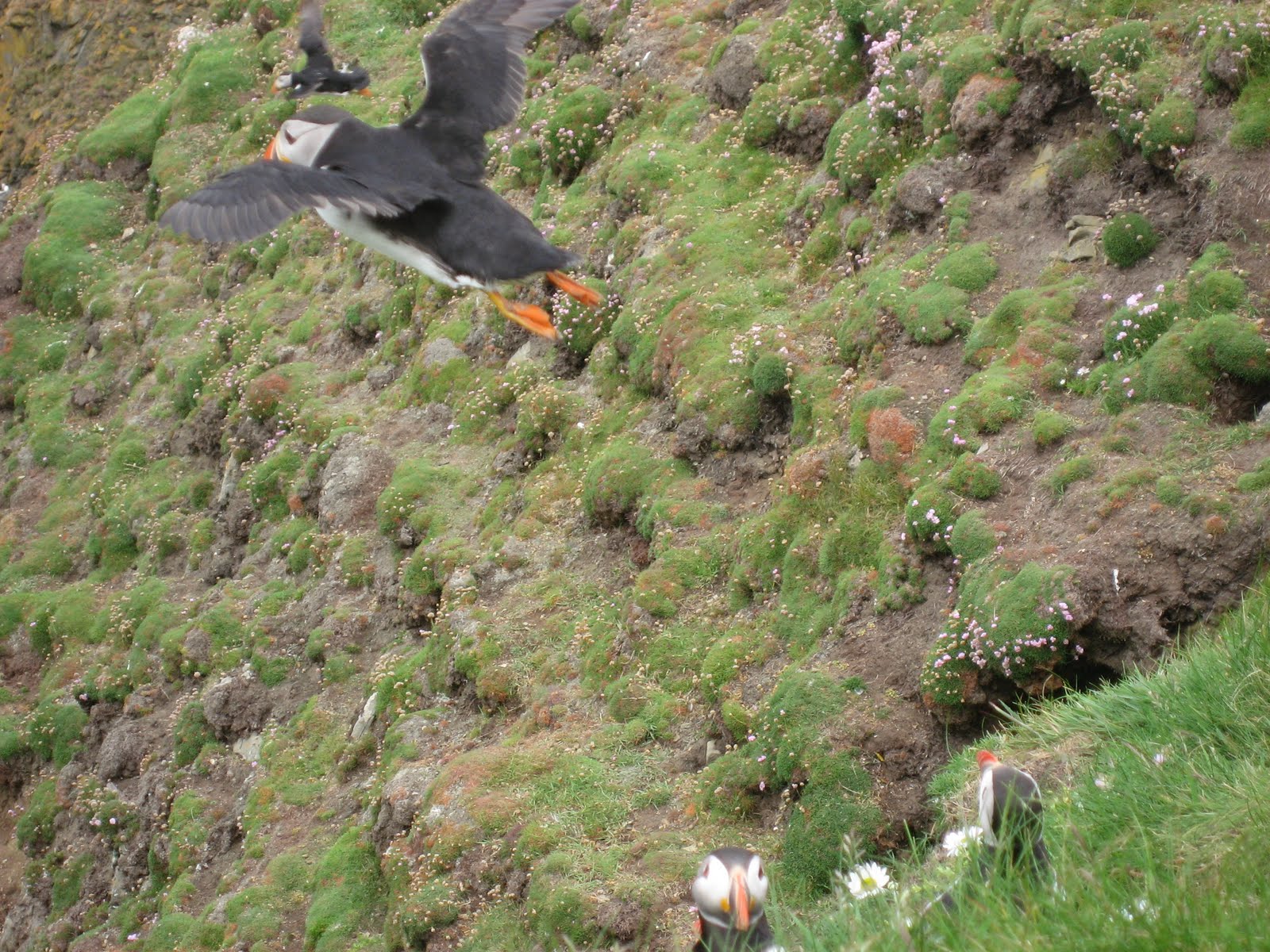
Meanwhile here are some holiday photo's - humour me on this, there are Puffins which were almost unbelievably cute. This would be Puffins coming and going...
Stealthy Puffins creeping up on us, and Puffins ready for their close up. They really are delightful birds, smaller than I remember, comical to watch (though what the last one thought of me and my commando style crawl across a cliff top to get it's picture perhaps wouldn't bear much inspection) and understandably popular. Love Puffins.
We also had the chance to do a hopefully good deed after finding an Oyster-catcher caught up on wool, it was to weak to make much of an attempt at running away so I decided to catch it and ask at the nearest house if we could borrow some scissors to try and cut it free. It was lucky for the bird that the lady we found was a retired vet, she had stitch cutters and managed to cut away all the crap so that it seemed likely the bird would not only survive but keep it's foot as well. I hope so anyway, the Oyster-catchers (dialect name Shalder) call is deeply evocative and although there's no particular shortage of them I do feel the more the generally merrier.
Meanwhile here are some holiday photo's - humour me on this, there are Puffins which were almost unbelievably cute. This would be Puffins coming and going...
Friday, July 6, 2012
On Holiday
| I want this please |
As of 5 O'clock this evening I have been officially on holiday, weather permitting I will be heading for Shetland on Sunday though between floods at this end and fog up there I'm not entirely confidant about my travel arrangements. Assuming nothing goes wrong my biggest headache now is in trying to work out what bags to pack and deciphering the hand baggage rules (after stringent research it transpires that the hand baggage allowance for the second leg of my journey as only two thirds that of the first part - I need a tape measure as a matter of urgency).
| Not this, no thank you, not at all |
On a positive note the clouds started to clear as I walked out of work today and the sky is mostly blue at the moment (makes a nice change), I'm hoping it's a good sign for things to come, I really, really, want to be away at the moment (can't help but notice that weather never stops me coming home - just from getting away). Meanwhile, and to take my mind off weather paranoia, it's time to choose which books to take with me; the big book strategy has worked well for the last couple of trips so I think two nice fat books will see me through, most likely a Trollope and maybe Robert Macfarlane's 'The Old Ways' though neither of these choices is set in stone yet.
| And really not this. |
Despite having a pile of things to do before leaving town I'm still enjoying the first night of the holiday feeling; actually happily wallowing in the belief that for the next couple of weeks I only have to do things I want to do (which is a bit of a fantasy but I'm enjoying it anyway). As this includes finishing the book I'm currently reading so I can write it up before I go and finding a tape measure so I can obsess about luggage I suppose I should go and make a start on those particular chores...
Sunday, July 1, 2012
Independent Booksellers Week
It seems I really don't pay attention to what's going on around me sometimes. I saw this in yesterdays Guardian - Julian Barnes on his life as a bibliophile, but only had time to go back and read it tonight and so finally saw mention of Independent Booksellers Week (shame on me). Barnes writes brilliantly about being a reader and book lover, I read the whole article going yes, Yes, YES - that's me! Except for the bits about collecting first editions, that sadly is not me.
Independent book shops deserve celebrating and more importantly supporting. The closest one I have and use at the moment is the rather wonderful Astley Book Farm, it's all second hand books, with an excellent range including some real rarities, also and most important - the ladies who run it are knowledgeable and welcoming.
The Scottish Borders by contrast are well provided for by a string of independent book shops (the list on this link is not exhaustive but gives a good indication). My favourite is probably the Mainstreet Trading Company (the cafe is really good too) but they're all excellent and I've had serendipitous discoveries in most of them - and there's still time for the others.
| Leakey's in Inverness, worth the journey for this place alone! |
In a week I'll be in Shetland (quite excited) which is served by The Shetland Times Bookshop. This is the first bookshop I knew, it still has a place in my heart, it's small and mostly a stationers but has a decent selection of books including a range of local interest things they publish themselves. Some of the happiest moments of my childhood were spent in there, I still get a buzz of anticipation every time I go in there and am delighted that whatever else has changed this institution remains.
Amazon, Waterstones, even on occasion W H Smiths are all great, but as the Mainstreet Bookshop in St Boswells demonstrates so well how an independent bookshop can be a huge boon to a community, this place is a destination - an imaginative bookshop both for adults and children, that very good cafe with wall space that works as a gallery, a small selection of antiques, other more general gifty items, a packed programme of events - it's all going on; the area would be much the poorer without them. Waterstones in Leicester does it's best, which isn't bad, but they don't come close to providing the community focus a really good independent can - something that's as important in a city as it is in rural areas. Times are tough for retailers everywhere so it's more important than ever to invest in the businesses doing it right and make sure those rare spare pounds go to a good home.
Any and all independent bookshop recommendations gratefully received.
Saturday, April 14, 2012
Sumburgh Head
I've not long finished Kathleen Jamie's 'Sightlines', it's excellent and thought provoking as was its predecessor 'Findings' and needs altogether more attention than I feel I have in me on a Friday night but one of the places mentioned in passing was Sumburgh head in Shetland. It's become something of a tradition over the last few years to start a visit home by going to see the puffins at Sumburgh (puffin cam went live tonight).
The puffins arrive in April and stick around for a few months of summer before heading back to sea, May is probably the best time to see them but there should still be a few hanging around in July when I'll be looking for them. There are other places to see puffins close up but Sumburgh is my favourite, it's the southern most tip of Shetland and very handy for the airport which is a couple of miles below. You don't have to be feeling fit or able to get there, you don't have to think about ferries or time, and a few minutes up there is enough to blow away the generally mucky feeling travel of any sort leaves you with.
The first time the Scottish one came north with me he was grumpy and tense on the flight (as if being dragged up to his girlfriends fathers house in the middle of nowhere wasn't bad enough there was the threat of unruly teenage siblings, and I think my mother might have been teasing him about the possibility of packs of dogs and shotguns...) so instead of taking him straight home we took a slight detour and went up the hill - it was a wise move. Car parked next to a field of exuberant sea pinks, a face full of very fresh air (and quite a bit of rain) and a puffin was enough to start the holiday on the right footing. (He's been back a few times now.) Last year when I was in Shetland whilst he was stuck at work, again the first thing we did was go and look for Puffins (even my sister who I was with, and who is highly hill averse was reasonably willing). Sumburgh has a good mobile phone signal (which isn't true of everywhere in the islands and certainly not true of my dad's house) so it seemed timely to call and rub it in a bit - to do this I found a specific square of concrete and waved like mad at a webcam (god knows what any other viewer hoping to see puffins made of it). I could have made a fool of myself in town but it wouldn't have been the same. In the end we all waved whilst talking on the phone, I dare say there are all sorts of conclusions about the modern world to be made from that, but at the time it was fun.
Apparently there are frequent whale sightings from up there too, though I'm not a frequent visitor and have never hit it lucky. There is a stone shaped a bit like Darth Vader which you can't miss (it's just by the road and looks better in life than in the pictures but do Google it). There are other birds to see as well, plenty of rabbits, a Stevenson lighthouse (where I think I was taken as a child to see the lamp when it was still manned) but the big thing for me is the view.
If you look north you can see Shetland spreading out in front of you looking surprisingly like it does on the map. The only other time I've had that sensation is flying over Bordeaux and seeing the Gironde below me - familiar but new at the same time. Look south and there's a lot of sea and sky (a lot), on a clear day there's Fair isle on the horizon and that's about it which is incredibly invigorating. Turn away from the miles and miles of bugger all ocean and it's back to contemplating the airport and a few yards beyond the runway some serious archaeology. After Leicester I prefer the sea and all that space, Leicester doesn't lack good archaeology and we do okay for industrial buildings too, but it's not easy to get a lot of sky or horizon in your view.
Monday, March 5, 2012
Shetland Rambles - Mairi Hedderwick
From Sark to Shetland - 'Mr Pye' (and booking a summer escape to the North) has set me to reading some of the unread island books I have around the place. This is a treat, I'm very fond of small islands and if I can't be on one I can at least look at pictures and read about them. Mairi Hedderwick is best known for her 'Katie Morag' books (about a little girl on Coll) and a quick look at her wikipedia entry makes it clear she's been well and truly bitten by the island bug - by my count she's tried to leave Coll only to return a few years later about 4 times. Islands are like that, they get a grip on you so that nowhere else will feel like home.
Initially I wanted this book for the pictures - it's a sort of travelogue wherein Hedderwick spends a summer travelling around Shetland following in the footsteps of the Victorian artist John T. Reid attempting to paint what he painted on his original trip in the 1860's. It sounds like a dream project really and the sets of illustrations (Reid's engravings, Hedderwick's watercolours) would be enough to sell the book, but there's also a surprising amount of text. I only know Hedderwick from her children's books so hadn't imagined she would have so much to say. (I don't know why I was only expecting pictures but there you are - with hindsight I'm quite ashamed of that).
She's an interesting companion, must be quite redoubtable as she's in her 70's and chose to spend an northern summer sleeping in the back of an ancient Landrover (the Countess), and is a woman of decided opinions. It's fascinating to see a place I know well through somebody else's eyes and prejudices. It annoys her that the hotels and guest houses are all full (in the middle of the season) when she turns up without reservations, indeed other tourists are always in the way, and there's plenty of space to dwell on the wrong doings of the landed classes. It seems incredible to her that Reid could have enjoyed the hospitality of these people rather than denigrating them - which seems to miss the point of Victorian society (people with no money can't afford much in the way of art either).
She also has a terrific empathy with the Islanders she meets, and a great deal of clear sightedness about the problems which face fragile island communities. Hedderwick fell in love with Coll in the 60's when mainland life hadn't quite invaded and she's clearly looking for somewhere that's still relatively untouched, for better or worse though you can't stop progress and so there's a definite sense of sadness and nostalgia running through the book. Balancing that though are plenty of great stories - old scandals, legends, ghost stories, and pen portraits of the people she meets. There is also the satisfying climax of finding some rare Reid originals in Buness house in Unst - the very northernmost tip of the U.K.
Thursday, February 2, 2012
The Times
Dad and I were both surprised to see the North Start Cinema advertising x rated films. In so many ways the past is another country, but being British some things remain constant - complaints about a royal wedding extravaganza and observations on the wettest November ever have a familiar ring to them.
Wednesday, February 1, 2012
Shetland Ramblings
Homesickness appears to be an incurable ailment. It's quarter of a century (and far more than half my lifetime) since I lived in Shetland but it will always be where I'm from and looks like it will always be where I think of as home - it's not as if I have any illusions about island life, or if I'm even sure that it would still be for me (though give me the chance and I'd go back in a flash to try it out at least). The end of January always makes me want to head north (a desire that probably wouldn't survive first contact with the weather) mostly because of Up-Helly-Aa, although this year impressive Aurora displays are added to the siren call (I don't want to infringe anybody's copyright but have a look at some of the pictures and videos here at Burra Bears).
Up-Helly-Aa is a big deal (I think it might be the biggest fire festival in Europe) and although there are several burnings all across Shetland now the big one takes place in Lerwick on the last Tuesday of every January. When I was a child it was a hugely exciting day partly because school closed half day on the Tuesday and everything closed on Wednesday so that people could recover (this is still the case). Shetland is a small place, really large crowds are rare so the best part of a thousand men marching through town with flaming torches has quite an impact. It really is a sight to see and judging by the palpable excitement on my facebook page it's still as big (if not bigger) deal than ever. Excellent pictures here.
It probably doesn't help that I'm currently reading Mairi Hedderwick's 'Shetland Rambles' - set in midsummer which is even more beguiling (there's a promise of sun and reasonable warmth). I had to put it to one side to finish a book group read but will have more to say about this one very soon. Also it's cold which makes me hanker after new knitwear, my favourite jumper is now over a decade old and has finally reached a point where repairs are ineffective. It's a long way to go for a jumper but there would be gloves and a scarf too... My Porch went to Hawaii for his island fix, arguably my parents didn't do me any favours imprinting Shetland on me - now if only I could bring myself to believe that.
Wednesday, September 21, 2011
The Prisoner of Happy Hansel – M. B. Paxton
I found this book on the curiosities shelf of an Age Concern
shop in Leicester and had to buy it. Happy Hansel (meaning happy gift just-so-you-know)
was the name of my primary school. ‘The Prisoner of Happy Hansel – A tale of Smuggling
Days’ sounds promising doesn’t it? A quick look confirmed a Shetland
connection, and really who more appropriate could have picked up this book...
It was part of something called the ‘Excelsior Library’ or
select stories by authors of repute and looking at the officers and agents was
available throughout the empire and America. I can’t find when it was written
and the book itself is unhelpful in that respect but the overall feeling is
late Victorian. By authors of repute the Excelsior Library means evangelically Christian
and I have to say this was a truly terrible book by any standard I can think to
measure it against, even an idea of Christian self sacrifice.
14 year old Maidie is sent to live with her Aunt Rachel and
Uncle Occo on their Shetland estate whilst brother Jack heads of to Jamaica to
try and sell some land to restore the family fortune and buy back the home they
lost. After a few weeks of not being allowed to read Tennyson and being
expected to be clean and tidy Maidie has a fight with her aunt and runs off to
sulk in peace. She falls asleep in a handy fishing boat waking some hours later
to find herself at sea with a group of smugglers, tenants of her uncle who has
suspicions of their activities. When they find her she’s handed over to a
saintly old grandmother and devout young fisher boy to be taken care of.
She stays with them for 10 months whilst her uncle and aunt
assume she’s been drowned - this despite still being on the family estate and
not really being a prisoner at all (this might be possible to imagine in the
wilds of Canada or Australia, but I hope British children where less credulous).
By and by Maidie learns to think of others, help around the croft, and to share
Haco and his grandmother’s love of Jesus. The old lady’s faith was born of
losing 7 sons and a husband to the sea in 6 months – the son she has left is
the unsatisfactory smuggler Daniel.
The climax of the action comes with a storm and a wrecked
ship. Maidie, Haco, and another young fisherman, Jarum, that Haco has managed
to dissuade from his former smuggling ways set off to try and rescue some of
the crew before the ship is totally broken up on the rocks. They manage to save
a sailor and a gentleman (who turns out to be brother Jack returning to
Shetland despite presumably being told that his sister had died and having no particular
business there) and are just about to attempt to get back to shore when they
realise that a child is still on board.
On a clear suicide
mission Haco jumps onto the foundered vessel to rescue the boy when the whole
lot goes down and they’re both drowned. Returning to shore Maidie collapses
into a faint for two weeks, the grandmother has died in the night (which saves
her the grief of losing another family member) and everyone else becomes good Christians
on the back of Haco’s example.
It was all very silly and as Christian messages go I’m
clearly too much of an unreformed sinner to understand it. Paxton uses the
place names of my childhood but not the geography – although I think he must
have known Shetland a bit because a lot of the dialogue is in dialect which is
much more convincing than the plot. Meanwhile I find myself very grateful for Enid
Blyton and the generally much higher quality of children’s literature that I
had when I grew up.
Friday, May 27, 2011
The Penguin Book of Norse Myths - Gods of the Vikings Kevin Crossley-Holland
I took this book with me to Shetland for holiday reading, I thought it might be vaguely appropriate and in between reading ‘The Hurricane Party’ and A. S, Byatt’s retelling ‘Ragnarok: The End of the Gods’ (coming later this year, really quite excited) I wanted to reacquire some knowledge of the myths beyond what I gleaned from the recent ‘Thor’ and what I remember from a book I read when I was 13.
‘The Penguin book of Norse Myths’ has sat on my shelf looking worthy for a number of years and in all honesty I didn’t have very high expectations for it (sorry Kevin Crossley-Holland I did you a grave injustice) assuming it would be a bit dry and possibly a bit of a chore to read through. As it turned out once I started I couldn’t put it down. There’s an introduction that I haven’t properly read yet though I did spend quite a bit of time studying the diagram of the world tree with attendant worlds. This is followed by the myths themselves which have been engagingly reconstructed from surviving sources. There are also excellent notes almost all of which I read; they detail what sources were used as well as some of the speculation and theory surrounding the myths, and finally a very useful glossary.
I couldn’t have wished for a better put together book which was a pleasant discovery but the real bonus was the humour and poetry that Kevin Crossley-Holland brings to his telling which is surely very much in the approved tradition. I slogged through a good chunk of ‘The Orkneyinga Saga’ (which I’ve just noticed has had a very attractive facelift since I bought my copy) when I first met the Scottish one we talked about it over a cup of tea and I liked him so much that I went home, dug it out, and made a really valiant effort over it, but available as the saga’s are they aren’t always as entertaining as I feel they should be. This is still a primarily scholarly retelling but it has a real feeling of life to it as well. So much so that myth number 30 ‘Loki’s Flyting’ is almost indistinguishable from the retelling in ‘The Hurricane party’ (which was the best part of that book for me) it’s Kevin Crossley – Holland’s version I’ll read again.
I like a myth cycle as much and quite possibly more than the next person but even so my knowledge is still very superficial so I may be quite wrong in my opinion that the Norse myths have something quite unique about them. I’m don’t remember reading any other cycle that talks specifically about the end of the gods. The end of the world certainly but not a world that’s turned inside out and is then reborn without the gods...
The telling of Ragnarok is a fitting climax for any book (and a brilliant starting point for a book too, especially set against the second world war – can’t wait for that new A. S. Byatt) Crossley-Holland starts it like this “AN AXE-AGE, A SWORD-AGE, shields will be gashed: there will be a wind-age and a wolf-age before the world is wrecked.” But at the end “There will be life and new life, life everywhere on earth. That was the end; and this is the beginning.” Terrifying and hopeful at the same time – a theme that runs all the way through the cycle along with a whole host of very human failings; no wonder so many writers have dipped in and borrowed over the years.
Subscribe to:
Posts (Atom)