Thursday, March 24, 2011

A Grand Day Out (again)

Sometimes a change is far better than a rest – I’ve had a really gratifying day in London and feel like a different woman for it; it’s comforting to know I’m only just over an hour away from one of the world’s great cities. It’s also comforting to know that I’m something more than an hour away from more temptation than my credit card and I could handle.

A fruitless search for the Scottish ones projected birthday present was followed by a book bloggers evening sponsored by Penguin. I wanted very traditional whisky tumblers – which apparently no one sells anymore. I tried John Lewis in two incarnations, Liberty, Fortnum and Mason’s... Surely all bastions of the traditional – or so I thought until today. Someone suggested Harrods but my feet hurt and my temper was going at that point. I also thought I was about to get lucky in F&M’s having explained exactly what I wanted – you know, something that makes you think of antlers and tartan and other Scottish clichés. The glasses produced had palm trees etched on them. Palm trees. Not dare I say it either traditionally Scottish or whisky related, also they were £108 pounds each; I appreciate an attempt at switch selling probably more than the next person but NO.

The blogging thing was more successful and not just because of the wine. Meeting other bloggers has so far been an unqualified treat, the author readings were short enough to make me want to hear more (which is the perfect length), and there was a goody bag. I’ve come home with a pile of books I would probably otherwise have ignored and the inspiration to read them (a win) as well as a few I bought. The mini modern classics were an impulse purchase at the train station (please can Foyle’s start a countrywide expansion) and I also got ‘There Once Lived A Woman Who Tried To Kill Her Neighbours Baby’ after Polly at Novel Insights spoke highly of it. (So far as good as it is dark).

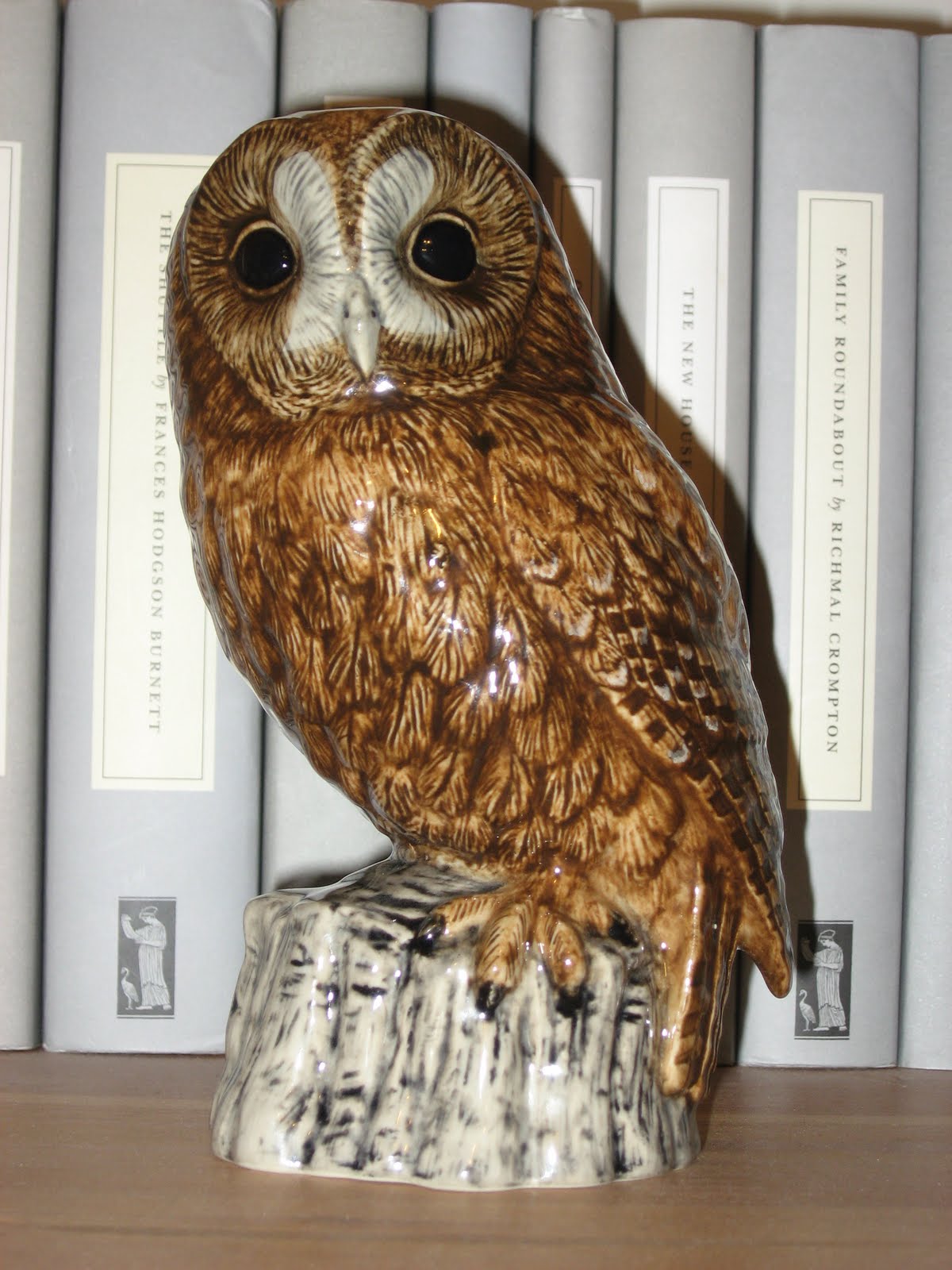
My train home ran on time and the bills in the post were balanced by a copy of Pam Corbin’s ‘Cakes’ (thank you Bloomsbury) and now I’m clean, fed, happy, and ready for the rest of the week. Oh and I got an owl money box which I’m really quite in love with – maybe even enough to start some sort of saving.

Sunday, March 20, 2011

The Rector and The Doctor’s Family – Mrs Oliphant

Not one book but two novellas. I fell on Mrs Oliphant quite by accident a couple of years ago after spending half an hour scouring the classics section in Waterstones Nottingham for books by women. It ended up being a toss up between ‘Miss Marjoriebanks’ and ‘The Female Quixote’ (Charlotte Lennox – and still on my wish list). It was a happy choice; I really loved ‘Miss Marjoriebanks who put me strongly in mind of Jane Austen’s ‘Emma’ and was mildly excited when I realise that it was one of a set. I think now that the Carlingford chronicles probably have more in common with Trollope’s Barchester than Austen (Trollope and Oliphant are contemporary, but the Barchester books pre date the Carlingford chronicles and I wonder how much are owed to them?)

Since then I’ve managed to pick up all the chronicles – last done by Virago but now sadly out of print, they do turn up in charity shops and with the exception of ‘Salem Chapel’ are all cheap on amazon. Reading ‘The Mystery of Mrs Blencarrow’ and finding a copy of ‘Phoebe Junior’ reminded me that my Virago collection isn’t just for decoration and so I’m working my way through the set. First up was ‘The Rector and the Doctor’s Family’.

The Rector’ is a mere 35 pages long and bears comparison with Trollope’s ‘The Warden’ – both books deal with an aging clergyman in a comfortable living realising that they may not be the best men for the job. Oliphant’s rector has been a fellow of All Souls for most of his career, Carlingford is his first job in the field, and it also allows him to provide a comfortable home for his elderly mother. He’s a good and mild man with his heart in the right place but a lack of worldly experience soon tells. There is the vexed question of getting a wife, and the even more vexed question of how to help the needy. The poor rector finds himself wanting at the crisis point – and that’s really it; it wasn’t the most inspiring start to my project – not bad but not amazing.

The Doctor’s Family’ is a different beast altogether. The Doctor of the title is young Dr Rider – he’s saddled with a very unsatisfactory brother – Fred. Fred is an alcoholic, heavy smoking, lazy, irresponsible, all round bad egg who has already cost his brother one practice and now after a trip out to Australia has returned to recommence sponging. Things are at a pretty unsatisfactory point for the good Doctor when two mysterious women turn up on his doorstep. Fred has failed to mention a wife (whose money he’s spent) and three children, he’s also got an energetic sister in law who’s responsible for this sudden appearance from across the world.

Susan (the wife) is as selfish and irresponsible as her husband, but Nettie is a different matter. Despite being the younger of the two and unmarried she takes all the cares of the household onto her shoulders – its Nettie’s money that provides for Fred and Mrs Fred as well as all the little Freds (who are an appalling bunch all in need of the naughty step), Nettie’s energy that finds them a home, keeps the children clothed and the house running smoothly. Dr Rider is clearly destined to fall in love with Nettie, but can’t and won’t take up his brother’s responsibilities (feeling not unreasonably that Fred should man up and do the job himself). For Nettie however the responsibility is simply hers – she sees what her family is, realises that they are helpless without her and so gets on with helping them. It’s a very feminine thing to do but still leaves the reader burning with indignation on her behalf. Reason says she should pursue her own happiness with the same determination but heart dictates that we do these things for our family. It’s certainly what Oliphant did for hers – repeatedly. I think there’s a sense of frustration and anger here as well as a bit of justification; there was no shortage of Victorian women forced to earn a living for their families – the indignant female artist is an image that crops up in paintings (such as this one - Emily Mary Osborn’s ‘Nameless and Friendless’) as well as novels, the industrious but indignant lady novelist is almost a cliché. Mrs Oliphant is a voice for these women – and in ‘The Doctor’s Family’ she hasn’t wasted her opportunity.

Friday, March 18, 2011

Not exactly perfect but...

I made biscuits – specifically St Patrick’s Day themed biscuits – shamrock/clover shaped affairs for the benefit of the blonde who I hoped would be impressed. She was convincingly enthusiastic so I feel pretty chuffed which is just as well because getting the green off everything is going to be a whole new challenge.

I’ve been eying up ‘The Biscuiteers Book of Iced Biscuits’ for a while. I don’t think I’ll be buying it (but wouldn’t turn my nose up at a copy if anyone wanted to give me a present) it’s such a very pretty book with some stunning ideas, but this kind of decorating takes a lot of time, a lot of patience, and a steady hand. I hope I’ve picked up enough hints from my covert browsing to have a go at basic stuff but honestly don’t have the patience or steadiness of hand required (the time is a whole other issue).

My biscuit recipe was from Nigella’s ‘How To Be A Domestic Goddess’ (I think they’re called cut out biscuits or butter biscuits or something very like – either way I can eat a lot of them and they hold their shape well) but I imagine any much loved biscuit formula would do the trick – and now for my distilled decorating knowledge – we can all have green sticky kitchens now.

Having made biscuit dough, chilled biscuit dough, rolled it out, squidged it back together, and cut out biscuit dough before finally baking into biscuits and allowing to cool - mix your icing. It should be royal icing which it seems easiest to buy in packets you just add water to (no raw egg to poison myself with thank you very much). Ignore the instructions on the packet – they are only a distraction. For each colour in the design (see how I did a green on green with only green thing – it’s because it was easy that way) there needs to be some thickish icing to pipe an outline in and much thinner flooding icing. That’s icing thick enough to write with and dry fast, and far thinner than I imagined icing that wants to be able to ‘flood’. It helps to have a vast array of icing bags, nozzles and little squeezy tube things to put icing in. The icing goes a lot further than I expected it to – this never happens with cakes.

Edible (or at least non toxic) glitter is the baking equivalent of candlelight. It makes everything pretty and covers up an icing technique I can most kindly describe as naive (I need a lot more practice okay- I admit that). I will be getting more glitter.

The icing will make the biscuits a bit soft – when it’s basically dry re-bake in a low oven (about 100°C) for 10 minutes or so to crisp them back up.

That’s it – that’s what I’ve learned. I want to make Easter biscuits for friends and family – so let me assure you would be recipients that if I do this it’s a lot more effort that buying an egg, so even though I’m blatantly embarking on this project so I can purchase more squeezy bottles and cookie cutters (love them) and will obviously be enjoying myself – it really is all about you!

Thursday, March 17, 2011

The Guilty Pile.

Months and months ago Rosy Thornton sent me an email asking if I'd like a copy of ‘The Tapestry of Love’ to read. Yes please I said because I’d heard good things about it and thought it sounded just the thing that I was looking for. I’ve still not read it. I also have a copy of Richard Mabey’s ‘Weeds’ which I’ve read 3 chapters of, was fascinated by, and haven’t got any further with, and perhaps most guilty of all is ‘The Captain’s Wife’ by Kirsten McKenzie. I’ve had ‘The Captain’s Wife’ since August; a lovely lady from John Murray had said to let her know if I wanted anything. I really liked McKenzie’s ‘The Chapel at the Edge of the World’ and so asked for this her second book. It arrived, I got really excited, the Scottish one read and loved it, and I still haven’t managed to open it.

The problem is that all these books are hardbacks and I really struggle with hardbacks. They don’t fit in my bag (which is small to fit in the teeny tiny lockers we have at work) and as most my reading is done on work breaks and bus trips books that don’t fit in my bag suffer. I gave up trying to read two books at once because I never seemed to finish either or any of them. I never seem to be at home for more than a few hours at a time so the chance of reading a book in one session is ever diminishing... See the excuses piling up – why in the time it’s taken me to write all this down I could probably have read a couple of chapters.

These three are the tip of an unread iceberg but they’re the only ones that induce guilt, partly because in accepting (or soliciting) them I made a bargain if only with myself to read promptly. Partly because I know I’ll get to most those other books (perhaps not the Milton or Dante – but all the rest for sure) in the fullness of time and when I’m in the right mood – but hardbacks... there are dozens of times I’ve meant to pick up all of these three and just haven’t. Anyway the point of writing all this down is as a prompt to self to get on with it. I procrastinate far too much so this is me getting my act together and setting myself a goal which should be easy to reach – hopefully the goal reaching thing will become a habit and I’ll be able to tackle hardbacks any old time.

Sunday, March 13, 2011

Next World Novella – Matthias Politycki

My preferred reading matter by and large comprises books written by women, written in the past and written in English but two of my stand out books of the last year have been Peirene titles – both written by men, contemporary, and originally written in German. I’m truly grateful to Peirene for sending me both ‘Portrait of the Mother as a Young Woman’ and ‘Next World Novella’ neither book would have crossed my path otherwise. For all the abundance of books out there it seems to me to be harder than ever to find something different – the choice in my local chain bookshop is disappointing to say the least and we don’t have an independent locally (that I know of, but I have dreams that one will reveal itself). Amazon has the range but unless you know what you’re looking for, or looking for more of the same finding things is tricky.

Thank heaven then for blogs and publishers who are inclined to flirt with them; it’s one good way to broaden my reading horizons – and with them horizons generally. ‘Next World Novella’ is an unsettling read (which seems to fit with the times); Hinrich and Doro have been married for 30 years seemingly happy until one morning Hinrich wakes late to find his wife has died in the night at her desk. What follows turns his perceptions on their head. Doro’s last act was editing an old manuscript of Hinrich’s, in an attempt to make sense of this unexpected loss he starts to read her commentary – with mounting discomfort he realises that his contented marriage was no such thing.

Slowly over the course of the day that Hinrich spends with Doro’s corpse some sort of truth about his failings and her intentions are revealed, Hinrich also finds that:
"Being dead, he thought, means first and foremost that you can’t apologize, can’t forgive and be reconciled, there’s nothing left to be forgiven, only to be forgotten. Or rather there’s nothing to be forgotten, only forgiven.”
It’s a frustrating situation, sudden death leaves so much to be explained, understood, and of course forgiven. Hinrich is left with his frustrations and only a fly to take them out on and in such a situation it seems you eventually have to be honest and face the truth about yourself.

It’s a hard book to describe, and being a short one far too easy to reveal too much plot (not that I mind spoilers but as so much of this book is a slow exposure of the inside of a marriage it seems wrong to give away to much). I will say that the end turns everything upside down again – I’m not quite sure what happens – it might be a dream, or what went before may have been the dream, or it may be that this is what might have been – or frankly it could have been something else entirely but whatever it is it feels hopeful and poignant at the same time.

There is a trailer here which is worth watching and if you come across this book please read it – it’s only short and time spent on it is time very well spent. Peirene have deservedly just won the new comer of the year award from the independent publishers guild, I hope they come by a whole lot more awards and a lot more recognition. I hope also to be able to pick up their titles on the high street someday soon (and that they might take their literary salons on the road and into the provinces).

Friday, March 11, 2011

Honey Cake

Work and indolence seem to have got in the way of baking recently, but the need to use up eggs and butter finally prompted me into the kitchen last weekend where I made a honey cake (recipe courtesy of River Cottage Everyday). Unfortunately I got distracted so one moment the cake was not quite ready and then 25 minutes later it was overcooked and sunk in the middle. Even so it was really quite good, and when I made a second attempt later in the week it turned out even better (it’s been a social kind of week, I haven’t eaten two cakes all by myself – I mean I probably could if I set my mind to it, but honestly I haven’t.)

I’m not sure why it’s taken so long to discover these almondy cakes – they must have been out there for years just waiting to ambush me and I’m so over chocolate now (I haven’t experimented yet but I imagine other nuts would work just as well – has anyone any experience with hazelnuts?) Equally good with coffee or as a pudding (or as the Scottish one demonstrated; not bad for breakfast) quick to put together, universally popular, and they seem to keep well (when they get the chance). It’s like cake nirvana.

To fit in with what I had in the cupboard I changed the recipe slightly – for the original, and quite possibly better version go to ‘River Cottage Everyday’.

One 20cm springform tin prepared with a layer of greaseproof paper and the oven set to 170°

250g unsalted butter

250g of golden caster sugar

150g self raising flour

150g ground almonds

1 teaspoon of baking powder

4 eggs
50g flaked almonds

A pot of honey

Mix the butter and sugar to a smooth cream, add the eggs and flour and beat together, finally add the almonds and baking powder mix it all up and stick it in the tin, smooth down the top and sprinkle the flaked almonds over it.

Bake for about 50 minutes to an hour (taking care not to get absorbed in an old episode of CSI and leaving it for an hour and a half) or until a knife comes out clean and the centre hasn’t sunk into a pit. (This cake does have a tendency to sink a little, or it does for me, but there’s a difference between cute honey soaking dimple and crater.) Finally and whilst it’s still hot, drizzle about 4 tablespoons of honey over the cake as evenly as possible – let it soak in and then eat – warm or cold it’s delicious.

My sink still leaks, but I don’t care because I have cake.


Wednesday, March 9, 2011

Hawkfall – George Mackay Brown

I’m putting sink troubles behind me this morning because the sun is shining again (second day in a row – amazing) and I have the morning off (not focusing on having to work very late, not thinking about it at all...). I’ve made lots of pancakes and eaten quite a few as well which has made me feel at peace with the world. Work to often gets in the way of things like this (eating pancakes on your own whilst still delicious doesn’t generally make you feel like you’re taking part in a long tradition) and now I have to think of something to give up for lent. Without being in any way religious I still think this is a good opportunity to implement a change in life – a second chance at a New Year’s resolution. This year I’m resolved to give up sneaking recyclables into my ordinary rubbish. The bottle bank is close enough for there to be no excuse.

These are the kind of things that George Mackay Brown makes me think of (you see there is a sort of point to all that rambling). He’s also a writer I find myself turning to over winter and spring – I see I was reading him this time last year as well. ‘Hawkfall’ was a happy find (at the Astley Book Farm) a pristine copy of a book I’ve wanted for a while in a half hearted sort of way. I thought it was a novel for some reason and I’ve struggled with Mackay Brown’s novels – but happily it’s another collection of short stories where I feel he’s hard to beat.

Fair enough I get a sense of déjà vu reading these stories now because there is a similarity between them; I’ve got well over half a dozen collections and found myself in very familiar territory, that said I think this is one of the best sets I’ve read, I didn’t want to finish it. I also found myself actually making notes whilst reading which is something I rarely do – of course I’ve lost them already, but all the same... What I haven’t lost is a sense of connection with the season changing. A reminder that the sky is sometimes blue, and will sometime be blue again, after spending most the daylight hours of the last 5 months in a windowless corner surrounded by wine bottles it’s something that’s nice to know.

It’s all summed up in ‘The Tarn and The Rosary’ (which has to be Mackay Brown’s own biography) Colm who has become a writer is living in Edinburgh trying to finish a second book. It’s hot and somehow unsatisfactory he wants to go back north, and at the same time doesn’t, writing to a friend
“I am not coming north this year. There are its true so many things I want to see – Tumilshun and the hills, the churchyard, the school, the piers where I fished and the ditches where I burned my fingers. But there are other places that give me a pain at the heart when I think of them – the doorless houses in the village, the Godspeed rotting on the beach, the black forge...”
But self imposed exile gives way to a new realization by the end of the story:
“During the last Gospel it came to him that in fact it would be the easiest thing in the world for him to go home. There was nothing to keep him here. There were still meaningful patterns to be discerned in the decays of time. The hills of Norday were astir all summer, still, with love, birth, death, resurrection.”
And that’s exactly why I read George Mackay Brown.

Monday, March 7, 2011

The Mystery of a Butcher’s Shop – Gladys Mitchell

I’ve been slightly distracted by sink problems over the last 48 hours. Something somewhere is leaking, not in an overly sinister fashion, but persistent enough to be damp and annoying. My father phoned with advice but I’m quite tired and could probably have been more lucid whilst trying to describe what was in front of me. Eventually, and under orders, I checked the washing machine filter – it was clear and clearly not the source of the problem but I ripped off half a fingernail and cut a finger in the process, so for now I’m shoving a pan under the drip and waiting for my mother and a larger wrench to visit soon...

I’m sure Gladys Mitchell never had these problems, and beyond certain that Mrs Bradley wouldn’t have been defeated by plumbing (or by plumbers for that matter). She’s certainly not in the least discomposed by seemingly incomprehensible crimes – fortunately she can apply psychology and clear the muddiest of waters in a way that makes no sense to me whatsoever. It’s infuriating and beguiling in about equal measure; I appreciate the hideous Mrs Bradley with her yellow claw hands, bright cloths, formidable strength, crocodile smile, wonderful voice and unique intelligence but have to reconcile myself to the possibility of having not a clue what’s going on.

The Mystery of a Butcher’s Shop’ isn’t too bad in this respect; it’s odd but entertaining (I particularly liked the absent minded vicar with kleptomaniac tendencies) but what I really like about Mitchell is this:

...’She thinks the Church Catechism is immoral.’
‘So do I,’ Said Aubrey feelingly. ‘I can’t stick learning stuff by heart. But what’s her objection?’
‘The bit about your betters. She says the village children are led to believe it means the squire and the people who go fox hunting and the factory owners who pay women about half what they would pay men for doing exactly the same work.’

It goes on for a little bit more in much the same way but what gets me about it is that it was written in 1930 and we’re still fighting the same battle for equal pay now. Mitchell was a prolific writer – she also had a long career as a teacher. She was clearly a woman with ideas and opinions that she wasn’t shy of expressing and compared to her contemporaries (Agatha Christie, Dorothy L. Sayers etc) she feels much more subversive. Mrs Bradley does and says outrageous things but crucially she has a career – she doesn’t just stumble on crimes she’s called in to consult and is no Miss Marple who has to conceal her intelligence. I’m so pleased that Vintage have started reprinting these books – there are another three due out in October this year which I look forward to as a welcome post summer/pre Christmas treat.

Sunday, March 6, 2011

Six of the Best

Last weekend Nancy Pearl did a top ten list of neglected classics (in The Guardian) ripe for BBC adaptation. It’s a nice list composed in equal measures of books I love, authors I love, and books I now want because of the good company they’re clearly keeping but... One of the books on the list is F. M Mayor’s ‘The Rector’s Daughter’ which is an amazing moving and eventually heartbreaking book which I can’t help but think would make for miserable television (girl leads loveless and disappointing life with remarkable grace and stoicism than dies) I think it’s a bit subtle for television. All of which started me making my own list of neglected books I’d love to see in glorious Technicolor on a Sunday Evening.

The rules (there have to be rules) were that I had to be able to imagine watching instead of reading, that there shouldn’t already be filmed versions (I broke this immediately), and that the lesser known works of better known authors probably shouldn’t be included (which meant ruling out Wilkie Collins and Trollope amongst others). This all turned out to be a bit tougher than I thought (damn all self imposed rules) but here’s my list of books, ten wasn’t a rule I felt I needed to pay much attention to.

It starts with Gavin Maxwell, there’s already a film version of ‘Ring of Bright Water’ but it doesn’t do justice to either Maxwell or this particular book. Think about it – fast cars, sharks, arctic exploration, brushes with the Mafia, aristocratic connections, confused sexuality, witches, amazing scenery, and of course otters – and that’s just for starters. I could see this being a properly exciting bio pic probably in 6 parts or more and based on all his books (for no good reason I’m picturing Daniel Craig hunting sharks possibly, and for entirely artistic reasons, without a shirt).

Now that the token man has had his mention... Mary Elizabeth Braddon’s ‘Lady Audley’s Secret’ is definitely begging for the Sunday night slot, any sensation novel I’ve read would be a good fit, but why this particular book isn’t much better known baffles me; plenty of sex and attempted murder with the chance for some lavish costumes – it’s what I pay my licence fee for.

I would also dearly love to see what E M Delafield’s Provincial Lady books would look like, possibly in a superior sitcom format. All that genteel bitching over the tea cups and pawning of the family diamond to keep up appearances, I’m sure it could be a winner or would it be better suited to radio? Hmmm.

Mrs Oliphant is another TV friendly writer who deserves to be as widely loved as Trollope at the very least. ‘Miss Marjoribanks’ is the only Carlingford chronicle I’ve read so far (though this is soon to change) and I would love to watch it – like a racier ‘Cranford’ with a few good female roles and a nicely caddish villain, a bit of romance, some tragedy, and a heroine who could give Emma a run for her money.

Elizabeth Bowen's ‘The Last September’ has already been made into a film, it’s got an impressive cast and I’ve only just found out about it via Google; the trailer looks rubbish . It took me two attempts to get into this book and I know that Simon Stuck-in-a-book isn’t much of a fan but stay with me on this one because it could be great to watch. The relationship between the Irish, English, and Anglo Irish is ripe for exploration – all those themes of loyalty, belonging, tradition, class, conflict, and then throw in a bit of coming of age drama and romance (but not to heavy on the romance please – there are other things in the world that matter) and bob’s your uncle – a thought provoking feast for the eye.

Angela Carter’s ‘Night’s at the Circus’ would be a belter to watch as well – hopefully ‘The Crimson Petal and the White’ will be such a success that those who decide will be looking around for another Victorian set drama featuring brothels (and would be happy to include a winged woman flying through the air with the greatest of ease). ‘The Company of Wolves’ wasn’t a flop - now I’m thinking about it I’d love to watch it again - and I think the world is ready to see more Carter. I love her writing but admit that not so many of her books would be just right for anything but a very specialised audience (I really wouldn’t want to watch ‘The Infernal Desire Machines of Dr Hoffman’ for example) but ‘Nights at the Circus’ would be a treat.

Making this list has been far harder than I imagined. It turns out that I have a lot of books I haven’t read (I sort of knew that) and so can’t comment on, and a lot of books which are already on film in one form or another whether I knew it or not. I don’t consciously go out looking for tie in novels, more often than not the book comes before the film but I’m clearly more in tune with semi popular culture than I imagined. Now all I want to know is what would make it onto your list?

Thursday, March 3, 2011

The Secret Garden – Frances Hodgson Burnett

Oxford World Classics sent me ‘The Secret Garden’ a while back which was timely because I’ve been half looking for a reason to reread it for a bit. Even so it would probably have sat on the shelf for a good bit longer if it hadn’t been for all the Persephone shenanigans over the weekend reminding me of Frances Hodgson Burnett all over again.

‘The Secret Garden’ is a book I loved as a child with entirely uncritical affection so I was slightly concerned about how it would strike me as an adult (I wondered too about reading a grown up complete with notes edition). I find it’s still a book I love because it’s still one of the best descriptions of spring and the excitement of seeing a garden come back to life I’ve ever read. Having the notes at the back felt slightly intrusive at first but became really helpful, especially when it came to giving a little context to ‘New Thought’ theories. I’m inclined to think that ideas about positive thinking and self belief are excellent things for children but I’ve grown cynical with age (it’s been a long day, everything aches, I’m cold, and feel twenty years to old – nothing but a long bath and a stiff drink will sort me out no matter what I tell myself) so whilst reading was torn between feeling it was all slightly embarrassing, and at the same time recognising those ten year olds.

What really struck me though was this; I remember ‘The Secret Garden’ being about Mary Lennox and her journey from an unloved life in India to happy and healthy little girl in Yorkshire. I find now that there really isn’t as much Mary as I thought, from the moment Colin appears it’s all about him. A Boy – how did I not notice this back in the days when I thought boys were a universally Bad Thing? I was also struck again by what a rough time of it Mary has. Not only ignored and hidden away by her parents (who should presumably have sent her off to school back in England before the novel starts) but unloved and made unlovable by the servants who surround her. As if that wasn’t bad enough the very idea that she’s left alone in a house stricken by cholera after everyone else has died or fled – well it’s not a pleasant thought, but does it make anyone treat Mary with sympathy – no it does not.

She’s sent on her way to England and the unknown with very little to comfort her; when she arrives there’s shelter but not much in the way of home. Plenty of food and a comfortable bed are not inconsiderable blessings but no one seems to consider that she might need for company or entertainment of any kind – this would be more understandable if she’d pitched up in a house without a child in it already. It’s something of a testament to Burnett that it’s actually quite possible to believe in the situation she creates.

Slowly Mary finds her health, opens up to the world around her and becomes absorbed in the garden - which is the part of the book I like the best. Eventually Misselthwaite reveals its other secret – Colin, who in his own way is almost as neglected as Mary, certainly as unlovable, and well on his way to fretting himself into an early grave. Mary rescues Colin from himself and from his household turning him into a happy healthy normal. Colin has a habit of lecturing and the manners of a young Rajah, but unpleasant as he is there are actually no shortage of people prepared to love him, for Mary there is still no one to put her first. The end of the book when father and son walk home together is lovely but in my memory Mary was part of that group and now I feel that she’s been a little bit cheated. There’s something fundamental here about the difference in the way boys and girls are treated; Dickon can come and go as he pleases, Colin is the heir not just to Misselthwaite but a whole world of potential achievement (scientist, athlete, lecturer...) but Mary seems destined to stay behind in the garden.