Showing posts with label The Flavour Thesaurus. Show all posts

Sunday, February 26, 2012

Walnut Truffle Cake

Sunday afternoon is cake baking time - not every week, but it's become a bit of a ritual to try something new (and have cake to look forward to), the cake I've had in mind for the last week is Dan Lepard's Walnut Truffle Cake from last week's Guardian. Flour free cakes I've done before, but this one uses mascarpone instead of butter and doesn't ask for the eggs to be separated before whisking which saves a world of hassle in washing up and folding in of things. I'm keen on walnuts too - the slightly bitter earthy notes in them (Niki Segnit describes them as tasting brown along with cinnamon, nutmeg, maple syrup, honey, and pears) make them much more interesting to me than pecans - it's nice that they're cheaper too. 

It was Segnit's flavour thesaurus that prompted me back to walnuts after a prolonged flirtation with almonds and hazelnuts (once I cared about politics, then it was cloths, now it's baking - what will my forties bring?) and baking wise they've been fantastic; their oiliness does something good to a cakes texture and that slight bitterness balances sugary sweetness nicely. Every recipe I've used so far with them has been exceptionally tasty. 

This one was a joy to bake - the ground up mix of walnuts, cocoa, and sugar is particularly pleasing - rather like especially nice soil. The mascarpone has a nice texture too and it's all quick to throw together. I used all dark chocolate because that's what I had, but next time I'll use some milk as well - with all dark the result is very rich and voluptuous - good with coffee or as pudding, milk chocolate will mellow it out a bit. The oven temperature was spot on as well, my oven is old and temperamental with a habit of running cool or suddenly taking me by surprise and developing a hot spot but for once the cake baked at the lower end of the estimated time range, and unlike a lot of dense flour-less mixes this one showed no sign of sinking. It would have been an absolute triumph if only I hadn't dropped it.

Fortunately the fall was short and didn't involve the floor but it was enough to comprehensively b****r it in terms of presentation or even the chances of sitting down with a nice slice. Happily I'm the sort of domestic slattern who can handle her cake in bits but it doesn't feel like an auspicious end to the week...

Friday, March 25, 2011

A Tale of Two (or Three) Cook Books

Because like it or not I’ve reached a point in my life where Friday nights are about baking (if I have the energy) blogging (if I have the energy) and staring at the television (requires no energy – happens a lot). Anyway tonight I had a few bits and pieces (including rhubarb that I bought at the beginning of the week in a fit of optimism) that needed using and a new book; Pam Corbin’s ‘Cakes’. Could the two come together in a glorious pudding-y collision?

Well as it happens not quite – the rhubarb has gone into a cake but it’s a version of the apple pudding cake from ‘River Cottage Everyday’ (rhubarb instead of apple, no cinnamon, bit of extra sugar on top for crunch and sweetness, tea spoon of almond essence) although there has been help from Niki Segnit’s ‘The Flavour Thesaurus’ which assured me that rhubarb and almond have an affinity for each other. Somehow this isn’t a combination which struck me as obvious but I now have a slightly burnt tongue that assures me that it is indeed so.

Cakes’ came in handy with an instruction to toss the rhubarb in a scant tablespoon of self raising flour – apparently this helps stop the fruit from sinking to the bottom, and it’s worked so I feel like I’ve learned something worth knowing. I also learnt that tipping the rest of the flour on top of the rhubarb when I emptied the dish means you just get a little lump of flour on top of the rhubarb at the end of the process, another valuable lesson for me.

I had meant this post to be all about ‘Cakes’ rather than all about cake but blogging and the scent of fresh baking are incompatible bedfellows; my mind will keep wandering back to the edible so a proper write up of this book will have to wait until I have the attention span to do it justice... And now as bed time approaches; the washing up has yet to be turned into drying up, ironing needs to be done, all Wednesdays books are still on the floor, and worst of all my census form still needs filling in – it seems some things about Friday (or me) never change.

Wednesday, February 23, 2011

Capsule Cookbooks – part 2

So much for the cookbooks that I could at a push do without – though they give me a lot of pleasure and almost as much inspiration... What’s on the shelf that’s indispensable? (Indispensable being a loose term here obviously because really all these books are a lovely luxury.)

Ever since I got it last summer I’ve been devoted to Niki Segnit’s ‘The Flavour Thesaurus’. It’s become a key to all my other cookbooks; take one ingredient, look for combinations, find a recipe in one of those many contenders – but better than that (and it would be pretty good if that was all it did) it’s also a great read, lovely to look at, and contains a few good recipes as well. It’s the perfect book for the semi confident cook like me; I like a bit of direction and Segnit does it so well – I’m maybe such a fan because her two key flavours approach is particularly friendly to wine matching and that makes things easier for me too.

Another newish book is ‘River Cottage Every Day’ which was a Christmas present from my sister a year ago. So far it’s been all about the baking, but there’s a lot of good stuff in there. Ideologically the River Cottage way (and sometimes it does feel a little like a cult – but I mean that nicely) is one that appeals to me. Fresh, seasonal, home grown or sustainably sourced – basically food with thought behind it, and all very makeable as well – nothing that the harassed wine merchant/book blogger can’t deal with at the end of the day as long as she’s prepared to get her hands dirty from time to time.

And whilst I’m on the subject of River Cottage there are the handbooks. I love this series and actually think they’re all indispensable. It’s not just food it’s an entire way of life from foraging to fishing via baking and preserving with a bit of gardening. If I was going to be stranded on an island these are the books I’d be hoping would wash up in a packing case and happily if I was going to limit myself to only ten cook books (hell will freeze over first) I could totally cheat the odds with these because so far all but two arguably fall into different categories. Pam Corbin’s ‘Preserves’ and Daniel Stevens ‘Bread’ are the two which are absolutely cookbooks, and I love both of them. ‘Preserves’ has made my kitchen far, far, stickier and jam making has become a bit of a passion, although that’s just the tip of the iceberg. ‘Bread’ isn’t the first bread book I’ve bought (I also have a Ballymaloe version, and actually other books about preserving) but what both of these books have in spades are good clear instructions, and good clear explanations of why you do what they ask. It’s an approach that appeals to my pragmatic learning style, the results have been excellent and they’re not going to be easy books to supersede.

I can’t imagine my kitchen without Nigella Lawson (I’m a child of my times) but though I have all her books – because basically I just can’t help myself – the one that I use more than any other is ‘How To Be A Domestic Goddess’. Hardly surprising given that I’m no stranger to the dark art of baking. There’s something about the philosophy behind this particular book, as well as the absolute reliability of the recipes that makes me think this will always be a great fall back book. It’s certainly been upping my calorie count for the last decade.

I’ve had ‘The Art of the Tart’ (Tamasin Day–Lewis) for almost as long and despite not having a good hand for pastry it’s been responsible for some great tart’s and some awful jokes. I have lots, though not all, of Tamasin Day-Lewis’ books but seldom have the time to use them properly; her thing seems to be food that demands a certain amount of time and pottering, perfect if you have a weekend to spend gossiping in the kitchen whilst giving something the odd stir before unveiling an amazing meal for 8. Not so good when you’re at work till 9pm and back for 9am. Still I can dream/hope and there’s something pleasingly grown up about these books, also once you’ve created your tart it’s very friendly to the work late start early cycle that I can’t seem to escape.

Claudia Roden is another food writer who’s left her mark on me. ‘A New Book of Middle Eastern Food’ (another Christmas present from my sister who’s getting good at this) is a classic that’s not especially pretty to look at but is packed full of not just food but history and culture. For my cooking life Mediterranean food with an emphasis on Italian has been in the ascendancy. It’s all balsamic this and a pinch of fresh basil that, which at one time must have been a nice change from French cuisine but is now so bloody ubiquitous that discovering first middle eastern food and then a whole lot of other culinary cultures (including French) was a real revelation. And delicious.

Better even than Claudia Roden however is Jane Grigson, all her books are fantastic but the ‘Jane Grigson’s Fruit Book’ and ‘Jane Grigson’s Vegetable Book’ are hard to beat. Arranged (just in case anyone’s missed out on these) alphabetically by fruit etc each chapter does sweet, savoury, and history. These are books which absolutely fire the imagination with the romance and promise of mulberries, damsons, pomegranates, carrots...

Which would leave me one book left and I think it’s got to be another newish one Susannah Blake’s ‘Afternoon Tea Parties’ because right now this is very much the kind of thing I love; home grown, a little bit vintage, not to formal, fun, decorative – basically indulgent.


Tuesday, June 22, 2010

Flavour of the Month

Or ‘The Flavour Thesaurus’ continued – sorry, but I’m not done with it yet and as it seems to be the only thing working for me at the moment I’m sticking with it. Desperate Reader got a bit of an unexpected redesign (as you can see), it all came about whilst I was trying to sort out ongoing problems with uploading pictures and then got distracted by new templates, and then hit the wrong box, and now I don’t think there’s any going back. I mostly like the new look...

I’m still having problems with pictures; phone laptop and camera clearly need some sort of relationship counselling as they refuse to communicate with each other, it’s all very frustrating but I’m keeping my fingers crossed for some sort of illustration with this post.

Now back to ‘The Flavour Thesaurus’ which is much more interesting. The more time I spend with this book the more I like it, and the more useful I feel it’s going to be. Although not primarily a recipe book there are still some 200 recipes in here, though be aware – they come in the Elizabeth David mould and are as brief as possible working on the assumption that anyone using the book will know their way around a kitchen. I’m happy with that; I feel I’m being treated like a competent grown up, and heaven knows I don’t often feel like one so any encouragement in that direction is, well, encouraging. Better though than the recipes (which are excellent, but I don’t lack for recipes and I’m seeing these as a bonus rather than the main event) are the tips and hints throughout. I’m also being sent back to the books I already own looking for things I can adapt to new (for me) combinations, or just looking. Anything which gets me using my cookbooks (so that I can justify the need for more because ‘look I use all of these all the time’) is a good thing by me, and actually the more books I have, the more useful a compendium like this is.... (Honestly it’s a really good thing)

And the proof of all this eulogizing; well after Friday’s football avoiding bake I have an entirely new cake in my repertoire and a flavour combination (cherry and walnut) which is looking for just the right recipe (initial results were good but could be better).

The new cake is Claudia Roden’s Orange and Almond cake, and without Segnit I doubt I would ever have cooked it, which would have been a loss for because it’s wonderful. The thing is you’re meant to boil the oranges for 2 hours beforehand which is an awfully long time and was more than enough to put me off – Segnit told me that a couple of minutes in the micro would do the job (I put the orange in a bowl of boiling water anyway which seemed like the right thing to do.) End result nice mushy orange in 3 minutes. One lined springform tin and the oven at 190°/gas 5 later all that was left to do was to cut the Orange into 4 and deseed it before putting it in a magimix (or push through a sieve – get a food blender) with 3 eggs, 125g of ground almond, 125g sugar, and ½ a teaspoon of baking powder. Blitz the lot until the orange is all pulp, pour into the tin and bake for about 50 mins. That’s it, and could it be easier?


These quantities are for half of Roden’s original recipe but I was short of eggs, next time I’m definitely making the bigger cake. It should come out pretty moist – it’s meant to be a wettish kind of cake – perfect for pudding as well as with coffee, and it has the most wonderful marmalade/orangey quality, it even got the Scottish ones seal of approval.

Sunday, June 20, 2010

The Flavour Thesaurus

Well I had all sorts of good intentions for Friday evening involving all sorts of productive activities and what did I actually do with my Friday night? Well after staring at my amazon wish list for a while, and spending some quality time on improving my recommendations I baked two cakes. Yes that’s right – two cakes, because one clearly wouldn’t be enough. In the process I’ve turned the kitchen into an even bigger bombsite than it was before which is sort of the opposite of what I meant to do with it, but on the bright side there’s cake...

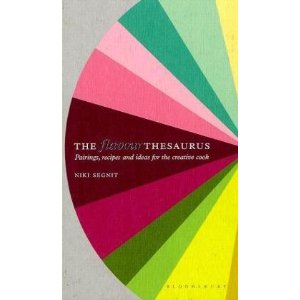
The reason for such excess is Niki Segnit’s ‘The Flavour Thesaurus’. It’s given me idea’s, mostly idea’s about baking so far and I get caught that way quite often, but still I’m really taken with this book, and it has a lot more to it than cake. What first attracted my attention about this book was Segnit’s use of a flavour wheel; flavour wheels are popular in my line of work – we use them for wine, whisky and beer tasting, mostly to make it look like what we’re doing is Proper Work (see it must be work - I have a chart) and not drinking in the middle of the day for money. (Tasting really is hard work, and most of my job is moving boxes – I know that’s real work from the quantity of cuts and bruises I collect in a week.) The way I’m used to using these wheels is to identify specific flavours and general characteristics with the aim of identifying and remembering what I’m tasting but I wondered how it would be used in a foodie context.

Much as I’d expect the wheel is broken down into umbrella categories – floral fruity, roasted, meaty...within those categories specific foods, thus ‘earthy’ contains mushroom, aubergine, cumin, beetroot, potato, and celery. Each category becomes a chapter which takes its dedicated flavours and explores their pairing possibilities. Despite my description it’s very exciting. Segnit decided to limit herself to 99 flavours – well, you have to stop somewhere and first impressions are that she’s got it pretty much spot on, more would be too much. She also decided to stick to food pairings rather than more complex combinations and I think this is a part of the real genius of the book for a few reasons.

I’ve spent a lot of time recently pondering on food and wine matching, it’s a big part of my job anyway and part of the homework that was keeping me so occupied a couple of weeks ago was working up endless food and drink scenarios. Concentrating on two main flavours makes matching a much simpler exercise, and if you want to get the most out of your wine this is A Very Good Thing. The discipline of thinking in two complimentary flavours won’t do me any harm either because I do have a habit of trying to complicate things, especially when the safety net of a recipe is removed.

Segnit talks about her collection of cookbooks being both a symptom and a cause of her lack of kitchen confidence, and of feeling bound to follow instructions in a way that made her question if she’d ever learned to cook (rather than simply follow instructions). It’s a point of view which certainly made me question my personal cookbook hoard but the answer that came to me was somewhat different. I’ve amassed a greater collection of books than recipes I actually regularly use. Each new book that comes into my kitchen inspires me; I make elaborate plans for when this or that is in season (and I enjoy it enormously). I’ve filled the Scottish ones garden with herbs so that next year I can make some wonderful sounding thing, but next year I can almost guarantee that work will keep me out of reach of the crucial ingredient until it’s gone over, or I forget what I had in mind for it.

The great thing about ‘The Flavour Thesaurus’ is that it’s making me look at things from the other way around – take an ingredient, think of a complimentary flavour to make them both sing, and if I can’t find a recipe – well if the flavours are basically right together and I keep it simple not much can actually go wrong. I know this all sounds pretty obvious but I don’t think I’m alone in getting stuck on a single idea - this is how we have Lamb (and any other way is wrong)... and that old chestnut from the one you’ve tried so hard to impress with your cooking “it’s not how my mother makes it”!

I could (and most certainly will in a future post) say a lot more about this and that’s before I’ve even got onto Segnit’s writing style; she’s funny, opinionated and knowledgeable. Her likes and dislikes come through, which again I’m inclined to see as a good thing – this kind of book needs and deserves a good big dollop of personality, just as it needs the element of scholarship she’s bought to it. Basically a book that mildly intrigued me is turning into one that’s having a profound effect on how I approach the contents of the fridge – it’s a bit unexpected and really quite exciting.