Sunday, April 5, 2020

Oats in the North Wheat From the South - Regula Ysewijn

Of all the things I'm missing at the moment being able to go to a bookshop for a browse and to buy much anticipated new releases is high on my list (right behind people, and my mum's dog). Ordering online isn't the same, and it's not as if I'm short of things to read anyway, so this has more to do with how I feel about bookshops than the fear of missing out on something new.

I ordered 'Oats in the North Wheat from the South' from Waterstones (who have had some bad press through this, but are also the only real bookshop choice in the city centre, and for that I consider them a local business that needs supporting) just after the shut down, it actually arrived before the official publication date - it's one book that I didn't want to wait any longer for than I had to. It is probably my most anticipated release of the year.

I wrote about Regula's earlier book, 'Pride and Pudding' a couple of weeks ago - it's an absolute delight for anybody with an interest in food history and a love of a beautifully shot photograph. There have been a couple of books in-between - a really lovely celebration of a vanishing culture in 'Belgian CafĂ© Culture', and a useful little book about puddings published by the national trust (but sadly without Regula's photography). 'Oats in the North' is the sort of companion to 'Pride and Pudding' I've been wanting though.

After all that anticipation I haven't been disappointed. It's not so much about the recipes - a lot of which I could find elsewhere, but about everything Regula brings to her books. In this case the most noticeable thing, even more so than in 'Pride and Pudding' is the chance to see how Britain, and British baking traditions look to someone with an outside perspective.

As Dr Annie Gray says in her introduction, I recognise glimpses of the Britain that Regula and her family discovered on holidays, but it's not precisely the Britain I grew up in. There's a really engaging sense (because the descriptions are delightful and flattering) of being explained. Especially when it comes to a Belgian talking about Belgian buns (not a thing in Belgium) for which there are two recipes (19th and 20th century versions). It makes me feel like I'm discovering these things anew, and I like it. I'm also craving toast*. I hadn't really appreciated what a British thing this was

There's also the matter of the research behind each recipe. I love this kind of hands on food history - the sort I can bake myself. I particularly like that where a recipe has evolved a lot over the decades more than one version is included, as with the Belgian buns, and the bits and pieces of information about cooking conditions in those older kitchens. There's also an acknowledgment of the role slavery played in bringing sugar and other ingredients here.

There's a bit to think about with that, too much to fit into this post, but it's important to understand how that history is just below the surface of everyday life, right down to the treat that is an iced bun, or a cake.

The photography is as ever a treat to look at (I've never seen an Aberdeen buttery look beautiful before), and the range of recipes is excellent, especially if you're after carb based comfort.  Even just reading about Sally Lunns and Fat Rascals is comforting right now. I made the Welsh Cakes though. A friends grandmother used to make these when I was a child and they were the best thing. She also made excellent scotch pancakes (also known as drop scones), which are not mentioned. Both properly want a griddle and are so good whilst still warm. Welsh Cakes are the first thing I'm going to make.

I'm so pleased I got this book now. It's sustaining both to read, and to bake from, and for me at least is a reminder of happier times past, and to come.

*Not an easy thing to get at the moment. It turns out the heat of last summer was enough to kill instant yeast packets I had, so the dough I made today isn't rising. I've added a spoon of sugar and another old packet of yeast and it's doing something, but I'm not quite sure what. It's also the last of my white bread flour which is proving hard to replace right now.

Friday, April 3, 2020

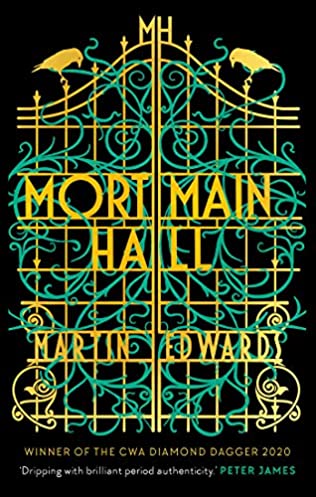
Mortmain Hall - Martin Edwards

Anybody who made it through yesterdays quite long post dedicated to my favourite drinks references in 'Mortmain Hall' will probably already have gathered that I enjoyed this book. I never doubted that I would after 'Gallows Court' (the first in the series) and was very pleased to be invited to join the blog tour again for this one.

I mostly know Martin Edwards through his work with The British Library Crime Classics series, and the two books he's written about the history of Golden Age detective fiction. There can be few people better qualified to write a something set in 1930, and possibly the best thing about these books is how much fun Edwards has with doing that.

We get wealthy, mysterious, Rachel Savernake and smart young journalist Jacob Flint again, this time investigating a series of cases where people just might be getting away with murder. But how, and why. Who is working behind the scenes to make this happen? Rachel isn't the only person who has noticed something is amiss, there's also the criminologist Leonora Dobell (pen name Leo Slaterbeck) who has an agenda of her own...

Everything comes to a head at Mortmain Hall, a deliciously gothic setting, in the teeth of a storm and better yet with all the suspects gathered in the library for the big reveal. There are a lot of things that go into making these books work so well, one being that they are very much an homage to Golden Age fiction, full of references and jokes. In that respect 'Mortmain Hall' reminds a little of some of the Detection Club efforts - specifically 'Ask A Policeman' where the various contributors swap their usual detectives.

The plot also matters, and 'Mortmain Hall' delivers something deliciously twisty, with plenty of red herrings and sub plots along the way, followed by a satisfactory conclusion. It works perfectly well as a stand alone piece, and if you know nothing about the era beyond seeing a couple of Agatha Christie adaptations (is it possible that there's anybody who hasn't seen at least one episode of Marple or Poirot?).

For anybody with a deeper interest in the period there is a treasure trove of reference to puzzle out. I've read enough to have recognised some of them, and to suspect more, but if I was minded to there's much more to chase up and analyze than what the characters choose to drink. The addition of a clue finder at the back is a happy reintroduction. It doesn't make much sense until you've finished the book so there are no spoilers, but it does mean you can look back and see how the clues built up.

I also really like the characters of Rachel and Jacob. Rachel is intelligent, beautiful, rich, and utterly ruthless, it's that final quality that gives her the moral ambiguity that makes her so interesting. She's intriguing, and attractive, but not necessarily likable, and I think that's a real strength. Jacob by contrast is more human, almost smart enough to keep up with Rachel, but prone to making silly mistakes when confronted by a pretty face, and with an entirely conventional moral compass. As friends they have an excellent chemistry that has a lot to offer in what I hope will be a long series of mysteries.


Thursday, April 2, 2020

Booze and Books - A Mortmain Hall post

I'm officially blogging about Martin Edwards latest book, 'Mortmain Hall' tomorrow, but with time on my hands to chase details I thought I'd talk about the drinks in it today.

One of the many things I like about Edwards' Rachel Savernake series (Gallows Court is the other one) is that they're exceptionally well crafted homages to golden age crime, not pastiches, and as such there's no shortage of references for the reader to decode if they feel moved to.

Drinks being my particular area of interest I can't help but notice them when they're mentioned (something I get a kick out of in older fiction generally is the opportunities it presents to trace drinking fashions).

About a third of the way through 'Mortmain Hall' I remembered to jot down the drinks that seemed particularly interesting, starting with the Chivas Regal that Rachel offers the journalist, Jacob Flint. I like this detail, in 1930 (when the book is set) blends were what people drank because their brand names were a sign of quality. Chivas Regal isn't just a premium blend, it's one of the oldest, and got in early as a royal supplier. It's a choice that sets a tone of tradition and quality that seems right at home in a townhouse library.

There are two types of sherry that get a particular mention - Oloroso and Bristol Cream. The oloroso is consumed in the Bookman's Club where Jacob is interviewing publisher Charles Bonnell. The atmosphere is redolent of  leather upholstery and tobacco which seems an altogether fitting background for my preferred style of sherry. There's a lot I could say about Oloroso but basically it's a dryish sherry characterised by a nutty flavour. It's fortified early so you don't get the yeasty character of something like a fino, and it can be aged in the barrel for a very long time. It gets darker with age, and slightly oxidized which gives its own particular character.

Charles Bonnell seems like a man who likes the best, so I'm imagining a particularly well aged sherry with an oxidized character suggestive of elegant decay and just maybe a slightly self conscious display of sophistication to awe Jacob with.

Later on Bristol Cream is served at Mortmain Hall. The Bristol Cream of the 1930's would have been a little bit different to the blue bottles everybody buys at Christmas. It's a mix of oloroso and much sweeter Pedro Ximenez. Sweetened Oloroso had been popular since the late 18th century. Quality is generally agreed to have declined since the 1950's when the method of production changed somewhat. In a 1930 context it seems like the perfect blend of old fashioned, old money taste, with a sweet edge that's a nice match for the gothic atmosphere of Mortmain Hall.

Gin and Tonics get plenty of mentions, as do Scotch and Soda's, but I was pleased to see a Gin Ricky in the mix too (gin, the juice and shell of half a lime, plenty of ice, top with sparkling water. It's a good low calorie alternative to sugary tonic water in these housebound times, and also my preference for summer drinking). Krug is mentioned in relation to the clandestine club, with the reflection that it's well priced there. As Krug is a super premium champagne this is a relative statement but is one of the hints that the club operates as a honey trap (I don't think that's a spoiler given it's name).

My favourite drink mention is a Boulevardier, also drunk at the Clandestine club. This is a mix of whisky, red vermouth, and Campari - a whisky version of a Negroni if you like, but rounder and more mellow. As far as I can find it originated in Paris around about 1930, but wasn't popular enough in England to make it into the Savoy cocktail book (neither does the Negroni). Again the suggestion of something Parisian and perhaps a little louche, as well as the flavour combination of bitter and sweet is very evocative of character.

And finally, a wine mystery. One character enjoys a bottle of full bodied Grenache with some venison. I asked Martin Edwards about this and he told me that he lifted it from a contemporary menu. I'd love to know what the wine was. French and Spanish wines tend not to use grape varietals in the name, and even Australian (Empire) wines of the day would borrow the manes of their old world counterparts.

I really hit the books to try and solve this riddle yesterday but got nowhere. Just such a Grenache would be an excellent wine to drink with venison. Something from the Cotes du Rhone is most likely, possibly from further south, maybe just maybe a Spanish wine? I might not have got an answer, but I had a lovely, somewhat dusty, time reading wine history and remembering how interesting I find it - for which a proper thank you is due to Mr Edwards for providing so much entertainment in these trying times.

Monday, March 30, 2020

You Let Me In - Camilla Bruce

Because I mostly read older books I forget how difficult it is to write about brand new books without giving spoilers, so bear with me here. 'You Let Me In' is Camilla Bruce's debut novel, and it marks her out as an author to watch. 

The blurb describes two stories and asks which one might be true. The dark fairy story of children lost to the woods and magic, or one of an emotionally and physically abused child. It seems to me that these are only two of the stories hinted at, and that both, or neither might be true. Which is appropriate for any novel narrated by a character called Casandra. 

As with her namesake this Cassandra is destined not to be believed either, her narration not so much unreliable as it is a set of stories or possibilities in which nothing is certain. Not even the basic premise that is the elderly author Cassandra Tipp has disappeared, or that this is the last in a string of family scandals that start with her being a difficult, possibly disturbed child, go through the gruesome death of her husband, and the later murder of her father and suicide of her brother. 

Part of the narrative is Cassie's assumptions about how her niece and nephew will react to the manuscript they're reading, but they're assumptions so the reader has no sense of meeting Janus and Penelope (names further freighted with meaning). That uncertainty is part of the charm of the book, not least because it helps distance the reader from what Cassie is telling us happened to her.

There's a lot here to admire and enjoy in Bruce's handling of the themes she's chosen. I enjoyed her representation of fairies, here they have a vampiric quality, they're dead things that choose a live thing to feed from - everything from trees to little girls. It's a clever mixing of folklore elements that works really well as the book unfolds. I also appreciate the way she alludes to violence and abuse without much detail.

Hints are enough, more than enough to build a picture, and when details do come they're macabre to the point of fantastic, which again helps keep them at a distance - like something out of a fairytale. This uncertainty also allows Bruce to explore the reactions and behaviour of Cassie and her family without having to explicitly judge or explain them, although there are enough implications for the reader to do so.

In this instance the claim on the back of my proof copy that this is about the elusive nature of truth, and offers "an unnerving glimpse of the dark place that might exist between reality and somewhere else entirely" feels entirely justified. Truth is a slippery thing, an interpretation of facts rather than a fact in itself and I thoroughly enjoyed reading Bruce explore that.

Friday, March 27, 2020

Knitting - Halimede and Shetland Wool Week

If nothing else all this time at home has been excellent for knitting, something I find really calming, and which also makes me feel like I've achieved something with my day, so good all round. I knitted Ysolda's Halimede shawl/hap in what is record time for me (10 days rather than a month).

I saw this on Instagram where I instantly fell in love with it. It had been a club pattern, but fortunately for me it was released to buy a few days later. It's taken me a while to get to it, but last week was clearly the right time and I cast on.


It's the first time I'd started a hap using a garter tab, or top down construction, so it was all quite new and exciting to me. Especially the reveal once I'd finally cast off and could properly see what I'd made. I'm more in love with the pattern than ever now, to the point that I think I need to knit it again, immediately, in a colour that will photograph better so I can more easily share that love. I've actually started something else but it's only a matter of time before I come back to this pattern.

Apart from getting my head around the garter tab (bear with me, that final reveal still feels like a bit of a magic trick) there was also the challenge of a new set of instructions. The way patterns are charted is fairly standard, but within that I guess every designer has their quirks. I don't think I'd really noticed that before but it's certainly reminded me that of the value of swatching and taking a moment to really think about what's in front of me.

Beyond that I used Jamieson's spindrift which is a lighter gauge of yarn than the recommended sports weight, but it's what I had and I'm happy with the fabric it's given me. I'm particularly pleased with the span of this hap, even more so for the relatively modest amount of yarn used (150g or 6 balls). I also pinned it out to points rather than gentle scallops along the edge, more or less without thinking, but I'm happy enough with that result too. It's definitely a project I can recommend if you have some yarn stash to get through.

Meanwhile the new patron for Shetland Wool Week has been announced. Wilma Malcolmson is an amazing designer, her colour combinations exquisite. I've bought quite a few (a lot) of her hats, scarfs, and gloves, over the years because they're irresistible. Her hat patterns is available to download for free, there are going to be knit-a-longs on facebook, and for anyone who wants a good introduction to fair isle knitting it would be an excellent place to start.

Wednesday, March 25, 2020

Miss Ranskill Comes Home - Barbara Euphan Todd

The last few days have had an oddly dream like quality. Because I'm currently unemployed and live alone I was already quite socially distanced, so this week hasn't been the big adjustment I was expecting. The current restrictions and advice on movement has taken away a lot of the worry I had about what my parents might be doing which is balancing much of the anxiety prompting news, and there's not been any difficulty buying food round here.

More than that, the weather has been magical, and the park on my doorstep fairly empty - certainly empty enough to keep a good 20m away from the half dozen other people who seem to be in it at any one time, so it's felt reasonable to sit there for a while. Most of the students have gone home so the area is almost deserted, the quiet is a bit eerie at times, but also pleasant. I don't know what's coming next, but for now things are okay.

I know they're okay because I can finally concentrate on reading more than a few pages at a time and can lose myself in a book again. I started reading 'Miss Ranskill Comes Home' weeks ago after stumbling on 'Move Over Darling' whilst channel hopping. I had it in my head that the plots were similar. They are not which became obvious immediately. A third of the way through there were things I really liked about the book, but Nona Ranskill was not one of them. I found her continued bemusement hard to swallow.

A month later I doubt I could have found a more apt book to be reading. Miss Ranskill is a well to do member of the gentry, a spinster well on the wrong side of 30 when she falls overboard and gets washed up on a desert island sometime in the summer of 1939. Her only companion is a carpenter washed up some time earlier after a similar accident. Four years later he dies of a heart attack just as the boat they've been building is almost completed. Miss Ranskill, alone, has little choice but to set off in the boat.

She's picked up by a British Convoy and lands back in an England she doesn't in the least understand. It's 1943, she's suddenly in the middle of a war she didn't know existed, and faced with a lot of rules and conventions that seem senseless to someone who has made do with next to nothing for 4 years.

With the last couple of weeks behind us I have to admit that Miss Ranskill's struggle to take in the enormity of war conditions is more or less on the nose, as are the caricatures of deeply patriotic types intent on policing the actions of others.

The plot, such as it is, doesn't really hold up to much scrutiny, but the relationship between Miss Ranskill and the Carpenter is a wonderful celebration of platonic friendship, and the skewering of social mores is elegantly done. The talk about rationing has a particular resonance whilst people still seem to be panic buying, and as someone who has bought their first tin of canned peaches in at least 15 years this particular quote struck home:

" 'But, Edith,' Protested Miss Ranskill, 'in peace-time we never had so much bottled fruit.'
   'In peace-time we could buy all the tinned fruit we wanted'.
   'But we scarcely ever did buy any.' "


Monday, March 23, 2020

Rhabarberstreuselkuchen - Classic German Baking

After what felt like a more or less normal, if quiet, weekend I was expecting the reality of social isolation to really hit home this morning. That's partly because I live above a pub that's now closed, and overlook the car park and offices of what I think is still the finance department of a university.

The pub is closed to customers, but I'm directly above the cellar where quite a bit of work is still going on (I guess they're cleaning lines and shipping out beer, whatever it is involves moving a lot of kegs around and is noisy). The car park, and this surprises me more, is about a third full. Closing down the university clearly doesn't yet extend to administrative staff. All in all it feels like a fairly ordinary Monday from inside my flat.

That it looks so normal makes me want to go out and do normal things - I hope this is where the illusion would end, but as I'm going to stay away from the town centre today I won't find out just yet. I had a decent fruit and veg shop on Friday and Saturday and really don't need anything (although I'm starting to fantasize about an M&S crusty baguette).


One thing I bought in a fit of enthusiasm was quite a lot of forced rhubarb from the market. The stall had six stalks left and I got the lot because I can't judge the weight of rhubarb by eye and it looked so tempting. It turned out to be a kilo and by yesterday was threatening to go limp.

I could have baked it all, which was the original plan, to have on yoghurt or porridge, but as there was so much of it I made a cake too. The recipe is from Luisa Weiss' 'Classic German Baking', and for a while has been one of many slightly disappointing rhubarb cakes I've made. They're generally wetter than I like and no amount of tinkering has ever got me results I've found really satisfactory.

Yesterday I had a break through. The recipe suggests that you can also add streusel topping. It's a simple cake recipe and the addition of more butter and sugar hadn't really appealed before, but as both the butter I had in the fridge, and almonds in the cupbourd were getting near their best before dates it seemed like a good time to use them. And now I've got a cake which is amazing.

The disappointment with previous cakes was probably a combination of personal preference, the way my oven works (always as personal as preferences) and maybe the exact size of my cake tin. Regardless a slightly crunch topping has made everything good again.

The Mandelstreusel is 100g of plain flour, 50g of ground almonds, 100g of granulated sugar, a 1/4 teaspoon of salt, and 100 g of unsalted butter. Mix in a bowl until bean and pea size bits form. It doesn't need to be to uniform. This quantity will apparently cover an up to 33cm cake tin, but I saw no reason not to use all of it. Luisa says it will also freeze well for up to 3 months. Something worth remembering for if I have left over almonds and butter (after say Christmas baking).

The simple rhubarb cake recipe is 500g of rhubarb trimmed and cut into chunks of roughly a centimetre then tossed in 2 tablespoons of granulated sugar. Pre heat the oven to 180C and line a 25cm springform tin with baking paper letting the sides hang over the edge). Beat 125g of granulated sugar with 100g of unsalted butter until pale and fluffy. Beat in 2 eggs, 1 at a time, add the grated peel of half a lemon, and half a teaspoon of vanilla extract.

Sift together 190g of plain flour, 2 teaspoons of baking powder, and 1/4 of a teaspoon of salt. Add half of this to the butter mix, loosed it with 60ml's of milk, and add the rest of the flour, beating until just combined.

Put the batter in the cake tin, it'll make a very thin layer. Top with the rhubarb which will make quite a thick layer, finish with the Mandelstreusel which should more or less cover the rhubarb. Bake for just over an hour, or until the streusel topping is golden brown. Allow to cool completely before removing from the tin. If you're not using the streusel topping add an extra spoon of sugar to the rhubarb, and it should bake in an hour.

Sunday, March 22, 2020

Pride and Pudding - Regula Ysewijn

Turns out it's not just in politics where a week can be a long time, even my ideas about cooking are changing daily as it becomes increasingly clear that some things (flour particularly) are going to be in short supply. Weirdly, whilst I might not be able to bake them for myself, there's no shortage of cakes or biscuits for sale locally, so sweet treats are hardly off the menu, even if they should be.

My current treat of choice is a hot chocolate, made with actual chocolate, and in the morning (I'm drinking one as I write). It's a nice thing to have an hour or two after breakfast especially when the mornings are still cold. It's also a habit that I picked up after reading Sue Quinn's wonderful 'Cocoa' which has a few recipes for really good hot chocolate. It's another cookbook with a lot of reading in it which I think is what we need at the moment.


There are also Kate Young's Little Library Cookbooks which are great companions for anyone stuck at home (she also has a ridiculously decadent hot chocolate recipe - although that's definitely more of a late afternoon affair). Her books are great for recommending novels, and for encouraging the game of picking the perfect food to accompany your reading. There are worse ways to amuse yourself and it's a lot more productive than following threads on twitter about panic buying and the like*.

If you have them this is also probably the moment that Niki Segnit's books are really going to come in useful. Wondering what to make out of the odd collection of ingredients at the backs of cupboard and fridge? A flavour thesaurus won't go amiss for helping put things together. 'Lateral Cooking' is really good for when it comes to having to expand a repertoire of skills and ideas too. 'Lateral Cooking' is another book that makes interesting reading beyond a search for current inspiration, and actually I think I'm going to spend some serious time with it over the next few days.

In the end though it's Regula Ysewijn's 'Pride and Pudding' that's going to be my choice of the day. She has a baking book due out on the second of April which I've been looking forward to for such a long time (Oats in the North, Wheat From the South). I'm hoping it'll be easy enough to get hold of. I'll wait as long as I have to, but it's helpful to have little things like this to anticipate.

There are a few reasons to love Ysewijn's books. There's her meticulous research into the history of what she's looking at, the way she makes food history so immediate coupled with the acknowledgement that you might not want (or be able) to cook everything in a book like 'Pride and Pudding'. It doesn't make it any less interesting to read about. But the real cherry on top is her beautiful photography, especially images inspired by Dutch and Flemish old masters, and in Pride and Pudding, the equally delicious design work by her husband, Bruno Vergauwen. 

I'd really love one of Ysewijn's food photographs in my wall, her work is delightful, and it's more than a bonus in her books. It brings the pleasure of childhood delight in picture books (the really good ones that were considered a bit of a treat to get off the shelf and that you were told to be careful with) 
back to my adult world.


*I'm trying not to get sucked into the negative side of the platform. But for all the downsides it's an excellent place to keep up with bookish news - I'm finding so many recommendations there right now. To chat, and because none of my immediate family are on it, get out some immediate worries about them. 

Saturday, March 21, 2020

Beyond The North Wind - Darra Goldstein

Yesterday became somewhat overwhelming, so much has changed in a week and I definitely had a wobble. This morning feels more positive. My plan for the weekend is to spend a lot less time on Facebook and Twitter - both have been really good for chatting to people and on Twitter seeing a lot of great book recommendations, but there’s also a lot of conspiracy theories, panic spreading, and lashing out which I’m finding much less helpful.

Whilst I’m in a positive mood the sensible thing to do is to make good use of the mute option. I’ve also been considering how I use Twitter (more likes, less retweets), and the next thing to do is to write some actual letters or postcards to the people in my life who I think might be worst hit by the reality of self isolation (those who don’t routinely use the internet for a start).

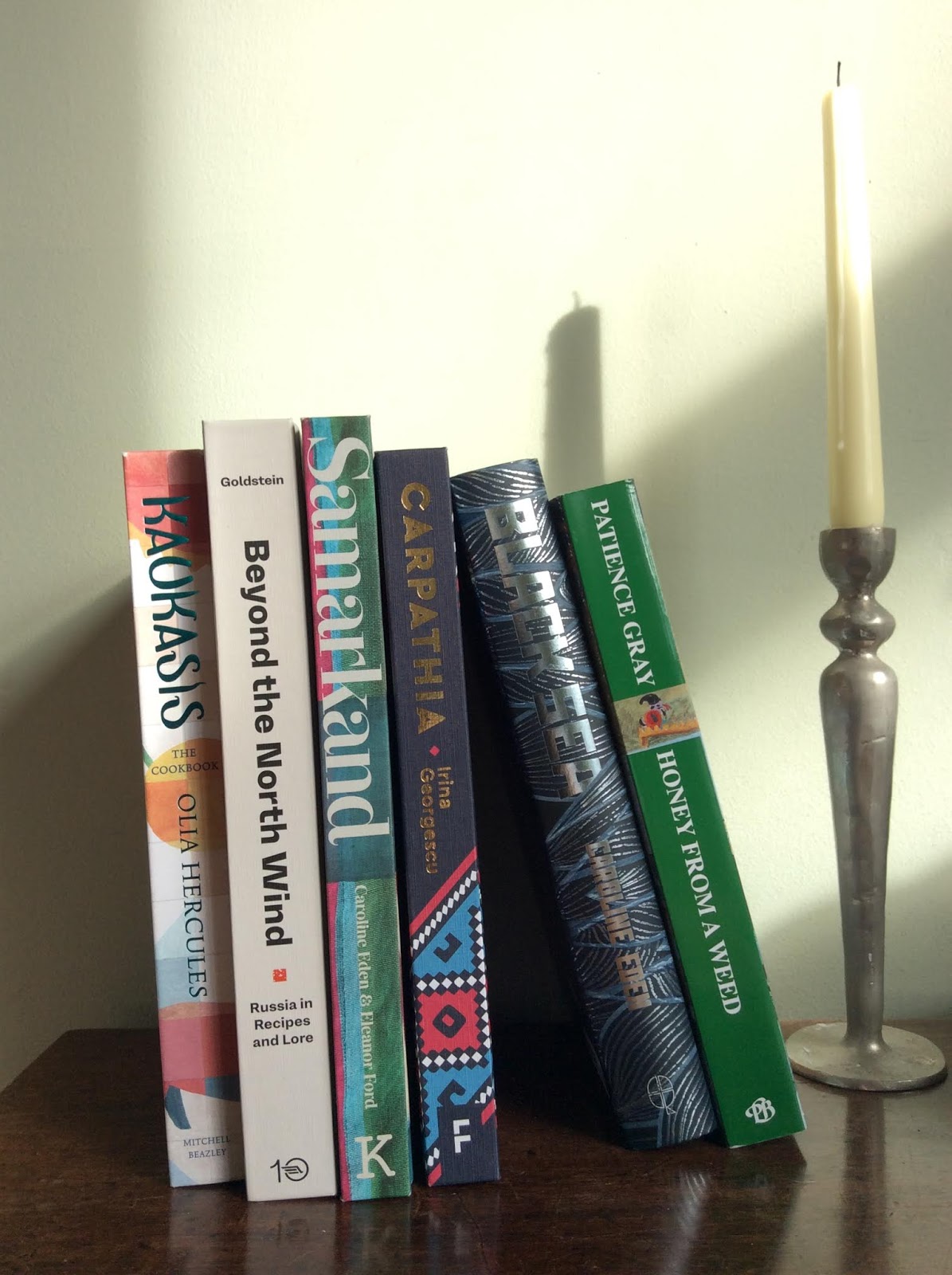
I can also do some armchair and kitchen travelling. Cookbooks that blur the lines between travel writing, history, and memoir are not new - it’s more or less what Elizabeth David was doing, it’s a big part of Jane Grigson's charm, and of Claudia Roden’s amongst others. I particularly love Patience Gray’s ‘Honey From a Weed’ too which I’ve pulled off the shelf to dip in and out of again.

Looking at my own shelves though the cookbooks which best mix travel and food have a definite theme. I’m not sure if this particularly reflects my interests, or if it’s irresistible writing sparking an interest but I’m happily following the travels of Caroline Eden and Eleanor Ford along the Silk Route in ‘Samerkand’, ‘Black Sea’ which is Eden’s brilliant book that travels and eats its way between Odessa, Istanbul, and Trabzon. Olia Hercules ‘Kaukasis’ is full of love for the places she goes and the people she meets.

I can’t remember if it was via Olia Hercules Instagram or Caroline Eden’s that I saw Irina Georgescu’s ‘Carpathia’, but it’s been a reason to be cheerful this week. It was definitely Caroline Eden who recommended Darra Goldstein’s ‘Beyond The North Wind’ which I’m really enjoying.

‘Beyond The North Wind’ is Russia in Recipes and Lore, and at the moment it’s the lore bit that I’m really enjoying. It’s a book that aims to unearth the most deeply Russian flavours. It goes beyond the Soviet era, and perhaps the best way to sum it up is this from the introduction, “I sought to discover the benefits of austerity rather than its limitations”. That’s an austerity imposed by climate, and soil as much as anything else.

There are things I want to cook in here, things I want to taste whilst I read, but right now I can open a window, sit on the sill with the sun on my back so that I don’t see the car park outside, and lose myself in altogether different places. The wind is even in the east today.

Friday, March 20, 2020

Sour - Mark Diacono

What a difference a week makes. So far Leicester city centre has been reasonably calm and getting fresh food hasn’t been a problem, but panic buying is spreading so that might change. The current situation is not encouraging, and seems designed to promote panic, uncertainty, and anxiety.

Meanwhile there’s rightly a lot about the heroism of NHS staff which is fully deserved, but not quite as much celebration of people working in supermarkets. This was my job for a decade, I know how physically demanding it is, how badly paid, how little respect employees get, and how important for all our comfort and well being.

I don’t really know what to do at the moment. For now I have the luxury of being able to stay at home, my redundancy payment will see me through for a while yet, and I’m diabetic which makes me vulnerable to this virus. On the other hand I could probably walk into a job in Tesco round the corner for the next few months which would be a financial relief because once that redundancy has gone I have nothing and long term the job situation is looking - well who knows, but it’s hard to be optimistic.

The supermarkets are recruiting like mad, and as far as I can see the people who will take those jobs are either doing it because they want to help the rest of us get food on the table, or because they have no choice but to put themselves in a role that will make social distancing really hard. All for something close to minimum wage. I think this is a fairly big deal which deserves even more attention than it’s getting.

And now to ‘Sour’. Mark Diacono is a brilliant food writer - warm, engaging, interesting, and inspiring in equal measure. Reading ‘Sour’ has been a pleasure, never mind cooking from it. It’s another book that’s been great at expanding my idea of what I might want to cook and eat. It’s also got a lot of information about fermenting and pickling in it.

That’s a whole lot of help in how to make the best of the food you have and cut down on waste. It’s also the chance to master what would be a new kitchen skill for me (fermenting) which is something I  can look forward too. Which I need right now in the interests of good mental health, and I assume there’s quite a lot of us in the same boat.

Perhaps even more than the practical elements of the book though is it’s tone. Reading it feels like having a friend in the room with you. It’s full of funny anecdotes about more or less everyday things and memories. Fiction is great to get lost in, but books like this are company in an entirely different, and very helpful, way.