Friday, July 30, 2021

English Pastoral: An Inheritance - James Rebanks

I bought The Shepherds Life for my father a couple of years ago, meaning to read it when he was done with it, and still meaning to. English Pastoral came from a friend and initially sounded more my cup of tea, so it's been my first experience of reading Rebanks in something longer than a tweet. 

I'm a little bit torn here because I'm definitely a fan, but as somebody with a farming background, a decade working for Waitrose behind me, and who's read a good chunk of Adrian Bell, Dorothy Hartley, and Clare Leighton I was hoping for something a bit more in-depth. On the other hand, I'm also the converted and this is an excellent place to start for people less familiar with the issues, and there was plenty for me to think about as well.


The first section of the book, Nostalgia is Rebanks remembering the farming world of his youth, and the way his grandfather did things - the mood is similar to the way that Adrian Bell was writing in the 1930s, Dorothy Hartley's books are more food-focused, and Clare Leighton's woodcuts are a glimpse of the country and calendar that she knew - all of them are worth looking up, Bell and Leighton are both in print with Little Toller who are excellent for classic nature and agricultural writing. 

It says a lot about the march of progress in farming that the world of the old-fashioned Fell Farms Rebanks remembers in the 70s and early 80s are not so different from the Southern pre-war farms that those earlier writers describe. I'm much of an age with Rebanks and can trace the same sort of change in Shetland, although that has as much to do with the advent of oil money as changes in technology as crofting will always be a marginal activity. 

The middle section of the book, Progress, was more interesting to me. The point is that the majority of farmers, like the majority of people, are decent folk trying to make a living keeping the rest of us fed. It's not an easy job and we all need to better understand that. In this book, supermarkets are the villains - and to an extent that's fair, but having seen how they work from the inside I'd also say they're as much victims of a broken system as farmers are. 

Food has been in a deflationary cycle for years now, we think because the discount supermarkets are so cheap that other retailers are ripping us off, they're not, and nothing about the system we have is sustainable. For meaningful change, we need action from the government, producers, retailers, and consumers. Wages have to go up at the bottom of the scale so that people can afford to pay a fair amount for food, we all need to agree on what we want this country to look like, stop wasting as much, buy and consume more responsibly where we can afford to, and be better educated about all of this. 

The final section, Utopia discusses the farm as it is now, and anybody who follows Rebanks on social media (and you should) will be aware of the work that's gone into changing things, improving the soil and biodiversity, making something fit to pass on to the next generation. He's honest about the cost of this as well - or the lack of profit in it. Rebanks is lucky - lucky that his books have been a hit, and for the profile that gives him. It means he can probably afford to farm the way he wants, and he knows that's not a luxury that's open to everybody. It's a sad reality of farming that hard work and good management, whilst it'll go a long way, isn't enough - you need a certain amount of good luck to make it work. Bad luck, bad weather, bad prices, can break you all too easily. 

Meanwhile, it's not all bad news - this is above all a hopeful book. One which shows that there's still a lot to learn, and ways to marry progress and tradition that are both efficient and sustainable. My own hope is that our experience of Brexit and Covid will change our expectations of what we'll find on our supermarket shelves and that we'll collectively be more receptive to some of the conversations that need to be engaged in. We need food, but we also need a landscape better suited to dealing with the consequences of a changing climate, and to understand the complexity of the system we live in and the need for diversity within it.

In short, an excellent starting point if you want to understand more about farming, and a rewarding one to read even when you do. 

Wednesday, July 28, 2021

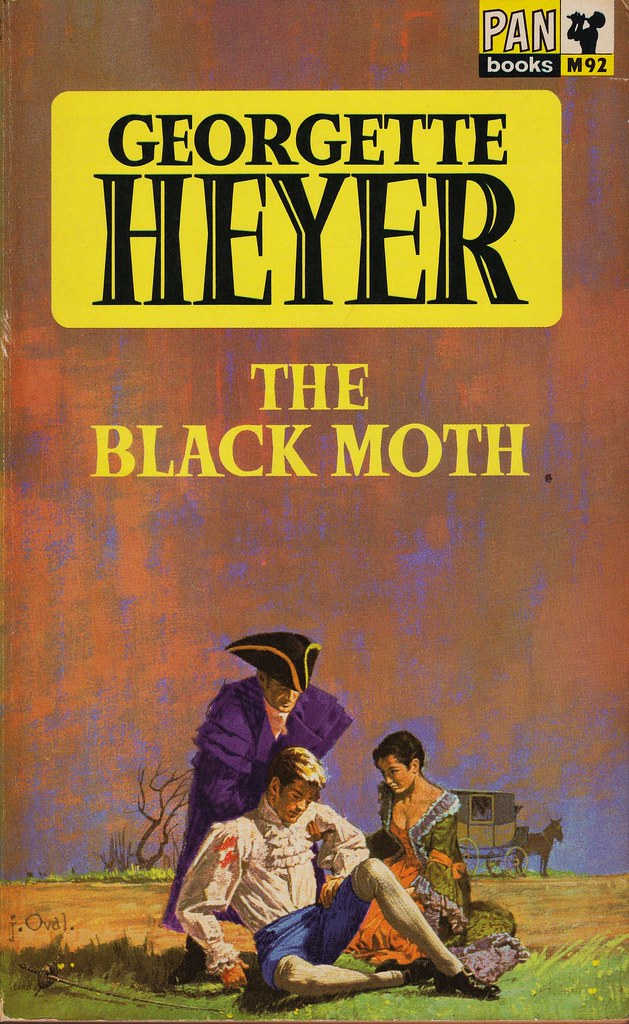
Some Georgette Heyer Book Covers

This is the centenary year for Georgette Heyer's 'The Black Moth', written when the author was 17 to amuse her convalescent brother, she kept on writing until 'A Lady of Quality' came out in 1972, with 'My Lord John' published in 1975 the year after she died.


Anybody who comes here regularly will have a sense of how much of a Heyer fan I am, she's been my go-to comfort read since I was first introduced to her when I was about 12/13 and she has never let me down in all the years since. I'm not blind to her faults, or indifferent to the changes in attitudes which make some passages in her work hard to read now, but they don't cancel all the things she's so very good at for me. More than that, the way her attitudes, and I assume the attitudes of her readership, do and don't evolve over the 50+ years she was writing are one of the things I find fascinating about her body of work. 

Those changes of attitude are also reflected in the covers her books get, even more so since her death, and publishers were presumably completely free to go with whatever they liked, or thought would do. The most obvious change is in what the expectations of romance and specifically historical romance as a sub-genre have come to be. 


I don't think of Heyer as a romance writer in the Barbara Cartland sense (I wonder how well known Barbara Cartland is these days, I see her books are still available) although Cartland plagiarised Heyer's work, or in the Julia Quinn sense - although the success of the adaptation of Bridgerton is surely bringing new readers to Heyer (they'll find a lot more humour and a lot less sex). She's more in the Robert Louis Stevenson mold - somewhere between the high drama of 'The Master of Ballantrae and the comedy of The Wrong Box. She definitely has plenty in common with Baroness Orczy of The Scarlet Pimpernel fame and leans heavily in her early novels on the writers who would have been popular (even racy) in her youth.


In Heyer the romance is only one element, adventure, mystery, comedy, and often a love of historical detail, all get more or less equal weighting throughout her books and the early covers represent this with a steady shift as the years pass to something more gendered and borrow in its expectations.


My own collection of Heyer's were bought in the late 1980s, they're Pan editions, the cover design is fairly horrible, and I have a real sentimental attachment to them. I really love the incredibly lurid Pan covers that preceded them (fabulous) and would be tempted to collect these along with the first edition hardbacks if I had space and money to make it feasible. The Pan covers may be high camp and pulpy but they capture the adventure element, the hardback editions are a decent indication of the comedy of manners you'll find within. 


The more recent covers have mostly been uninspired. The detective novels have done okay, and I really quite like the ones that have appeared regularly around Christmas in the last few years, but stock images of Victorian art are dull and tell me nothing about what's going on in the book. The newest jackets which I think are on about half a dozen titles match the covers the Bridgerton series has, and again say nothing about the books themselves. It'll be interesting to see what The Folio Society does with 'Venetia' later this year (but their editions always look good) but the one that's really caught my attention is the hardback to celebrate the centenary of The Black Moth.


This is a beautiful book, the cover is the colour of mulberry juice (I realised after covering myself in mulberry juice). It's robust but light, has a glorious mustard/gold ribbon - the colours are worthy of some of the costumes Heyer describes, no dust cover to get damaged, an exemplary introduction and afterwords, print friendly to middle-aged eyesight, and a highwayman motif that does justice to the story and its spirit. There's even a handy list at the front which breaks down the books into categories - I'm struggling to find praise high enough for this edition.

What I will say is that if all 33 of the Georgian and Regency novels appeared like this, each with a bespoke introduction (or even just the Philippa Gregory one here) I would find the £428.67 to buy them all (at £12.99 each) it would be worth it and then some. 

Tuesday, July 27, 2021

Mulberry Jelly - Caught Red Handed

My local museum has a remarkable garden which is somewhat underappreciated (all the better for those of us who do appreciate it), the jewel in its crown is a very old mulberry tree (there are also figs, a white mulberry, a quince, pomegranate, medlar, and a citrus I've not satisfactorily identified) which is something quite special. 


It's been a working garden in one form or another since the 17th century, there's a Mulberry tree in Bradgate park (one time home of Lady Jane Grey) that is supposed to have been one of the 15 bought to this country by Sir Walter Raleigh. In a very unscientific way I'd like to speculate that this tree is almost as old, and maybe even a daughter of the Bradgate tree. The museum tree as it stands looks like just one small surviving part of a really old one, it has a siren-like pull for me.

I've had fruit from it before, once with the permission of the gardener, and once without actually asking anyone if it's okay. The gardeners are normally quite amenable if you can catch them, but the desk staff inside the museum have sucked in a breath and talked about health and safety (mostly in regard to some ferocious stinging nettles around the tree with a sideline in doubt as to whether the fruit is edible). There was no gardener around yesterday so working on the principle that it's easier to ask forgiveness than permission I started picking - it was alright whilst I was under the tree, you can't be seen from the outside, but the berries are only just ripe and I was spotted working my round to the back of it.

The attendants were lovely, they would have been well within their rights to ask me to leave, but didn't, and let me carry on for which I'm really grateful. I managed to get 600g of mulberries, which filled the tub I had and seemed a good place to stop trespassing on the museum's hospitality. 


The reason mulberries are not a familiar fruit to us now (the attendants had no idea what they were) is that they're not the easiest thing to handle. They're very delicate and very ready to fall off the tree and stain anything they touch a deep purple. They don't keep well, are full of seeds, tend to attract small spiders and a ton of other little bugs, and get themselves a fie covering of web tangled up in the little hooks that cover them. The season for picking them is quite short too, so they're easy to miss if you can't grow them yourself. 

I've a handful of recipes for mulberries, mostly from Mark Diacono's books, but as with blackberries and raspberries I find the pips quite annoying, and the one year I made mulberry vodka I was put off by the number of dead things floating in it. They can't really be washed for fear of losing too much of the juice or diluting it. In the end, a jelly seemed like the best use of my prize - I promised some to the museum people if it worked out.

The branches on old mulberries droop towards the ground making a leafy sanctuary, inside this tree smelt amazing - a combination of bindweed sap where I'd pulled it apart to stop it climbing all over the tree, crushed nettles, and mulberry leaves and berries. It also ticked with a sound that I hope was not ominous - the bark was clearly full of insects getting on with their business.

I don't often get to pick the fruit I end up cooking, and it does change how much I value it, it also gave me more time to think about exactly how I'd use it. Mulberries are a relatively low pectin fruit, they need some help to set, and because of the smallish quantity of berries I had, it made sense to use apples to bulk it out as well as add pectin, rather than relying on jam sugar. When I got home with my prize I had a good look through 'The Closet of Sir Kenelm Digby Opened' as he's a similar vintage to the garden and tree.

It turns out that in between his career as a soldier, sailor, pirate, philosopher, medical theorist, diplomat, bibliophile, collector, mathematician, writer, alchemist, scientist, cook, and lover he didn't have anything to say about mulberries, but he has plenty to say about jelly. Certainly enough to make me feel that any I might make would be a suitable hommage to this tree's long life.

The advantage of a jelly is that it's boiled, strained, and boiled again so apart from picking over the fruit to make sure it's reasonably clean and not rotten. You don't have to do much to it or worry about what might be lurking in it (all obvious bugs were safely removed with the help of an elder leaf and left safely in the garden).

To my 600g of berries, I added 400g of Bramley apple roughly chopped to make a kilo of fruit, put it in a pan with 400ml of water - using the quantities suggested by Pam Corbin in her River Cottage preserving book. She does mention mulberries in a handy fruit chart which indicates if you'll need more pectin and how much water to add for different kinds of fruits along with other useful tips for making an excellent jelly. I then bought this to a boil and simmered it gently for around 40 minutes. 

When it was properly mushy I strained it through a muslin cloth (weighed down from the top with a plate to extract more juice without squeezing the fruit - another Pam hint) and considered reboiling the leftover mush to extract a little bit more juice - but didn't. I wanted the flavour to be as strong as possible. After a couple of hours straining I added the juice of a lemon to the liquid I had - about 700ml's in total and weighed out sugar at the ratio of 450g to every 600ml of liquid. Following Pam's advice I bought the liquid to a boil before adding the sugar - Sir Kenelm actually says the same, he also uses lemons in his jelly making. And then boiled rapidly until it looked thick enough to start doing wrinkle tests. When I was happy (about 10-15 mins in) I took it off the boil, skimmed it, and potted it into sterilised jars - I got 2 and a 1/2 of them. 


I'm pleased with the results the lemon juice combats the sweetness of the sugar a little, and the earthy, cabernet franc wine flavour of the mulberries comes through well - the apples don't interfere with it. The museum attendant was delighted with the jelly and scones I took them. Searching around online I've found a few recipes that use different herbs and spices, but I like the emphasis on the fruit flavour here and if I had enough jelly it would be an easy matter to reheat a jar of it with some extras if I wanted. I might consider adding mint which I think would emphasise the winey notes of the mulberries, and I'd try this with apple cider vinegar to make a sharper condiment too. Overall it's an excellent way to make the most of a smallish quantity of mulberries if you're lucky enough to find some. 


Monday, July 26, 2021

Regency Buck - Georgette Heyer

This post will almost certainly contain spoilers, but for a book that's been popular, and in print, since 1935 I think that's okay. Regency Buck has been the most recent Georgette Heyer Readalong title (a favourite of the organiser, but not, it turns out of many others). There are very few Heyers I don't feel some level of affection for, and I've come out of this slow read with more respect for this particular title than I had going into it.


One reason for the general group skepticism over this one is that it doesn't work brilliantly as a romance, and most of the readalongers are there for the romance - which is fair when you're in a group dedicated to a woman famous for writing romances. For me, the evergreen appeal of Heyer is that romance is only a part of what she offers - and I will argue repeatedly and at length to anybody who will listen that I don't think it's even her primary focus. Or if she is a romance writer it's in a more old-fashioned sense and along the lines of Robert Louis Stevenson (who can also be very funny). 

The traditional romance convention would be that a heroine needs rescuing, preferably by a hero who can materially improve her lot along with being generally splendid and capable. The heroine here (Judith) is young, beautiful, exceptionally wealthy, independently minded, and a little bit spoilt. The situations she needs help with are mostly social and given her fabulous wealth fairly low stakes. The hero opens the book by being an absolute arse who assaults Judith when he first meets her. They then find out that he's her legal guardian - which is awkward and emasculating. Judith has an annoying younger brother, Perry, who somebody is trying to do away with. Not because he's exceptionally annoying (a bad, but tempting, motive for murder) but because his equally vast inheritance will go to Judith and somebody would rather have all the money than half of it and an annoying brother-in-law. 

The book is set in 1812, but as much fun as the historical details are they're basically fancy dress. This novel belongs firmly to the 1930s. Heyer wrote and then later suppressed a couple of contemporary novels, as well as 12 detective novels. I've read the murder mysteries, and think they're fun, some of them are really good, others are a bit clunky - they use more or less the same characters as the historical novels, but stay truer to genre conventions. I'd really love to read the suppressed books to see what kind of issues she covers in them.

Which brings me to the point of what I like so much about Regency Buck. Judith should have the world at her feet, but she's constantly held back by a double standard that says men can behave thus, but women cannot and it's still depressingly familiar. Time and again we see Judith subjected to unwelcome attention from much older, more socially powerful men, who won't take no for an answer. Heyer makes no comment on Judith's experiences, but the way she writes these scenes doesn't leave much doubt that she's experienced this kind of behaviour, and that she didn't like it.

It's a bold move to have the hero behave the way he does when we first meet him too, it makes a lot of sense in terms of the thriller elements of the plot, and back in the day (or even the 1980's when I first read this) it might have been seen as something of a romantic fantasy - but Heyer never quite lets him off the hook for it, we know he knows he's behaved badly, and that it will colour their relationship and understanding of each other to the last chapter. 

Heyer has plenty of faults, and she's really not going to appeal to plenty of people, but I find her consistently interesting as well as entertaining, especially in the way she shows women's lives. Maybe it's because she doesn't offer much commentary that what she's written has stayed so relevant - but the nature of her observations coupled with the way she pushes at the boundaries of the romance genre say more than enough. Regency Buck will never be a favourite, but it turns out it'll almost certainly always be worth reading one more time. 

Sunday, July 25, 2021

The Crooked Shore - Martin Edwards

This is book 8 in Martin Edwards Lake District Mysteries, but the first one I've read. The first thing I can say about it is that it works really well as a standalone, the second is that I'm now inclined to go back and read the rest of them - which is a mark of quality on both counts.

For those like me, who didn't know, the Lake District Mysteries focus on cold cases and a team headed by DCI Hannah Scarlett. In this book, they're looking into a disappearance from 20 years previously when a young woman disappeared, assumed murdered. The man accused of killing her is never convicted, but after the court case ends up committing suicide. His son does the same thing in the same place 20 years to the day later which precipitates the new investigation.


The cold case angle also appeals to me - in real life murders at the rate they happen here somewhere like the Lake District are unlikely, but I can willingly suspend my disbelief to imagine a scenario where one old tragedy sets a domino effect of continuing violence and disturbance across the decades. It doesn't take any suspension of disbelief to know that holding a grudge is something that people excel at, especially in small communities where memories are long. 

I have to be careful to avoid spoilers here, but I like the way the narrative follows a few different major threads and wondering how they'll all come together. It's an almost guaranteed page-turner for me, especially when I'm enjoying all the different elements (which I did here) and the way everything finally resolved in this was essentially satisfying. 

This is important given how much was going on, and if I had a criticism it would be that just before the end it felt like there might be a bit too much happening - and that isn't really a criticism, part of the fun of a book like this is the roller coaster feeling of gathering momentum. It works because of that cold case element - these are things that have been coming to a head for decades. There are also some interesting questions about moral and legal guilt which I'd love to discuss at length but can't if I'm to avoid those spoilers.

What I can happily talk about is the way Edwards uses small details to really good effect. There's the Lake District setting (which I suppose is actually a really big detail) which even if you don't know the area well (I don't, I've passed through it, but rarely stopped, and when I have it's been raining) still gives a tremendous sense of place. Some of the locations are fabricated, but it's still possible to pull up a map and follow what's going on. My favorite detail however is that one of the characters wears Givenchy's L'Interdit. It wasn't a scent I knew so I found it - and did it ever give me some opinions about the character who uses it. 

The thing about flavours and scents in books for me is that they make reading a much more layered, interactive, thing. You can use a lot of words describing someone's personality,  you can also offer a scent and let the reader work it out from there. My views on L'Interdit may be miles from Martin Edwards, although as it turned out my conclusions were fairly accurate - it wouldn't have mattered if they weren't. The fun of this is in the speculation that it gives rise to, and the treasure hunt aspect of tracking down a perfume, or a drink, or visiting a place that I've read about.


Thursday, July 22, 2021

What's That Bird - Rob Hume

Despite the heat, the feeling that everything is breaking down around me (mostly just the water pumps and my phone, but those are significant), the fact that my partner is merrily sailing around the northern isles without me (he gets long holidays, I have to find a job), and the state of the world we're living in - this has been a good book week.

I was lucky enough to get a review copy of the centenary edition of Georgette Heyer's 'The Black Moth', which is both beautiful and comes handily equipped with an excellent introduction and a couple of good afterwords. I have a lot to say about this, I'll keep it for another day. I've also had a couple of new British Library titles land - Margot Bennett's 'The Widow of Bath' and 'Cornish Horror's', and today hit it lucky in The Works.


I love a discount book shop, and I love The Works which is one of the few which has survived. I found 3 decent holiday-type reads for £5 - though they'll probably be more rainy day reads than holidays and a very simple bird book of the sort that I've been looking for forever. Or so it feels.

It cost me £3 and is the sort of book I'm half tempted to buy in bulk to leave in car glove boxes, give to youngish children, and generally scatter around. It's by no means comprehensive but I knew it was what I'd been looking for when I opened it at 'Small Brown Birds' and it passed the crucial test of having Dunnocks displayed next to Sparrows - which a grown-up bird book wouldn't dream of doing. 

I spent hours trying to work out what a dunnock was last spring - they're like sparrows but obviously not sparrows, and if I ever knew what they were I'd forgotten. A book that will easily slip in a pocket and tell me the difference between a fieldfare and a redwing is as good a place to start as any - once I've mastered the small brown birds in here I can move on to something more scientific. 

Meanwhile, the illustrations are admirably clear, and breaking the classifications down into habitat (Close to home, woodland and forest, open country, water and waterside, coast and sea) is handy. As is the gallery of birds identified by colour. I'm genuinely delighted by this find (even if it doesn't bother with barn owls - we all know what they look like anyway) and will be looking at other books with Rob Hume's name on for my next step up. If you want a really good beginners book this one ticks all the boxes for me. 

Tuesday, July 20, 2021

The Nordic Baking Book and The Nordic Cook Book - Magnus Nilsson


To add to the water pump woes, and the heat that makes it feel all but impossible to do anything, there's now an absolutely massive spider at large in my flat. It scuttled out from underneath some clean washing this morning, hid in a pair of knickers that I felt inclined to bin, and finally disappeared under the clothes horse and probably into a duvet cover. I don't wish the spider ill, but I really don't want it jumping out at me again, or in my bed (or underwear, even if I'm not wearing it at the time), and I'm at a bit of a loss as to how to deal with it. I think I'll have to take the duvet cover into the corridor (too many more spiders hanging around the windows for me to shake it out without getting more of them) which will probably freak out the neighbours if they see me - and honestly, it's Far Too Hot for this nonsense.

It's also too hot to finish sorting out the books to go (loading them into the back of a car isn't going to be fun) but I need to get them gone. Two books that are staying are Magnus Nilsson's The Nordic Cook Book and The Nordic Baking Book, although I did wonder about them briefly. I have recently found myself referring to both of them quite a bit, but before that, they'd remained more or less untouched since my sister gave them to me as Christmas presents.

The problem is, they're huge and unwieldy with it for practical kitchen use. A lot of what The Nordic Cook Book covers is the sort of thing (puffin, fulmar, pilot whale) that I wouldn't dream of cooking even if I could - and to be fair I don't think there's any expectation that you might cook these things, but they're a significant part of the food culture in places like Faroe and Iceland so it would be wrong to leave them out. I've also been told by people who have used the baking book that some of the recipes are unreliable.

The question of reliability is an interesting one - the original Mrs Beeton was a collection of things sent in and not necessarily checked, and I've seen some fairly suspect looking recipes in my time in magazines and compendium, but now we not only really expect things to work, but don't necessarily have the knowledge to be able to tell when they won't or know how to fix them. 

Because of how I use these books, reliability isn't my main criterion. I think the instructions for how to braid dough (which I do want to know) are sound, and the history of some of the other things I've looked up is convincing enough for me to quote with confidence (and references). The idea that things might not work is still off-putting, but the insight into a culture is enough to carry me through. 

And now, if I can just catch the merest breath of breeze after weeks of having these weighing down my desk I might just find the energy to haul them back to their normal resting place under the kitchen bookshelves, because they're too big to fit on them (I'll also be praying that's not where the giant spider has taken up residence, nothing about today will be improved by squashing it with kilo's of cookbook).

Monday, July 19, 2021

The Jumper update

It is ridiculously hot here, which I do not like at the best of times. As the pumps that bring water to my flat keep cutting out and can't be properly fixed until next week it is far from the best of times. All too frequently there's no water to flush toilets, wash hands, drink, wash in, or wash clothes in - a poor combination when it's over 30C.

It's also far too hot to knit, sweaty wool as well as being unpleasant to handle is going to be a moth magnet, so progress is grinding to something of a halt about 2/3rds of the way through my first sleeve. It should cool down by the weekend, but until then I'm not going to stress about it - although I do want to finish this as soon as possible so I have an accurate idea of how much yarn I used (my partner is sailing up to Shetland soonish - whilst I'm stuck here in the heat with flies for company - I can't give him a shopping list if I don't know what I need).


So far I've used less yarn than I had anticipated which is good news and found that a 25g ball goes further than I expected when I've stuck in something random for fun. I'm also finding knitting the sleeve okay, although it demands much more concentration than the body when everything was complete repeats. It's one thing remembering to make the increases, but having to work out exactly where I am at the start of each row is slowing me down even more than the heat. Carefully annotating the pattern and judicious use of stitch markers is helping. 

I had meant to talk about colours in this post, but they're all the bright red is glowing like hot coals in the evening sun and I just can't do it tonight - so, next time. 

Friday, July 16, 2021

Apricot, Cherry, and Fennel Bread - Cooking in a time of Covid and Brexit

I spent a lot of yesterday in the kitchen (thankfully a reasonably cool day compared to the forecast for the rest of the week) working through some of the recipes in Sicilia which had really appealed to me, really over-cooking for the one other person who was coming round and generally having a lovely time of it. I found quite a quantity of significantly out of date things at the back of the cupboard (gone now), didn't find a whole lot of things I thought I had on hand, and rediscovered a stash of dried cherries I had put somewhere safe to use last Christmas (they were fine).

It's been a while since I've tried to shop for specific ingredients rather than just buying what looked good, or is available, and then deciding what to do with it. Trying to find specific things was an eye-opener. I don't know if the reason is Covid, Brexit, or a combination of the two but there's nothing like looking for something to show up how many gaps there are on the shelves. I couldn't get the pasta shape I wanted, shelled pistachios weren't to be had, or dried figs. I wanted fresh figs too, which could be had for a price I decided to pass on in M&S, but to be fair they're not really in season yet. Everywhere I looked ranges had shrunk, there were gaps, and prices have gone up. 

Not being able to get shelled pistachios, dried figs, or even a particular pasta is a small thing, very much a first-world problem, but it's a much more real signifier of lost liberties and changed times to me than wearing a mask will ever be. Not being able to physically travel isn't much of a hardship whilst I can't afford to do it anyway, and it was always a luxury, but not being able to travel in my own kitchen is hard.


Regardless, I still managed to make a really good bread based on the fig and fennel loaf in Sicilia, and despite all the gaps I hadn't anticipated in my own store cupboard. It's the kind of loaf that seems just a little bit too expensive to buy when I see them out and about (it's not so much the bread, but the desire for a bit of goats cheese to put on it, and maybe a really good honey, and perhaps some properly ripe fruit to have with it, and then should it be the fancy butter... and then I've spent £20+ on what was meant to be a simple lunch for 1).

Making a couple of loaves at home removes the temptation to buy everything else in the deli to go with them, and is deeply satisfying. This is a recipe that can be played around with a lot, the dough can be made the night before you want it and left to prove in the fridge so if someone is prepared to get up early to knock it back and stick it in tins it'll be ready for a later breakfast or brunch. It's also a very good reason to buy Sicilia, which has plenty more where this comes from. This isn't exactly the version from the book, but rather the one that I cobbled together. 

Take a tablespoon of golden sugar, a 7g sachet of instant yeast, and 300ml of lukewarm water. Mix them together and set aside for 10 minutes or until it's bubbling away happily. Meanwhile put 200g of dried fruit chopped into smallish bits (I used cherries - no need to chop - because I had them, I had planned on it being apricots, the original recipe uses figs) 150g of fresh fruit, in this case, it was apricots, 50g of dried cherries (I thought about opening a bag of cranberries to mix it up, but the cherries needed using) 375g of strong white flour, 60g of rye flour, 60g of wholemeal flour, 1 1/2 tablespoons of fennel seeds, 1 tablespoon of pumpkin seeds, and 2 teaspoons of fine sea salt, in a bowl and toss together.

Add the yeast mix, stir well, and knead for about 5 mins - this is a wet and sticky dough. transfer the dough to a clean bowl, drizzle well with olive oil and turn it to cover thoroughly, cover with a damp tea towel and leave to double in size.

Turn the dough out and knead gently for another couple of minutes, set aside whilst you butter and flour a couple of 450g/1lb tins. Half the dough, form it into 2 balls, roll well in polenta or semolina, and place in the tins to prove for around another 40 mins under their cool tea towel. 

Heat oven to 200C, 180C fan, gas mark 6. Sprinkle the tops of the loaves with water and put them in the oven. Reduce the heat to 190C, 170C fan, Gas mark 5. Bake for 40 -45 mins until the tops are golden and the bottom sounds hollow when it's tapped. Cool on a rack for 10 mins before removing from the tins, allow to cool completely, and enjoy. 

I also made a strawberry almond and rosewater cake (with Vanilla because no rosewater) with a strawberry compote - again very good, and an amazing pistachio pesto which is by far the best pesto I've ever eaten. I'm loving this book. 


Tuesday, July 13, 2021

Sicilia - Ben Tish

This book turned up out of the blue when it was still cold and miserable back in the spring (thank you very much Bloomsbury), I spent a couple of happy hours leafing through it, and then because the publication date wasn't for months (10th of June) it worked it's way to the bottom of the pile of books on my desk where I'd notice it every few days and think I must look at it again.

That time has come only a month and a bit after it was published, and only partly because I've got a friend coming round for dinner on Thursday and was looking for some inspiration as to what to feed her. I'm still in the process of sorting out books to go and will admit that I've looked at 'Sicilia' providing a sturdy base for teetering paperbacks over the last couple of months and wondered if I really needed it. Mediterranean food isn't generally my biggest enthusiasm, I like it, but it doesn't catch my imagination in the way some other cuisines do - partly due to the difficulty of getting really good, ripe, fruit and veg in supermarkets here. Cheese is often disappointing too, and the lack of a herb garden doesn't help.


'Sicilia' is a mind changer though. It helps that it starts with a bread chapter, and I'm a very big fan of bread, especially these kinds of breads - the sort that are meals in themselves. They come filled with sausage or as lasagne bread, made with grapes wine, and honey, they cross over into cake territory stuffed with lemon, orange, cranberry, and nuts, with more nuts to top. And there's a fig and fennel bread that I'm absolutely making this week (despite being a fig sceptic) because it's precisely the kind of thing I'm craving in this weather - something that will be perfect with a little ricotta or goats cheese spread on it, fruit, honey, and maybe a little charcuterie on the side. 

If I wasn't stony broke I'd send a copy of this to my stepmother as it's both very much her kind of food and full of things it would be great to eat in a larger family group (all those breads, a whole lot of fritters, some very nice things done to fish, her polytunnel produce comes up trumps at times like this too). As it stands I'll be off to the international supermarket tomorrow to buy reasonably priced pistachios (it's relative) to make a pesto with.

This book also hits the mark as 'A love letter to the food of Sicily' which makes up its subtitle. The love for Sicily comes across on every page. Some of the recipes aren't traditional, but all of them are an homage to the flavours and history of the place. A pork, orange and mint ragu with fusilli is an example of this and is something I'll make as we move into autumn. 

There's a lot to like here, both in the way it evokes a sense of place, and for the selection of dishes - most look easy enough to make, some are calculated to impress, others to be regular favourites, plenty are both simple and frugal, and all of them feel like that thing I've missed the most in the last 18 months - food to share.