After what felt like a more or less normal, if quiet, weekend I was expecting the reality of social isolation to really hit home this morning. That's partly because I live above a pub that's now closed, and overlook the car park and offices of what I think is still the finance department of a university.
The pub is closed to customers, but I'm directly above the cellar where quite a bit of work is still going on (I guess they're cleaning lines and shipping out beer, whatever it is involves moving a lot of kegs around and is noisy). The car park, and this surprises me more, is about a third full. Closing down the university clearly doesn't yet extend to administrative staff. All in all it feels like a fairly ordinary Monday from inside my flat.
That it looks so normal makes me want to go out and do normal things - I hope this is where the illusion would end, but as I'm going to stay away from the town centre today I won't find out just yet. I had a decent fruit and veg shop on Friday and Saturday and really don't need anything (although I'm starting to fantasize about an M&S crusty baguette).
One thing I bought in a fit of enthusiasm was quite a lot of forced rhubarb from the market. The stall had six stalks left and I got the lot because I can't judge the weight of rhubarb by eye and it looked so tempting. It turned out to be a kilo and by yesterday was threatening to go limp.
I could have baked it all, which was the original plan, to have on yoghurt or porridge, but as there was so much of it I made a cake too. The recipe is from Luisa Weiss' 'Classic German Baking', and for a while has been one of many slightly disappointing rhubarb cakes I've made. They're generally wetter than I like and no amount of tinkering has ever got me results I've found really satisfactory.
Yesterday I had a break through. The recipe suggests that you can also add streusel topping. It's a simple cake recipe and the addition of more butter and sugar hadn't really appealed before, but as both the butter I had in the fridge, and almonds in the cupbourd were getting near their best before dates it seemed like a good time to use them. And now I've got a cake which is amazing.
The disappointment with previous cakes was probably a combination of personal preference, the way my oven works (always as personal as preferences) and maybe the exact size of my cake tin. Regardless a slightly crunch topping has made everything good again.
The Mandelstreusel is 100g of plain flour, 50g of ground almonds, 100g of granulated sugar, a 1/4 teaspoon of salt, and 100 g of unsalted butter. Mix in a bowl until bean and pea size bits form. It doesn't need to be to uniform. This quantity will apparently cover an up to 33cm cake tin, but I saw no reason not to use all of it. Luisa says it will also freeze well for up to 3 months. Something worth remembering for if I have left over almonds and butter (after say Christmas baking).
The simple rhubarb cake recipe is 500g of rhubarb trimmed and cut into chunks of roughly a centimetre then tossed in 2 tablespoons of granulated sugar. Pre heat the oven to 180C and line a 25cm springform tin with baking paper letting the sides hang over the edge). Beat 125g of granulated sugar with 100g of unsalted butter until pale and fluffy. Beat in 2 eggs, 1 at a time, add the grated peel of half a lemon, and half a teaspoon of vanilla extract.
Sift together 190g of plain flour, 2 teaspoons of baking powder, and 1/4 of a teaspoon of salt. Add half of this to the butter mix, loosed it with 60ml's of milk, and add the rest of the flour, beating until just combined.
Put the batter in the cake tin, it'll make a very thin layer. Top with the rhubarb which will make quite a thick layer, finish with the Mandelstreusel which should more or less cover the rhubarb. Bake for just over an hour, or until the streusel topping is golden brown. Allow to cool completely before removing from the tin. If you're not using the streusel topping add an extra spoon of sugar to the rhubarb, and it should bake in an hour.
Monday, March 23, 2020
Sunday, March 22, 2020
Pride and Pudding - Regula Ysewijn
Turns out it's not just in politics where a week can be a long time, even my ideas about cooking are changing daily as it becomes increasingly clear that some things (flour particularly) are going to be in short supply. Weirdly, whilst I might not be able to bake them for myself, there's no shortage of cakes or biscuits for sale locally, so sweet treats are hardly off the menu, even if they should be.
My current treat of choice is a hot chocolate, made with actual chocolate, and in the morning (I'm drinking one as I write). It's a nice thing to have an hour or two after breakfast especially when the mornings are still cold. It's also a habit that I picked up after reading Sue Quinn's wonderful 'Cocoa' which has a few recipes for really good hot chocolate. It's another cookbook with a lot of reading in it which I think is what we need at the moment.
There are also Kate Young's Little Library Cookbooks which are great companions for anyone stuck at home (she also has a ridiculously decadent hot chocolate recipe - although that's definitely more of a late afternoon affair). Her books are great for recommending novels, and for encouraging the game of picking the perfect food to accompany your reading. There are worse ways to amuse yourself and it's a lot more productive than following threads on twitter about panic buying and the like*.
If you have them this is also probably the moment that Niki Segnit's books are really going to come in useful. Wondering what to make out of the odd collection of ingredients at the backs of cupboard and fridge? A flavour thesaurus won't go amiss for helping put things together. 'Lateral Cooking' is really good for when it comes to having to expand a repertoire of skills and ideas too. 'Lateral Cooking' is another book that makes interesting reading beyond a search for current inspiration, and actually I think I'm going to spend some serious time with it over the next few days.
In the end though it's Regula Ysewijn's 'Pride and Pudding' that's going to be my choice of the day. She has a baking book due out on the second of April which I've been looking forward to for such a long time (Oats in the North, Wheat From the South). I'm hoping it'll be easy enough to get hold of. I'll wait as long as I have to, but it's helpful to have little things like this to anticipate.
There are a few reasons to love Ysewijn's books. There's her meticulous research into the history of what she's looking at, the way she makes food history so immediate coupled with the acknowledgement that you might not want (or be able) to cook everything in a book like 'Pride and Pudding'. It doesn't make it any less interesting to read about. But the real cherry on top is her beautiful photography, especially images inspired by Dutch and Flemish old masters, and in Pride and Pudding, the equally delicious design work by her husband, Bruno Vergauwen.
I'd really love one of Ysewijn's food photographs in my wall, her work is delightful, and it's more than a bonus in her books. It brings the pleasure of childhood delight in picture books (the really good ones that were considered a bit of a treat to get off the shelf and that you were told to be careful with)
back to my adult world.
*I'm trying not to get sucked into the negative side of the platform. But for all the downsides it's an excellent place to keep up with bookish news - I'm finding so many recommendations there right now. To chat, and because none of my immediate family are on it, get out some immediate worries about them.
Saturday, March 21, 2020
Beyond The North Wind - Darra Goldstein
Yesterday became somewhat overwhelming, so much has changed in a week and I definitely had a wobble. This morning feels more positive. My plan for the weekend is to spend a lot less time on Facebook and Twitter - both have been really good for chatting to people and on Twitter seeing a lot of great book recommendations, but there’s also a lot of conspiracy theories, panic spreading, and lashing out which I’m finding much less helpful.
Whilst I’m in a positive mood the sensible thing to do is to make good use of the mute option. I’ve also been considering how I use Twitter (more likes, less retweets), and the next thing to do is to write some actual letters or postcards to the people in my life who I think might be worst hit by the reality of self isolation (those who don’t routinely use the internet for a start).
I can also do some armchair and kitchen travelling. Cookbooks that blur the lines between travel writing, history, and memoir are not new - it’s more or less what Elizabeth David was doing, it’s a big part of Jane Grigson's charm, and of Claudia Roden’s amongst others. I particularly love Patience Gray’s ‘Honey From a Weed’ too which I’ve pulled off the shelf to dip in and out of again.
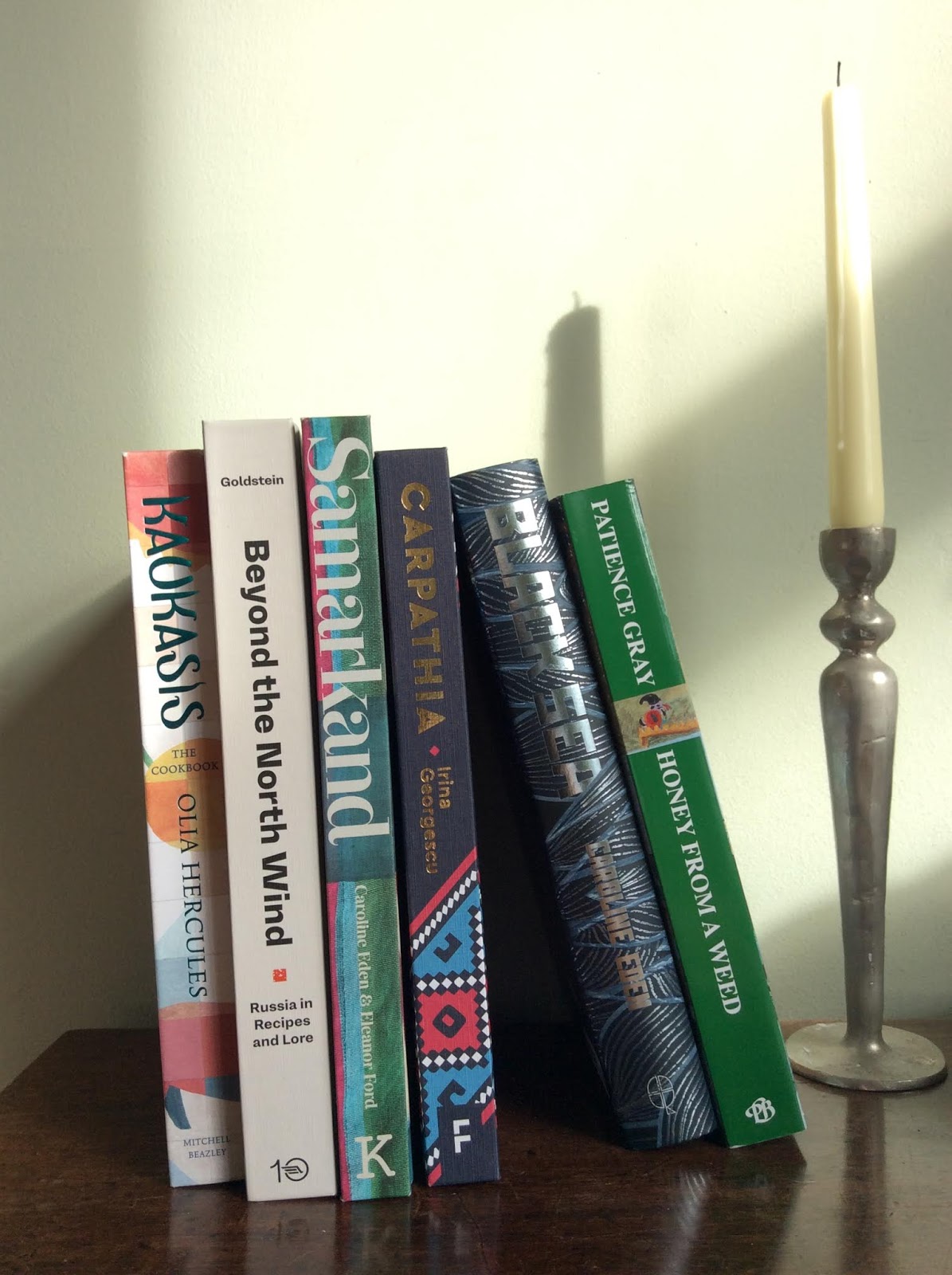
Looking at my own shelves though the cookbooks which best mix travel and food have a definite theme. I’m not sure if this particularly reflects my interests, or if it’s irresistible writing sparking an interest but I’m happily following the travels of Caroline Eden and Eleanor Ford along the Silk Route in ‘Samerkand’, ‘Black Sea’ which is Eden’s brilliant book that travels and eats its way between Odessa, Istanbul, and Trabzon. Olia Hercules ‘Kaukasis’ is full of love for the places she goes and the people she meets.
I can’t remember if it was via Olia Hercules Instagram or Caroline Eden’s that I saw Irina Georgescu’s ‘Carpathia’, but it’s been a reason to be cheerful this week. It was definitely Caroline Eden who recommended Darra Goldstein’s ‘Beyond The North Wind’ which I’m really enjoying.
‘Beyond The North Wind’ is Russia in Recipes and Lore, and at the moment it’s the lore bit that I’m really enjoying. It’s a book that aims to unearth the most deeply Russian flavours. It goes beyond the Soviet era, and perhaps the best way to sum it up is this from the introduction, “I sought to discover the benefits of austerity rather than its limitations”. That’s an austerity imposed by climate, and soil as much as anything else.
There are things I want to cook in here, things I want to taste whilst I read, but right now I can open a window, sit on the sill with the sun on my back so that I don’t see the car park outside, and lose myself in altogether different places. The wind is even in the east today.
Friday, March 20, 2020
Sour - Mark Diacono
What a difference a week makes. So far Leicester city centre has been reasonably calm and getting fresh food hasn’t been a problem, but panic buying is spreading so that might change. The current situation is not encouraging, and seems designed to promote panic, uncertainty, and anxiety.
Meanwhile there’s rightly a lot about the heroism of NHS staff which is fully deserved, but not quite as much celebration of people working in supermarkets. This was my job for a decade, I know how physically demanding it is, how badly paid, how little respect employees get, and how important for all our comfort and well being.
I don’t really know what to do at the moment. For now I have the luxury of being able to stay at home, my redundancy payment will see me through for a while yet, and I’m diabetic which makes me vulnerable to this virus. On the other hand I could probably walk into a job in Tesco round the corner for the next few months which would be a financial relief because once that redundancy has gone I have nothing and long term the job situation is looking - well who knows, but it’s hard to be optimistic.
The supermarkets are recruiting like mad, and as far as I can see the people who will take those jobs are either doing it because they want to help the rest of us get food on the table, or because they have no choice but to put themselves in a role that will make social distancing really hard. All for something close to minimum wage. I think this is a fairly big deal which deserves even more attention than it’s getting.
And now to ‘Sour’. Mark Diacono is a brilliant food writer - warm, engaging, interesting, and inspiring in equal measure. Reading ‘Sour’ has been a pleasure, never mind cooking from it. It’s another book that’s been great at expanding my idea of what I might want to cook and eat. It’s also got a lot of information about fermenting and pickling in it.
That’s a whole lot of help in how to make the best of the food you have and cut down on waste. It’s also the chance to master what would be a new kitchen skill for me (fermenting) which is something I can look forward too. Which I need right now in the interests of good mental health, and I assume there’s quite a lot of us in the same boat.
Perhaps even more than the practical elements of the book though is it’s tone. Reading it feels like having a friend in the room with you. It’s full of funny anecdotes about more or less everyday things and memories. Fiction is great to get lost in, but books like this are company in an entirely different, and very helpful, way.
Thursday, March 19, 2020
Bread - Daniel Stevens
Bread baking is the perfect occupation for people spending more time at home. It doesn’t demand any sustained effort from the baker but it will punctuate a good few hours of your day, and it’s a particularly satisfying thing to make.
There are no shortage of books* on the subject, but this River Cottage Handbook by Daniel Stevens is my personal favourite. It’s not the first bread book I had - that was a Ballymaloe one, but I never really clicked with it beyond making soda bread. I also have an Elizabeth David book on English Bread and Yeast cookery, but it’s out of reach on the top shelf in the kitchen and I don’t think I’ve ever properly read it (the spine certainly looks un cracked or creased from my position some feet below it).
When I bought this book back in 2009 finally learning how to bake a decent loaf was a mission, and it absolutely got me doing that. The instructions are clear, the science is explained, and there’s a great range of recipes to get started on. These include some nice things to do with left overs (bread and butter pudding is surely the food of the Gods) as well as oatcakes, scones, shortbread and similar. It’s everything the beginner needs.
It’s been a long time since I made much bread, back in November when I finished work it was something I really looked forward to doing again, and then found I’d lost the knack of. At the risk of sounding overdramatic I felt like I’d lost something really important. A couple of loaves later I had the touch back - and that in turn is deeply satisfying.
I have always loved the rhythm of bread making - a few minutes of activity followed by longish waits as it proves. Knocking back the dough during the proving process takes about as long as it does to make a tea or coffee. I really love the way the dough is so clearly a living thing and the way you quickly learn how to feel when it’s right. The scent of it is pretty good too.
I might even get another sourdough starter underway - although sourdough isn’t perfect for a household of one. It’s amazing if you can reliably get through a loaf every day or two though, and is a delightful thing to make. For near instant results soda bread is perfect, and then there’s a whole world of muffins, crumpets, buns and other treats to be explored.
It’s also worth considering that whilst industrially produced bread might not particularly agree with you, home made bread might. That’s certainly been my experience. The extra time that hand made bread gets is one part of why, as is the lack of chemical additives designed to prolong shelf life. And again, I find the process of making bread good for my state of mind as well as being good to eat.
*A lot of general baking books will also cover bread, as will a good few general cookbooks, there is also the Internet. I’ve not bought any more specialist bread books, tempting as they are, because this one more than covers all my bread making needs.
Wednesday, March 18, 2020
Solo - Signe Johansen
Today’s cookbook for strange times is ‘Solo, the Joy of Cooking for One’. I don’t know if it’s the best solo cookbook out there, but it’s the me I have, and I like it. I do wish there were more cooking for one books around though, they really need to be more of a thing.
Scaling recipes up is a lot easier than scaling them down, there’s a lot of us who live alone, or cook alone, or who are living in couples, but most recipes I have feed 4, 6, 8... which is a lot of left overs to get through. I’m not a huge fan of batch cooking either - cooking double for a family of 4 makes sense, 8 portions for 1 person isn’t something I find particularly tempting (unless it’s a really good cake, but that won’t keep and isn’t good for me). I find a freezer full of last weeks meals quite a dispiriting prospect.
I’m much more enthusiastic about cooking a biggish bit of salmon (one of Johansen’s suggestions) that can then be used in a number of other things over a couple of days. I’m also really lucky in Leicester in that we have an excellent meat and fish market where it’s easy to buy small quantities - only want a couple of slices of bacon, or a single chop - no problem, not much packaging, and no premium pricing. The quality is good and the prices very reasonable. So obviously the market is almost deserted at the moment.
I really hope it doesn’t close, it’s a much nicer environment to shop in than a supermarket, and reassuringly right now the only person handling what you buy is yourself and the butcher/fishmonger. The choice is better too.
Meanwhile with so many of us stuck at home alone it’s important to establish routines, especially around food - it’s too easy to fall into the habit of living of biscuits and sandwiches (at least I find it so) when days are all more or less the same and there’s nobody to judge you. A book that covers everything from yes, things on toast, through to lazy weekend projects, taking in things to make ahead and some batch cooking along the way is always going to be useful.
Signe Johansen’s Scandi food sensibility (lots of fruit, veg, and fish in here) informs this book, but it’s influences also come from much further afield - it means there’s something for every mood. What I really like about this book though is that it understands the temptation to not really bother, and politely but firmly tells me whilst that’s okay occasionally it really isn’t good enough long term. It’s a reminder a periodically need.
Tuesday, March 17, 2020
From the Oven to the Table - Diana Henry
I got a smart meter fitted last year, and seeing what having the heating on cost me day by day* (and on one terrifying occasion what baking a loaf of bread did) really curbed my oven use. The heating is off now though and the oven back in action and I’m finally been using Diana Henry’s ‘From the Oven to the Table’ a lot. Everything I’ve cooked so far has been a hit, and I’m finding it a great book to be stuck at home with so I’m recommending it here again.
This one came out a couple of months before I was made redundant and so I had bought various store cupboard ingredients in anticipation. The nice thing about this is that despite the ingredient lists looking quite long next to each recipe when I actually come to read through them it turns out that I need chicken thighs and peppers, or a large bunch of dill etc - but I’m sorted for all the other bits.
What I like about Diana Henry’s books generally is that she’s big on flavour with a minimum of fuss. This book is more or less one pot (or baking tray) cooking which needs a minimum of attention once it’s gone in the oven which is an approach I like on principle even when I’m not short of time to fuss around.
That’s partly because there’s a difference between having time on your hands, and being in the mood to make food that’s a major production. Sometimes I like to cook as a distraction from stress, but there are other times when it’s really tempting to live off toast for a week because it’s all a bit much, I can only imagine how that goes if you have a family to feed.
In this book I’m finding a balance that encourages me to make good food. That in turn is mood enhancing, and generally makes everything feel a bit less grim**,which makes good self care easier - a nicely virtuous circle. I’m also going to give Diana’s chicken book, ‘A Bird in the Hand’ a shout out too (and really all her books) as a great way of making those packs of frozen chicken thighs at the back of the freezer look more tempting.
More than that, after success with lamb chops sweet potatoes, peppers and mojo verde (I don’t view sweet potatoes with much enthusiasm, and actively dislike coriander leaf most of the time) I’m almost convinced it’s time to overcome a deep rooted conviction that I don’t like cauliflower. It’s good to broaden my ideas.
*unemployed life
**seeing much less of family and friends, unsure when I’ll get to see dad again (due to distance rather than pessimism) - small and necessary sacrifices under the circumstances, but they still get me down.
Monday, March 16, 2020
Drinking French - David Lebovitz
I’m not self isolating as such, but I’m currently unemployed which amounts to much the same thing in that I’m spending a lot of time home alone. This is fairly high on my list of favourite things (just me and the books, various creative endeavours, a stack of Mae West films, the radio for company, and time - it’s all good). It helps too that in this city centre at least there’s little sign of shortages. Apparently there’s not much pasta or toilet roll around but not being in need of either of those things I’m not overly worried.
My own experience locally is that bigger supermarkets are struggling rather more than smaller shops to keep their shelves stocked, the difference between panic and calm might well be less than half a mile. Going out in the city is surprisingly calm and serene at the moment and gives a totally different picture to all those images of empty shelves and impossible to get home delivery spots.
Anyway. It looks like we’ll all be spending more time at home over the next couple of months, if for no other reason than that so many events are being cancelled. Which seems to me to be a great chance to get into the kitchen and actually engage with some of the cookbooks I so happily collect.
The first one up is the last one through the door - David Lebovitz’s ‘Drinking French’. I saw Anja Dunk talking about it on Instagram and wanted it badly enough to order it straight away. I’m not on a book buying ban, but with no money coming in I’ve really cut down on what I spend so getting this feels like an indulgence in itself. I used to buy books like this because they were specifically useful for work, without that excuse it feels like even more of an indulgence - which is actually quite nice.
It was also worth buying, it’s an absolute gem. I was principally interested in the apéritifs section, not selling them any longer hasn’t dented my passion for them. What Lebovitz does is introduce a range of apéritifs with a run down of their history and flavour profile, then follows that with a couple (or more) drinks recipes for them. It’s surprising how often books are not laid out like this. Byrrh and Suze are the bottles I’ve been curious about, and this book is encouraging me to make the effort to get them at some point.
It’s also reminded me of how much I like Pineau des Charentes (a mix of grape juice and brandy, there are also apple versions which are fabulous), has interested me in Picon, and RinQuinQuin. I already have a bottle of Dubonnet to play with and a goodish range of vermouths so there’s plenty I can be getting in with before buying anything new.
Apéritifs are only part of the story here though. There are also café drinks which covers coffee,
tisanes, has a really tempting recipe for Armagnac marshmallows, various takes in lemonade, and something to say about flavoured syrups. There’s a whole chapter on liqueurs and infusions which are tempting me yet again to try and make my own liquors (I have not had much luck with this, I don’t know why not) though maybe it’s wiser to buy the commercial versions. Again they come with some really tempting sounding cocktail recipes.
The actual cocktail chapter has a pleasing selection of classics, modern takes on classics, and so on. They’re things that you can make at home without to much effort or trouble, they sound good, and the list of ingredients isn’t daunting - all of which is exactly what I want in a cocktail recipe.
A chapter on apéro snacks is a nice finishing touch, along with instructions for making a range of bar syrups for home use (again, they mostly sound like things I’d use). And as a final bonus - it’s an American import about French drinking, so for once with an American book it’s probably actually easier to source some of these bottles in the U.K.*
*Amazon are fairly good for liqueurs they’re generally not the cheapest but this is balanced by their delivery which is probably the most convenient, Gerry’s in Soho (you can order online) The Whisky Exchange, and Master Of Malt are all excellent.
Friday, March 13, 2020
A Virus Post
I wasn’t going to post about this, but it’s been an elephant in the room for me all week, and consequently I’ve not really been thinking much about anything else. It’s an odd time to be job hunting. I feel like I’m self isolating anyway - which has not allowed me to do as much reading as I thought it would - and between employment uncertainty, and not knowing what the implications of this virus are going to be over the next couple of months is making it really hard to plan.
I like having a plan and things to look forward to - as lots of us do. I’ve gone ahead and booked flights to Shetland in May knowing that they might be cancelled, but also knowing that last minute travel is prohibitively expensive. I’m not making any other plans more than a few days ahead, partly because so much stuff is getting cancelled anyway, but more because being prepared to do whatever we can to slow the spread of this thing down is important.
I’m also sympathetic towards people who are stocking up, not that there’s much evidence of panic buying in Leicester city centre. I grew up on an island off the mainland of Shetland, there were never more than a couple of families on it, generally just us in the winter, and getting storm bound wasn’t unusual. A formative experience in all sorts of ways, I’ve never liked to have empty cupboards - just in case, and because you never know.
When I found out I was being made redundant last year one of the first things I did was clear out all the cupboards in my kitchen, getting rid of anything out of date, and restocking them until they were over full (there may be olive oil and preserved lemons lurking in a box under my bed)*. It was a mostly rational decision, I was working for Waitrose, knew I wouldn’t be able to easily buy a lot of these nice things anymore, and that whilst I was earning there was no guilt attached to buying a few extra packets of biscuits or the expensive sardines with lemon. There was also an element of this being something that I could control in the middle of having no idea what the future would bring.
And very useful all those things have been, they’re still helping me keep a lid on my current spending without my going without which has been really good for morale. After fires in Australia, floods here, a climate crisis that everybody is surely closer to having to accept, Brexit, and all the other crap going in the world, a situation where the advice is more or less to hide under the blankets is something it seems we can embrace.
If extra pasta and toilet roll (or choco Leibniz and preserved lemons) make anyone feel like they can at least do this one thing in the face of very real worry about either our own health or that of our loved ones I’m not judging. Just in time logistics inevitably means that any significant or unexpected demand for specific items will cause short term supply issues. If nothing else this might be a timely reminder to think about how supply chains work, and all the things we’ve come to take for granted in how we shop.
Mostly though, just keep well!
*My kitchen is tiny, there are only 2 very small cupboards to put food in.
Monday, March 9, 2020
Chocolate and Bananas - a Baking Post
When I’m staying with either of my parents a childhood love of bananas comes back in full force, at home they seem to be a real effort to eat, which is why I had 2 very ripe specimens left in the fruit bowl this morning (when they start to go a bit mushy I just can’t).
At least it was an opportunity to make Sue Quinn’s Brown Butter, Banana and Tahini Chocolate Chunk Cookies which have been on my to do list for as long as I’ve had Sue Quinn’s brilliant book Cocoa.
The cookie recipe only needs one banana, and doesn’t need doubling. Years ago when I worked in the kitchen of a nursery I used to make a really good banana loaf, unfortunately I’ve lost that recipe in the mists of time and couldn’t find anything that sounded much like it when I started looking (in my memories there might have been sultanas in it?) but a Mary Berry recipe looked hopeful.
To be fair I chose the Mary Berry recipe partly for its small quantities (it’s on the BBC website) and because it would finish off an open packet of chocolate chips as well as use that miserable looking banana, but it was not a success. This is partly because I’m a little bit ambivalent about the flavour of baked bananas - it’s quite a strong one, and in this loaf cake seems oddly synthetic. The texture is also a bit odd - sticky, very moist, and a touch rubbery (for want of a better word). It’s not a cake I’ll make again.
The cookies on the other hand turned out really well*. Tahini, salt, and the brown butter all do their bit to balance the banana and make something which tastes just grown up enough. I didn’t have the spelt flour the recipe called for, but will make sure to have it if I make these again. I’m wondering what Rye flour would be like too, and peanut butter instead of tahini (depending on what’s in the cupboard). There’s a link to the recipe Here, but honestly - buy the book.
I’ve enthused about ‘Cocoa’ a few times in the past year, but it really is an excellent book. Everything I’ve made from it has been excellent, it’s much more than just sweet things, has made me a committed fan of cocoa nibs, and is the first place I look if I want something a bit special to cook for an occasion. The flavour combinations are great, and all the information about cocoa and chocolate is brilliant too - especially the bits about buying, tasting, and storing.
*If I’m ambivalent about baked banana, D is not. He ate a couple of the cookies, and took more away with him. He wasn’t impressed by the loaf cake either though.
Subscribe to:
Posts (Atom)