I vividly remember my first sip of port - I'd have been 10 or 11 and dad let me try some, I had no idea it would be sweet, it was a formative moment; a glimpse of a whole world of possibility. An adolescent diet of Georgette Heyer sold me on the idea that knowledge of wine was an essential part of a cultured education. Brideshead Revisited finished the job, snobberies and all.
I like port rather more than it likes me so I've learnt to approach it with caution and only ever in company. It's just the thing for a family gathering where it can be shared round and over indulgence is unlikely. Once opened a bottle should be finished within a week, two at most, to get it at its best, which also makes it a good holiday ritual.
Port became popular in the UK in the 18th century during one of those endless wars with the French which cut off traditional supplies, and it's been popular ever since. With no cellar to hand in which to store pipes of vintage port (Heyer, Waugh, and my grandfather would doubtless all shake their heads over such a lack of amenities) I go for a good L.B.V.
Late bottled vintage is port from a specific year that spends longer in the barrel (typically 4-6 years) than a vintage (which would get about 18 months and then does the rest of its ageing in the bottle) which essentially means it's ready to drink when you buy it. If it says unfiltered on the bottle it will need decanting, or careful pouring to avoid the bitter sludgy dregs (or crust) in the bottle. Decanting doesn't need to be an elaborate affair. Pouring the wine through a fine sieve lined with muslin (or a clean pair of tights) and into a jug, giving the bottle a quick rinse and then returning the wine to it will do the trick (though it might be frowned on by purists). I would argue that it's worth spending a little bit more - quality rather than quantity is the key here, and why cut corners for something that's only going to be an occasional treat.
Port seems like such an archetypically conservative drink that the equally conservative Trollope (Anthony rather than Joanna) comes to mind, but so does the Duke of Wellington and his war with the French. I do have an edited collection of his dispatches, but I suspect it's a combination that would most likely lead to a nap on a comfortable sofa rather than dedicated reading. Scott on the aftermath of Waterloo might be more gripping, but neither is going to come close to 'Vanity Fair'.
It's a testament to how exciting I found this book when I first read it that it comes as a shock to realise how long it is every time I consider a re read. The idea that in the other side of Christmas there's a spot by a fire, the peace to tackle it again, and the prospect of sharing a bottle of port (Warre's LBV to be specific) with my father is what's going to get me through the next 2 weeks.
Thursday, December 10, 2015
Wednesday, December 9, 2015
A Very Short Introduction - Fino
Sherry. The great thing about working with wine is that you have to try things you might normally ignore. To encourage an open minded approach you often have to try them blind, and you have to properly evaluate what you're tasting. This is where my love of sherry has come from.
Selling sherry can be a tricky proposition, we get through a lot of Harvey's Bristol Cream and Croft original at this time of year, mostly sold too, or for, people of a certain generation and whilst there's nothing wrong with either of those there is so much more to sherry than those to can offer.
Fino is at the opposite end of the sherry scale - it's bone dry with a zesty tang, and is at least (at last) enjoying something of a revival due to the popularity of tapas. Fino is a great food wine, for anyone to whom sherry means sweet it can come as a bit of a shock, but (unless you really hate dry wine) stick with it and it grows on you. The thing to know about Fino is the fresher the better. Tio Pepe now print a bottled on date on the back of their bottles and recommend drinking within a year (never buy a dusty bottle of fino, chances are it's hung around far to long) and some others are following suit. Once you have a bottle open it should be treated like wine - kept in the fridge and finished within 2 or 3 days (not left another year).
We tend to start Christmas dinner with sherry (in and with the soup, my mother is a boozy cook) so it means there's always some in want of using over the next few days. To settle down post Christmas glut with a glass of something refreshingly dry and left over party staples (a bit of air dried ham or salami, some olives, a slice of manchego) is something to look forward to.
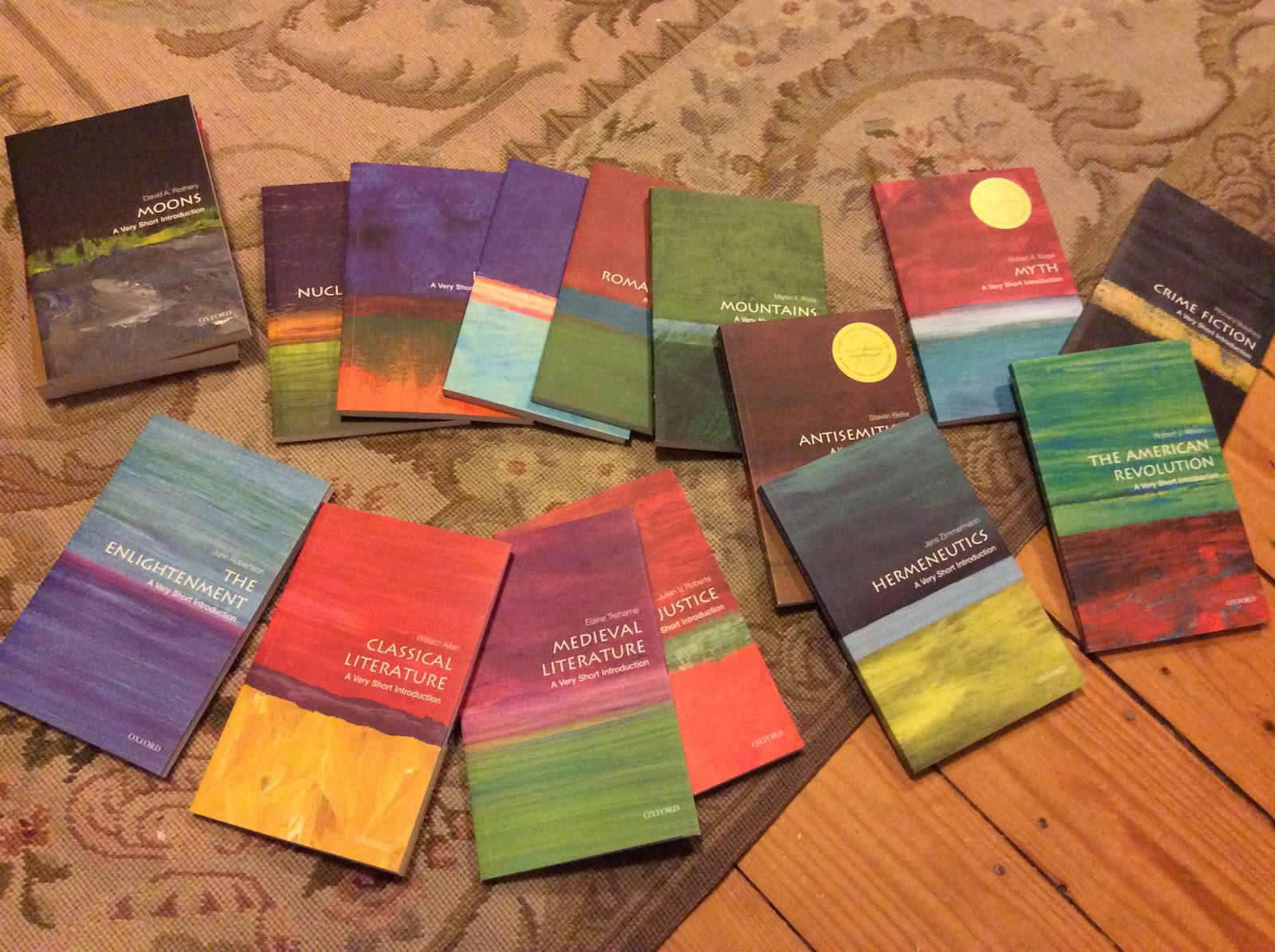
It's tempting to associate a good dry sherry with golden age detective fiction, especially anything with an academic setting, but as much as I like a match that really immerses me in a book I'm going for something else this time. I have a fluctuating collection of Oxford's A Very Short Introduction's. They arrive unannounced in the post from time to time direct from OUP, or sometimes as presents (they make excellent stocking fillers or little extras for the book lover in your life). The collection fluctuates because D 'borrows' them, sometimes I remember to retrieve them but books which are so well suited to fitting in a pocket should have a nomadic life (but not in a shoplifty way).
I think they're the perfect books for browsing through with a glass of really good fino to hand (and maybe those olives etc). Both deserve and encourage a bit of thoughtful consideration
Tuesday, December 8, 2015
The King's Ginger - For the discerning and courageous drinker
My week feels like it's being sponsored by ginger (which on the whole I'm not very fond of). It's mostly come in the form of troublesome gingerbread (new recipe, delicious eating, far to soft for decorations which is why most of mine are now in bits on the floor. Tomorrow it's back to Nigella who knows the importance of a hard biscuit at a time like this.) these things are sent to try us.
Despite that ambivalence towards ginger I really do like the King's Ginger - a really pokey liqueur from Berry Bros and Rudd. The label says they invented it for Edward the seventh in 1903 to help keep the cold out when he was driving. Drunk neat it certainly does that, the first sip is take your breath away ginger (hence the courageous drinker - it has a kick like a mule, in a good way), but after that it mellows out with lemon zest and something sweet.
It's very good on its own, especially after a cold walk but it's also an extremely versatile cocktail ingredient (for both summer and winter drinks). It's website recommends using it to mull wine or cider with, to add to champagne Kir Royal style, and to use instead of ginger wine in a whisky Mac. A measure in a hot chocolate doesn't go amiss, or simply mixed with ginger ale if you want to keep it simple.
In terms of a book choice it seems only fitting to stay with the Edwardian feel of the thing - maybe it's the picture of Edward on the label that does the trick (it's a good enough drink to be able to play up to a mildly eccentric image) but it makes me reach for Dornford Yates, John Buchan, or similar.
I had a binge on Yates about a decade ago - I'm hazy about the details but generally it was all smart young men dashing about the continent in their customised Rolls Royce's rescuing damsels in distress and sorting out dastardly foreigners (not for those in a sensitive or politically correct frame of mind). Reading Buchan's 'The Three Hostages' a couple of months ago reminded me strongly of Yates - it's the same sort of boys own adventure, silly, but essentially entertaining. They're also books that I can share with D who likes this sort of thing so they make good holiday reading.
I have a copy of Buchan's 'A Lost Lady of Old Years' that's been hanging around unread for a while now - I can see myself getting stuck into both the book and the King's Ginger over new year.
Monday, December 7, 2015
Krupnik (Honey Vodka) for the guns
I was having a tidy out a bit ago and found the dregs of a very old bottle of krupnik in the wine rack. It had to go - what was left had lost much of its original flavour, but it reminded me of how good it was, and though it wouldn't be hard to find somewhere selling it, I'd quite like to make my own for next winter.
The bottle I had was Polish, and I had thought it was particularly a Polish thing but Wikipedia says it was invented by monks around the 16th century and is popular in a few Slavic countries. To be fair it's probably popular anywhere it's been tried. It's a heady, warming, blend of honey, spices, and vodka.
Try as I might I couldn't think of any book I knew that had a polish connection, much less one that complimented the farm house kitchen feel this particular liqueur conjurs for me. In the end I thought about who I used to sell it to when I worked somewhere that stocked it. The answer, excepting Polish ex pats, was the shooting set.
There turns out to be quite a bit of friendly competition amongst shooting types to provide interesting/different/obscure liqueurs on shoot days along the lines of sloe gin, Kings ginger, or similar. Krupnik falls right into that tradition so it seems quite fitting to pair it with 'BB's 'The Shooting Man's Bedside Book'.
I've been learning to shoot over the last couple of years, strictly clay pigeons - even if I could afford it the idea of shooting birds for sport doesn't appeal very much. Clay pigeons however are a lot of fun, not necessarily an expensive sport (the biggest cost is a gun, after that you don't need much - a hat, glasses, ear defenders, and pockets - and none of it needs to cost much) and is quite accessible for not terribly fit women approaching middle age... It doesn't have the drinking culture that game shooting has, but where guns are involved I can only see that as a plus.
I picked up 'The Shooting Man's Bedside Book' as a Christmas present for my mother last year (she's the one that sold me on shooting) and liked it so much I got myself the next copy I managed to find. It's a compendium of all sorts of anecdotes, advice, poetry, records of things shot, and as a bonus has some charming illustrations. It's an oddly appealing little book, and just the thing to curl up with by a fire (ideally in a house with hot and cold running dogs on tap) on a cold winter afternoon with that glass of krupnik, and no intention of going anywhere.
Sunday, December 6, 2015
Hot Buttered Rum and Dickens - in a Christmas mood
Whilst I'm thinking about drinks I still haven't got round to trying (Constantia) there is also buttered rum. I love the idea of this but my experience with a run tea and cinnamon cocktail (disappointing) has put me off a bit. Ruth Ball has a recipe for buttered rum in the excellent Rebellious Spirits but mentions that it can get a bit oily as it cools which doesn't sound so tempting.
however, there is a recipe for Hot Buttered Rum in the Waitrose Christmas drinks list that sound like it might be worth trying. It adds some whipped cream which would cover any floating butter, and just generally makes it look extra appealing.
It seems all you need to do is heat a teaspoon of unsalted butter, a teaspoon of maple syrup, 1/4 of a teaspoon of ground allspice and an optional 3 cloves, in a pan until smooth and combined. Then turn off the heat and stir in 50ml of golden rum, and poor into a mug or heatproof glass. Top up with warm apple juice and whipped cream, finish with a grate of nutmeg. Increase quantities as desired.
I think a drink like this demand Dickens in full on festive force. 'A Christmas Carol' certainly seems appropriate, as do all those collections of Christmas stories. It's only recently I've come round to Dickens (I'm more of a Wilkie Collins fan) after reading 'Great Expectations' a couple of years ago (more of a purl - a hot mix of beer and gin - kind of book) but in these busy days before Christmas snatched moments between writing cards, hunting for presents, baking, and generally organising, only really leave time for short books, or better yet, short stories. It shouldn't be all work and stress over the next few weeks, and this is a combination which sounds appealingly cosy and festive.
Saturday, December 5, 2015
Jane Austen and Constantia
When I find either a wine I'm familiar with in a book, or a wine in real life that I've only previously met in literature, it's very much like meeting a friend. I'm even happier when a characters preferences run along the same lines as mine.
It's hard to express how excited I was to find that my local wine shop sells Constantia, or the depth of my shame when I say I still haven't bought it, never mind tried it. It's a terrible omission. Constantia has a venerable history, Klein Constantia was the first vineyard in South Africa (established in 1685), it's sweet wine a favourite of Napoleon's, mentioned by Dickens and Baudalaire - and most importantly (because this is where I first found mention of it, and so it's who I associate it with) by Jane Austen in 'Sense and Sensibility'.
The fortunes of Constantia have gone up and down over the years, and the wine available today is a 1980's recreation of the 19th century legend - which is quite good enough to satisfy me. Mrs Jennings recommends it for its healing properties on a disappointed heart which has the ring of personal experience about it. Anyone suffering from a disappointment could do worse than hit a bottle of really good dessert wine (in moderation, obviously) and any Austen fan could do much worse than purchase a bottle of this (maybe from Berry Brothers & Rudd who have been around almost as long as Constantia, and whose shop doesn't look like it can have changed much since Austen's day).
I was going to make it a Christmas present for myself, but spent the money on gin instead (Bath Gin, it has a winking Jane on the label, she presumably wouldn't have drunk gin though, I doubt it would have been respectable enough in her day - though someone may be able to correct me on this). Maybe in the new year (a bottle should be about £35-£40), but definatley the next time I re read any of her books. or if I suffer from a disappointed heart. There's something irresistible about being able to drink something she mentions like this; it's almost like being able to have a drink with her (well, sort of).
Friday, December 4, 2015
Whisky Galore and Hot Toddy's
Despite any impression I might be giving with these book and booze posts I don't actually drink very much alcohol. Not drinking alone has been a rule ever since I started out in the wine trade and got a close up view of what can happen to habitual drinkers, and as I basically live alone it's a policy that keeps me fairly dry. The one exception to that rule is the occasional hot toddy (for colds and cold days), it's a perfect winter drink and I love them.
My guess is that purists would insist it has to be whisky in a toddy, but I feel that brandy or rum are perfectly acceptable substitutes according to taste and available ingredients. I always have more whisky around than anything else (apart from gin, there's quite a bit of gin in my flat too) so always use it, and it's always a single malt because again that's what I have. I like to keep it simple - a generous splash of whisky in the bottom of a mug, an equally generous slice of lemon given a bit of a squeeze, a spoon of honey to taste. I was looking up recipes before writing this post and am slightly, as well as irrationally, sniffy about how elaborate some of the recipes are (all-spice and juniper are all very well, as indeed is a cinnamon stick, but I'd argue that's moving towards a punch). It's clearly my deep held belief that a toddy should be confined to 3 good things and some almost boiling water.
The book is obvious - Whisky Galore by Compton Mackenzie is a treasure. Funny, charming, sharp, and essentially affectionate as well as owing a debt to an actual incident it has a lot to recommend it. The film is just as good and something of a pre Christmas tradition for me. Watching it with some sort of whisky based drink in hand is surely essential - for authenticity it would be a blend (I'll confess that spotting the brands is an essential part of watching the film for me) because that's what we drank before Glenfiddich really launched the single malt market in the 1970's. It would also be neat spirit in the kind of little tot glasses rarely seen outside of charity shops these days - but a toddy better captures the spirit of both book and film, and something warm in a mug that won't knock you out is - well, it's civilised.
Thursday, December 3, 2015
Ludmilla Petrushevskaya and 'Russian' coffee
Back in the '90's when I was a student in Aberdeen (often cold and wet in the winter, and on reflection also in the spring, summer, and autumn) I found a recipe in a cocktail book for Russian Coffee, you take a silver coin and place it in the bottom of a cup, fill it with coffee until you can't see the coin and then with vodka until it appears again. It appealed to me because it was warm, simple, and the coin bit is the sort of detail I like. I have no idea how authentically Russian this practice might be, but it fitted well with the Cold War stereotypes I had.
Tonight I've been hosting a wine tasting (which has made school night drinking seem like a better idea than it actually is) and walked back home through the sort of deluge that makes even ducks decide it's a bit wet. I'm cold, still a bit damp round the edges, and if I didn't need to be up at 6 for work would be drinking one of those coffee's right now. These days it wouldn't be the half and half mix the coin dictates but just enough to give the coffee a kick, but otherwise it's held its appeal for me. It's still the simplicity that appeals, as well as the aromatic, spiky, quality of the coffee (I'd go for something tangy and strong with fruity notes rather than smooth and mild), it's also one of the few times I see the point of vodka (I prefer gin. Because it tastes of something.).
Ludmilla Petrushevskaya does nothing to dispel my preconceived ideas of Communist Russia, I loved her collection of Love Stories and the scary fairy tales of 'There Once Lived A Woman Who Tried To Kill Her Neighbours Baby'. I have 'There Once Lived a Mother Who Loved Her Children Until They Moved Back In' to look forward to. Her combination of fairy tale tropes, dark humour, and merciless observation, are deeply satisfying - and sometimes unexpectedly uplifting, much like the coffee and vodka. This is a combination for a really filthy day, when all you can do is embrace the crappy weather and exploit the atmosphere it creates.
Wednesday, December 2, 2015
Fairy tales and Madeira
Some months ago Oxford University Press were kind enough to send me a copy of 'Victorian Fairy Tales' edited by Michael Newton, and a bit later The latest edition of Jack Zipes 'The Oxford Companion to Fairy Tales'. It is actually my birthday next week, and no pressure family and friends but OUP have set the bar pretty high already (when it wasn't even my birthday). To say I was delighted to come home and find these is an understatement so I've been feeling increasingly guilty for not writing about them.
I've been dipping in and out of 'Victorian Fairy Tales' for months, but still have a few to read, and now would need to reacquaint myself with those read a while ago before I could say anything very sensible. I can unequivocally say that the books a delight though. E. Nesbit's 'Melisande' has made me determined to read more of her (I missed her children's books when I was young, and still only know 'The Railway Children' from the film). It's a gorgeous looking book to - perfect Christmas present material for any fairy tale lovers in your life.
The 'Companion to Fairy Tales' is equally fabulous. Opening it is to start on a reading adventure - following links and finding all sorts of unexpected delights. If anything it's an even better present for fairy tale lovers (if, that is, you know such a person who's had the patience to wait this long to get a copy). I haven't spent nearly enough time with it yet (even now when I know I have a longish list of things to do, and not much time to do them in, before bed it's hard to resist the urge to forget it all and read through the night) but I will. It's a book with a definite magic about it.
These are books which deserve something really special in the way of wine, and happily I have just the thing. There's a touch of magic about Madeira's to. It's an utterly counter intuitive wine. The two things wine usually needs to avoid are heat and oxygen. Madeira is aged in open vats in heated rooms - it means it will basically never change once it's been in the bottle, even if the bottle's been open some time - years even. Almost the first thing I was taught about it was that nothing under 15 years old is really worth drinking. This is debatable, you can still get an idea of how marvellous it is at the younger end, but.... A few years ago I was lucky enough to be at a tasting of a range of older wines. The star was a 1905 vintage - it was a 102 years old when I tried it and easily the most wonderful thing I've ever had. Vintages from the 1920's and '30's were just as exciting. It wasn't just the complexity, or depth and concentration of flavour, but also the freshness of these wines - and the sense of drinking history, and maybe even time itself.
Relatively speaking those very old vintages are not so expensive; £355 for something drinkable from 1912 seems reasonable (extravagant, but reasonable). There are plenty of really interesting bottles to be had for something between £50 - £100 which compares well with really good whisky. My bottle of 1973 is as old as I am and ageing rather better than me. It's a rare treat rather than an everyday drink and maybe something of an acquired taste (good Madeira deserves a bit of thought and effort - learn to love it!). It has a Victorian gravitas about it (possibly because that's when it was last really appreciated) and it would be an acceptably authentic drop to pair with - well I can't help but think of Trollope at a time like this - but it's the fairy tale quality of the wine that appeals to me so fairy tales it is.
Tuesday, December 1, 2015
Pastis and Zola
My interest in wine, and drinks generally, came from an interest in food. That and wine is a romantic sort of thing, or at least it is when you get past wanting to drink it primarily for its alcoholic properties. I really wanted to learn about what went with what, to get those combinations that create a meal that's so much more than the sum of its parts. In the end it took me ages to get a grip on it, and it's still something I find tricky at times. There are rules and guidelines but what really matters is matching people with wine with food - which is a slightly different skill, technically perfect matches mean nothing if you don't actually like the wine.
Thinking about matching booze with books is certainly adding a bit of fun to my working day and it's also making me consider things I wouldn't normally drink. I don't particularly like pastis, or any other anise flavoured drink, but it does one very attractive thing. It louche's - when you add water it produces the opalescent effect that absinthe is so famous for, but without the utterly obnoxious amount of alcohol that absinthe contains.
Pastis also strikes me as just so damn French, and if I'm matching a drink to a book I want it to be an immersive experience. I haven't got very far with my Zola project this year but Radio 4's recent dramatisations have given me a bit of a push, it might be time to make another effort with both the Rougon - Macquart's and a bottle of Henri Bardouin's finest (if it's to be pastis it had better be the best on the high street). It would also see me through a chunk of Oscar Wilde's output, any collection with the words French and decadent in the title, all those Sartre books I still haven't read after being bowled over by 'Nausea' at an impressionable age and so on.
But it's Zola with his vivid descriptions of physical surroundings - overly lush vegetation in the graveyard or the hot house, the grime and smoke in the stock exchange, perfumed boudoirs where things are amiss, who makes me want to make the extra effort.
Subscribe to:
Posts (Atom)